I once assured myself that I would never write about Twitter. Everyone these days has already written about the subject, especially all the social-media marketers out there, and I’m not a jump-on-the-bandwagon kind of guy. Still, I spend a bit of time thinking about authenticity, transparency, and celebrity so this post was bound to happen.
Before commenting on how celebrities use Twitter, I want to explain how I use it, and why I have a love-hate relationship with celebrities. (It relates, I promise.) For one thing, Twitter offers a chance to share my thoughts and feelings with the world and to meet interesting people from different backgrounds, and by different backgrounds I mean more than just different types of social-media marketers. Those folks are useful in some cases, but I follow enough of them already. I’m more interested in meeting honest and talented people who do unique things and have captivating ways of seeing the world. I don’t care so much about people trying to sell me things, but I do care about people, when I’m not fighting off my own inner demons, and I am curious to learn how my fellow humans navigate through this strange, but miraculous, journey of life.
At its best, I also see Twitter as a way of counter-acting a profit-worshipping, depersonalized culture of buracracy and venality. The casual nature of this simple-to-use online service encourages honest disclosure. Go ahead and criticize Twitter for encouraging an ethos of oversharing, but at least people on Twitter are less likely to proclaim that everything about themselves and their world is great. In real world conversations, people are tragically far less honest. Don’t believe me? Go ask a few random strangers on the street or even acquaintences how they’re doing. Did any of them, perchance, mention that they were doing fine or doing great? What a surprise that is, right?
(I despise the kind of self-congralatory marketing that some individuals and companies use in a delusional attempt to persuade the world that everything really is great all the time. It goes something like this, "I’m unconditionally awesome right now just like I’ve always been, and I’m going to continue to be more and more awesome each year." Not to rain on your parade, but your ability to produce profits that just go up and up into infinity is somewhat impeded by the reality of your eventual death. Sorry.)
To continue with our experiment, go find a few random people on Twitter and pay attention to how they answer the previously mentioned, now implied, question. I would be willing to bet good money that there are more compelling, more transparent responses from the Twitter crowd. There’s something special, almost magical, about being part of a community that is fueled by honest discourse. To benefit from that transparency while withholding it from the group is a form of resistance, a selfish action that makes it a little harder for the community’s ideals to prevail.
I embrace that sense of transparency that comes with Twitter while recognizing the risk it brings. If I am too honest, I might convince some people that I’m an idiot or a jerk. Maybe they won’t hire me or maybe they’ll use my words against me as a result. But, I’m willing to face those risks because being transparent forces me to live a life worth sharing. I acknowledge dark spots in my life on Twitter to be honest about who I am and to bring those dark spots into the light. You see, I care more about becoming whole than about gaining market share, although there is nothing wrong with gaining market share if done in an honest and excellent way. If you think that’s a foolish outlook, then by all means avoid doing business with me. I don’t sell to everyone, and we’ll both be happier if you take your business elsewhere.
I’ve said my share of dumb things on Twitter, but I’ve made a point of not deleting those tweets. (I have deleted one or two of the more impulsive and grammatically incorrect ones, but I haven’t done that for a few weeks.) I’d rather let you get a glimpse of what I’m really like than to make you think that I’m more noble than I am. Again, at stake is the correcting influence of transparency, and if I’m going to embrace that idea then I should walk the walk.
Onward we go to discuss celebrities. I know, I buried the lead. It was on purpose: honesty not fame is the foundation from which I hope to build the ideas that follow.
Like almost everyone else, I admire people who are excellent at what they do. I’m astonished by George Lucas’s cinematic wizardry, Tiger Wood’s concentration, Nicole Kidman’s elegance, Michael Phelp’s dedication, Oprah’s graciousness, Steve Job’s vision, Tom Wolfe’s depth, Tim Burton’s style, Brittany Snow’s sincerity and so on. Even the celebrities who are famous for being famous tend to have some enigmatic quality tat captivates our collective attention, and yet the selfishness and baseness of some celebrities does much to screw up the world.
(The next paragraph that follows may seem abrasive, but please trust me through it. I need to make an important point, and I don’t know how else to do it.) Have you ever reduced, in your mind, a celebrity to the status of a stupid skank who exists only to corrupt and to earn more money for powerful, amoral mult-national corporations? I have … but, when I remember that we are created in the image of God, I can’t continue to maintain that thought. Even the celebrities I am tempted to despise are loved b God, even they have something special to contribute.
Now that I think about it, I’ve done my sare of thoughtless and skank-like things, and usually it was because I was hurting and I didn’t know how to better resolve the pain. Maybe then I shouldn’t be so quick to judge, right? Same goes for you too.
From that perspective, it’s harder to see even the seemingly shallow celebrities as completely useless human beings. They may be tragic examples of spoiled potential, but they are still children of God, and so they still matter by definition.
I suspect that the angels and demons fight harder for the souls of celebrities since they are blessed with their awe-inspiring gifts.
I suspect that the angels and demons fight harder for celebrities since they are blessed with the awe-inspiring gifts that they have.
I once assured myself that I would never write about Twitter. Everyone these days has already written about the subject, especially all the social-media marketers out there, and I’m not a jump-on-the-bandwagon kind of guy. Still, I spend a bit of time thinking about authenticity, transparency, and celebrity so this post was bound to happen.
"Illusion" from flickr.com/demisone
Before commenting on how celebrities use Twitter, I want to explain how I use it, and why I have a love-hate relationship with celebrities. (It relates, I promise.)
On Twitter, I’m interested in meeting honest and talented people who do unique things and have captivating ways of seeing the world. When I’m not fighting off my own inner demons, I do care more about people than about selling stuff, and I am curious to learn how my fellow humans navigate through this strange, but miraculous, journey of life.
At its best, I also see Twitter as a way of counteracting a depersonalized culture of profit-worshipping and dishonesty. The casual nature of Twitter’s simple-to-use online service encourages honest disclosure. Go ahead and criticize Twitter for encouraging an ethos of oversharing, but at least people on Twitter are less likely to proclaim that everything about themselves and their world is great.
In real world conversations, people are tragically less honest. Don’t believe me? Go ask a few random strangers on the street or even a few acquaintances how they’re doing. Did any of them, perchance, mention that they were doing fine or doing great? What a surprise that is, right?
In case you didn’t realize it by now, I despise the kind of self-congratulatory marketing that others use to persuade the world that everything really is great all the time. It goes something like this, “I’m unconditionally awesome right now just like I’ve always been, and I’m going to continue to be more and more awesome each year.” Not to rain on your parade, but your ability to produce profit that goes to infinity and beyond is somewhat impeded by the reality of your eventual death. Sorry.
"nopants spectrum" from flickr.com/kenyee
To continue with our experiment, go find a few random people on Twitter and pay attention to how they answer the previously mentioned, now implied, question. I would be willing to bet good money that there are more compelling, more transparent responses from the Twitter crowd.
There’s something almost magical about being part of a community that is fueled by honest discourse. That’s why I’m compelling to protest against the people who use Twitter only to sell things. To benefit from that transparency while withholding it from the group is a form of resistance, a selfish action that makes it a little harder for the community’s ideals to prevail.
I embrace that sense of transparency that comes with Twitter while recognizing the risk it brings. If I am too honest, I might convince some people that I’m an idiot or a jerk. Maybe they won’t hire me or maybe they’ll use my words against me as a result. But, I’m willing to face those risks because being transparent forces me to live a life worth sharing.
I acknowledge dark spots in my life on Twitter to be honest about who I am and to bring those dark spots into the light. In addition to that, I’ve made a choice not to delete tweets just because I regret writing them. That way it is easier for you to see what I’m really like.
You see, I care more about becoming whole than about gaining market share, although there is nothing wrong with gaining market share if done in an honest and excellent way. If you think that’s a foolish outlook, then by all means avoid doing business with me. I don’t sell to everyone, and we’ll both be happier if you take your money elsewhere.
Onward we go to discuss celebrities. I know, I buried the lead. It was on purpose: honesty, not fame, is the foundation from which I hope to build the ideas that follow.
Like almost everyone else, I admire people who are excellent at what they do. I’m astonished by George Lucas’s cinematic wizardry, Tiger Wood’s concentration, Nicole Kidman’s elegance, Michael Phelp’s dedication, Oprah’s graciousness, Steve Job’s vision, Tom Wolfe’s depth, Tim Burton’s style, Brittany Snow’s sincerity and so on. Even the celebrities who are famous for being famous tend to have some enigmatic quality that captivates our collective attention, and yet the selfishness and dishonesty of some celebrities does much to screw up the world.
"Tiki Alien" from flickr.com/pete4ducks
(This paragraph may seem abrasive, but please trust me through it. I need to make an important point, and I don’t know how else to do it.) Have you ever reduced, in your mind, a celebrity to the status of a stupid skank who exists only to corrupt and to earn more money for powerful, amoral multi-national corporations? I have … but, when I remember that we are all created in the image of God, I can’t continue to maintain that thought. Even the celebrities I am tempted to despise are loved by God, even they have something special to contribute.
Now that I think about it, I’ve done my share of thoughtless and skank-like things, and usually that was when I was hurting and didn’t know how to better resolve the pain. Maybe then I shouldn’t be so quick to judge, right? Same goes for you too.
From that perspective, it’s harder to see even the seemingly shallow celebrities as completely useless human beings. They may be tragic examples of spoiled potential, but they are still children of God, and so they still matter by definition. Besides, I suspect that the angels and demons fight harder for celebrities since they are blessed with the awe-inspiring gifts that they have.
Let me give an example to explain what I mean: I know that I’m ultimately responsible for the decisions I make, but films with strong moral centers have influenced me to do good after I saw them. On the other hand, I’ve done reprehensible things while under the influence of values-deficient films. I know I’m not the only one who has even been influenced by what he’s seen, heard or read, because if that were true, companies wouldn’t spend millions of dollars on advertising.
The shiny, illustrious people we call celebrities have a similar influence, for good or evil, since they are similarly larger than life and also have access to our collective attention. They can use that attention for good–to inspire us, address problems and point us toward the light–or they can demoralize us and lead us towards decadence and decay. I talk about this more in my post entitled, How to Avoid Being a Corporate Artist.
I know it’s hard to believe, but celebrities are people too, and being a celebrity is not as easy as it looks. They have to deal with thousands of people who want their limited attention, time, and money. Some folks out there want to exploit or humiliate them while others try to seduce them with drugs or sex. This is why I pray for celebrities on occasion. (To be fair though, I’ve also thrown curses at some of them. I do let my anger get the best of me sometimes, but I’m trying to get that right.)
In any case, our collective future depends in part on the choices that celebrities make. Their choices matter as much, if not more, than the choices that ordinary folks make, so it’s not a bad idea to care about the celebrities we admire and maybe even for those we don’t.
With that said, it would be nice if celebrities would also care about their fans, and Twitter is a good way to do that. Some already do, at least to some extent.
Hugh McCloud, a cartoonist with wry and insightful observations who writes gapingvoid, follows me on Twitter. He’s got a new book about creativity coming out in June. It’s called Ignore Everybody: and 39 Other Keys to Creativity and it’s already selling well through pre-orders on Amazon.
Jeff Heusser also follows me on Twitter. He’s one of the founders of fxphd, one of the preeminent online training programs for visual effects in the world.
Paul Coelho is the internationally renowned writer who wrote the best seller, The Alchemist. He’s another guy who is following me on Twitter. He’s currently promoting his new book about the excesses of celebrity called The Winner Stands Alone, a digression from his more fable-like tales, but a book that I’d still like to read.
I mentioned the products above because they seem interesting and because they are from people who matter to me. Whose stuff didn’t I promote? The stuff from people who aren’t following me back on Twitter. The Gospel of John reminds us that we love God because he first loved us. In Twitterland that translates into this: I care about you because you first followed me.
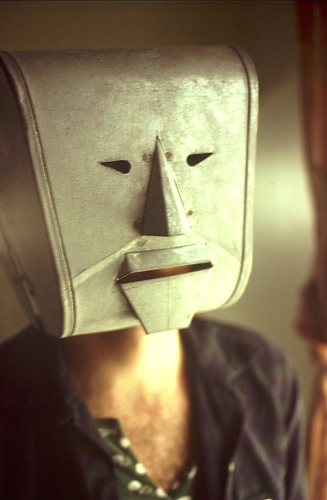
"Man in the mask"ot; from flickr.com/68137880@N00
I don’t expect every celebrity to follow me back. They often have more important things to do, and if they follow everyone they will get flooded by tweets they don’t value. Fair enough, a celebrity who doesn’t follow me back had better add value with interesting, thoughtful, or amusing commentary. If the celebrity in question or his staff writers tweets dozens of times a day, my patience for self-indulgent commentary greatly diminishes. (I tolerate more self-promotion and self-indulgence from those who follow me back, because they can’t be so bad if they are smart, sophisticated, and decent enough to be following me.)
Speaking of staff writers, it is dishonest to have someone else write tweets on a celebrity’s behalf without disclosing as much. It’s 140 characters or less, people. How hard is it to write your own 140 characters for your fans? Why not care enough about the people who help you enjoy the lifestyle that you do by sharing things to delight them and show your appreciation.
If you must use assistants to write your posts, then why not disclose as much? Much as it pains me to admit this, Britney Spears sets a good example in this arena. On her Twitter page, her tweets are distinguished from those of her managers by attribution lines. It’s a sad state of affairs when Britney Spears takes the moral high ground that you avoid.
Since there are a growing number of fake accounts, it is hard to tell the difference between what is a real account and what isn’t. Sometimes these fake accounts are created by over-zealous fans who should have better things to do. Other times, I suspect the devils who try to control celebrities perpetuate lies so that their celebrities can be everything to everyone. For example, you could have one celebrity account geared to the Goths and one to the soccer moms. By keeping the accounts ambiguous in nature, you can encourage others to believe that the fake niche account they found is really the celebrity in question. And market share goes up and up!
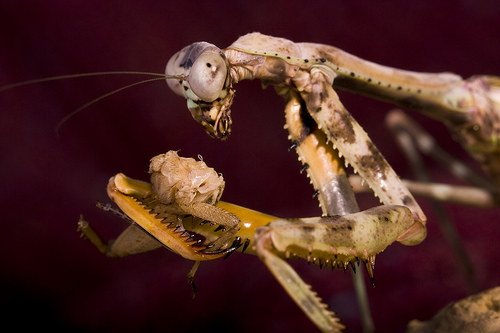
"Budwing Feeds" from flickr.com/destinysagent/
Yet the more market share you gain in this dishonest way, the greater the risk that you turn yourself into a soulless product. Sounds great, except people don’t care about products; people care about people. Consumers will devour a product until it is licked dry. Fans, on the other hand, will go out of their way to help the people they cherish. Wouldn’t you rather have long-term fans than short-term consumers? Then my dear celebrities, offer honesty and affection to the people who support what you do.
Fans and celebrities both have a responsibility to treat each other as people, not as products to consume or as numbers to hoard for ego-purposes. (Yes, Aston Kutcher I’m talking to you.) To do otherwise is to perpetuate foul one-sided relationships that lead only in death. There are bigger things in this world than just your ego, your lust, or your profit-margins, so don’t be the jackass who ruins them with your selfishness.
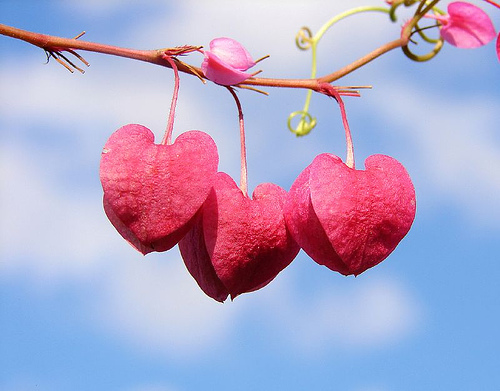
"String of hearts" from flickr.com/aussiegall
I close with a hypothetical. What if certain people really are meant for each other, meant to collaborate, support or love each other, and together they could go on to do greater things than they could apart? Wouldn’t that make life a little more magical? But what if corporate, build-up-the-numbers thinking distorted the truth and prevented these destined pairs from harmonizing? Wouldn’t that be a lamentable if these people never go on to fulfill their grander purposes together? It could come in the form of celebrities who never inspire and get inspired by their fans, friends who never meet, or star-crossed lovers whose love never takes root.
Whatever the case may be, it’s a tragedy, but it is a tragedy we can avoid if we aim for excellence with the honesty and love that heaven puts in our hearts. That’s not a bad way to make the world less corporate, don’t you think?