In this new year in a tumultuous world, why should you care about being less corporate? For one thing being less corporate can lead to more sales, as I’ve explained before. But really, most of us don’t do things just for the sake of earning more money. We pretend we do sometimes, though. That way we don’t have to talk about what really drives us: a desire to belong, to be useful, to be loved, to matter.
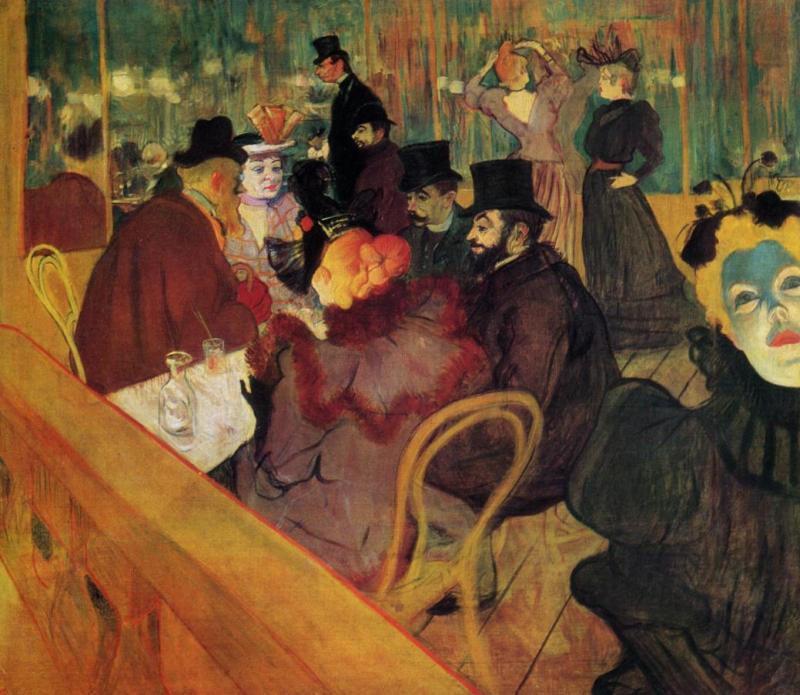
At The Moulin Rouge by Toulouse Lautrec
Talking about that stuff leaves us vulnerable, and that’s not an easy thing to do. Instead, it is much easier to discuss things that can be measured, a paycheck, material possessions, and other quantifiable signs of status. What’s wrong with that, you ask? I answer by calling your attention to the bizarre human ritual known to sociologists and common folks alike as the dinner party.
It is an unstated rule that every good guest at any self-respecting dinner party must acknowledge how great things are going for himself (or herself, the dinner part is a undiscriminating taskmaster, after all). That is why you will hear witty variations of the following dialogue at almost any dinner party you attend: “Yeah, I’m doing great. The job, wow, really great. The kids … really, truly great. The new house and the car, you’re not going to believe this, but they’re so unbelievably great that I can’t even describe how great they are.” Fantastic stuff, is it not?
This is not to say that only great things are discussed at dinner parties. Of course this is not so. The weather is an acceptable topic that can safety deviate from greatness. Also it is perfectly acceptable, according to the dictates of dinner party etiquette, to point out how other people fail to live up to the essence of greatness, namely the greatness that any given speaker so magnificently exhibits.
Let’s be honest: do any of you enjoy that kind of thing when you are stuck reading it and not enforcing it? Probably not. (If you’re one of the few people who does enjoy hearing that sort of thing, you should probably stop reading this blog and look for a more dinner-party friendly blog, perhaps something like FabulousDinnerPartyBanalities.blogspot.com.)
At our core, we know that people are more complex than they let on, but we’ve been conditioned to hide our struggles and our shortcomings in the name of pursuing the success that comes from that coveted, perfect image. And so, the truth of a person is often valued less than the image he forges in our crazed, perception-driven world, and that’s a sad and corporate thing.
(To be fair, dinner parties, like anything else in this world can be enjoyable if done with the right intentions. There is something to be said about sharing a nice meal with friendly, but sincere, companions, and getting to know others in a relaxed and unpretentious setting. )
As long as people avoid addressing problems for the sake of maintaining appearances, they’ll never get the support they need to get better or to fix things. A Microsoft executive could have the smoothest sales presentation in the world with the slickest tech demo, but I would not believe a word he said if he tried to convince me that Vista was a great, problem-free, operating system. However, if he or she acknowledged the problems that users have experienced while explaining steps that Microsoft was taking to correct those problems, then he might earn my interest and possibly regain my trust.

The picture above is from 192 Creative, Smart & Clever Advertisements, a post that justcreativedesign.com did a few weeks ago. There are some clever, unconventional ads on display there, so check it out if you’re curious, but be warned: some of the ads are a little vulgar. Anyway, this picture shows a nice variation of the campaign that Cingular did about dropped calls.
First of all, the campaign focuses attention on a problem that cell phones sometimes have. Here, no one is trying to tell you that cell phones work great all the time. Nor did Cingular claim t0 avoid dropped calls entirely. Rather, their ad says that Cingular has “the fewest dropped calls.” In other words, they face the problem too, but unlike their competitors, they name the problem and in so doing, focus attention on correcting it.
I’ve expressed my disagreements with Obama before, but I do admire his ability to inspire people and his enthusiasm for change. If Obama refused to acknowledge problems and insisted that everything was it should be, then he’d definitely have far fewer followers. John McCain’s unfortunate quote about the fundamentals of our economy being sound, became for some an indication that McCain would not acknowledge the challenges that reality was serving us. Remember McCain at the next dinner party you attend when you are tempted to sing odes to your own problem-free existence.
Working at Canon, I’ve learned that it can make a big difference when we acknowledge the concerns of our customers. We don’t have to agree with every accusation that someone brings up, but we get more favorable customer responses when we explain that we are looking into an issue instead of claiming that no such issue can exist under any conceivable circumstance. If we do our jobs well, then our customers will come to trust that if there is a problem with a camera model, then Canon will take steps to correct it, through a firmware update or a service notice as we’ve done in the past.
Everyone makes mistakes, whether it is a company, an employee, a spouse, a religious leader, or a politician. Learning from mistakes and correcting them are better goals than avoiding mistakes entirely; Afterall, the only ones who don’t make mistakes are the ones who don’t challenge themselves or try something new. Uncorporate honesty can help with both learning and correcting.
So many dumb things happen because no one wants to question the boss or the popular one. We tell ourselves that we’re being nice, but we’re really being corporate, spreading banality and failure throughout the world with our unwillingness to speak up. And if you’re not honest enough to ever let others see when they’ve hurt you, then you are robbing them of an opportunity to see the consequences of their actions.
I don’t believe it is appropriate to bring up every problem to everyone. Some matters are better handled in a private context, but too often people and organizations are hesitant to acknowledge problems even to each other, and that is a problem. Relationships can fall apart simply because two people fail to sufficiently name and honestly address the points of frustration with each other. Businesses lose clients and damage their reputations simply by sticking to PR half truths for as long as possible instead of acknowledging problems for what they are and fixing them.
Christ fought for good, but he did not hide the suffering he faced or the problems he experienced. It’s an admirable but very difficult thing to do sometimes. Our instinct is to put more and more armor on, not to take it off, piece by piece. Some days I come close to terror when I remember the things I’ve said and done in the spirit of honesty; By acknowledging my own struggles, vulnerabilities and shortcomings, I’ve given my enemies enough ammunition to do serious damage, but then my honesty has helped me inch closer to wholeness, and that is worth the risk to me.
I thought long and hard about writing this article. You see, I have to believe what I’m writing or it is almost impossible for me to write anything. Could I really recommend the less corporate path, with my life the way it is? I was set to become a good, if not great, lawyer after high school. I won the debate tournaments in my district, and my advisers and relatives all thought that law school would be ideal for me. I even got to tour one of the big DC law firms, and some of the lawyers involved expressed interest in staying in touch.
I have a great deal of respect for lawyers. The good ones are eloquent and they fight for right and for civility, justice, and order. But that was not me. I cared too much about winning with whatever argument I could craft. I don’t know for certain, but I’m fairly confident that if I went to law school then I’d be making much more money now, although I would probably also be a less authentic version of myself.
Still, far less humor would probably come at my expense during those fabulous dinner parties (yes that’s one reason why I’m not such a fan), and people would actually return my calls. I would be doing something with much more measurable results, and I wouldn’t have to watch one heart-felt creative endeavor after another get trampled upon by indifferent or bureaucratic recipients.
Knowing all those things, could I in good conscience recommend a less corporate life to others? Yes. It’s not the easier way, but I’m a better person for listening to my heart. I’m not perfect, but I’m closer to a sense of harmony than I was before. I may never fix everything that aches or find the success that would make it all OK, but I am not the corporate monstrosity that I could have been. That has to count for something. If you disagree, then take solace in knowing that somewhere out there, a charmingly sinister dinner party is summoning you.