A Very Merry (Un)Birthday to you Mr. Shakespeare!

Depending on when you read this, today is the birthday or close to the birthday of William Shakespeare. Technically this was supposed to be ready on the 23rd, but I was late in finishing it. I was deliberating over an ending, truth be told. However, there are some discrepancies about the actual birth date, so let’s not make much ado about nothing, or a missed deadline in this case.


A birthday is as good of a time as any to explore the work of the world’s most influential writer, but there’s no way that I can do the Bard justice in just one blog post. Instead I will focus on a few distinctive qualities that are meaningful to me as a jumping off point for your own explorations.

Shakespeare’s world is so vast that no one who studies it intently will walk away with the same impressions. A general will see something different than a poet, a mother, or a slave. In that spirit, I’m not offering you a definitive guide. It’s just my own personal interpretation.

While I am not a Shakespearean expert in the vein of someone like Harold Bloom, I have spent some time studying Shakespeare’s plays and seeing them performed. I’ve been blessed to see a live performance by the Royal Shakespeare Company and to visit London’s Globe Theatre and the recreated Blackfriars Playhouse in Staunton, Virginia.

I’ve also done some theater work that involved Shakespeare, most notably I played a part in Othello for a local theater company in Virginia. Also, the first screenplay I ever wrote happened after I saw a production of A Midsummer Night’s Dream and met a certain girl, so Shakespeare has been an important part of my life for several reasons.

Oberon, Titania and Puck with Fairies Dancing – William Blake, 1786


I have worked hard to distill Shakespeare into a reasonably brief (“reasonably” being the operative word!) blog post that is entertaining and informative. If I succeed in doing that, would you agree to comment, say thanks, or share this with others?

Whenever I find value in something, I look for ways to show appreciation. Sometimes that means paying for a valuable service or product, but if there is no cost involved, then I might take a moment to say thanks or to share my thoughts. Can you commit to do the same? If you can, I would be grateful!

With that said, let’s get on with it. Once more unto the breach, dear friends!

William Shakespeare’s birthday has been traditionally placed on April 23rd, 1564, but some intellectuals have called to question the exact date of his birth. They site discrepancies in the Gregorian calendar as justification for disputing the long established historical tradition that placed Shakespeare’s birth on the 23rd.

By doing so they avoid acknowledging the once unquestioned bit of trivia that Shakespeare died on the same day in which he was born, April 23rd, which happens to be St. George’s day. That St. George is the patron saint of England adds some significance to the birth date in question, much to the annoyance, it can be presumed, of the very intellectuals who dispute the date.

There is something symmetrical about a birth and death that happen on the same day, a day that has special meaning to the nation into which our person of interest was born, and any self respecting intellectual knows that there is nothing particularly symmetrical about life, excluding of course, the phenomenon known as the Circle of Life, a key concept that has been sufficiently demonstrated, to the satisfaction of most intellectuals, in Disney’s The Lion King.

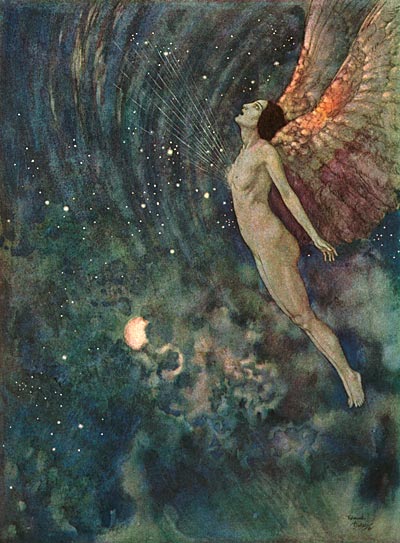
Celestial Map – S. L. Hegrad, 1783


As Sir Elton John beautifully conveyed in his sweeping ballad, the Circle of Life “moves us all,” or as Shakespeare might say, “the wheel is come full circle.”

But, Elton John’s Circle, while beautiful, is not likely to come up in many Shakespearean discussions, so let us not dwell on it too long. However, the film from which the song is derived is widely understood to be an adaptation of Shakespeare’s play Hamlet. So, as you can see, even a seemingly arbitrary Disney song is at least tangentially related to the topic at hand, the topic being the wide and wondrous world of William Shakespeare.

While the exact date of Shakespeare’s birth is still being debated, no one questions that Shakespeare died on April 23rd, 1616. Say what you will, but the year 1616 does have a certain symmetrical je ne sais quoi, right?

Regardless of whether Shakespeare died on the same day as his birth, we can say with certainty that Shakespeare died on the same day as another notable historical figure. His is the visage that children around the world paint to celebrate the coming of spring, at least so Google would have you believe.

That man, as you must have guessed, is Cesar Chavez, a left-wing activist who died on April 23, 1993.  In California, Chavez is influential enough to get several murals painted in his honor along with the above doodle which was featured on the Google homepage on March 31, 2013. Elsewhere on that very day, others chose to celebrate the coming of spring in a somewhat different manner:


Now, it is very strange that Bing would display painted eggs on Cesar Chavez Day. Those eggs do look nice, but they don’t look like any Cesar Chavez mural that I’ve ever seen! I say give them a C+ for effort, or you know, C for Cesar Chavez, because his name starts with a …

Right then.

What a brave new world in which one of the world’s most influential companies can ignore a holiday celebrated by millions to acknowledge a semi-obscure Californian activist.

Shakespeare, for one, did not shy away from spiritual matters. His plays are filled with prayers to heaven, prophecies, ghosts, magic, reflections on the afterlife, confessions, and conversations about good and evil. That is not to say that Shakespeare used his plays to sermonize, just that he refused to sterilize religion out of his work.

Then again, Shakespeare did live a few hundred years ago. How relevant could his work really be in these modern times? Well, let’s take a look.

You would be hard pressed to find any reputable university that doesn’t have a dedicated Shakespearean scholar or two, and there is a Shakespeare Society in all kinds of places including Southern Africa and China. Hmm. OK, but then China has everything these days. Let us examine further.

Shakespeare’s stories have been re-imagined as a gang rivalry in New York (West Side Story), A Broadway-bound musical (Kiss Me Kate), a sci-fi adventure in outer space (Forbidden Planet), a modern dramatization of French Revolutionary ideals (Three Colors: Red), and a couple of samurai pictures from Akira Kurosawa (Ran, Throne of Blood).


Throne of Blood – Toho, 1957


Earlier I mentioned that Disney’s Lion King is a retelling of Hamlet, but so is The Story of Edgar Sawtelle, a New York Times best sellerThose two stories are about as different in tone as possible while still involving animals and alluding to the Great Dane of Denmark. (The term “Great Dane” in this context is meant to reference King Hamlet and not the admirable canine breed, although the double meaning is at least partly responsible, I suspect, for the admittedly brilliant recasting of Hamlet as a troubled dog-trainer in Wisconsin.)

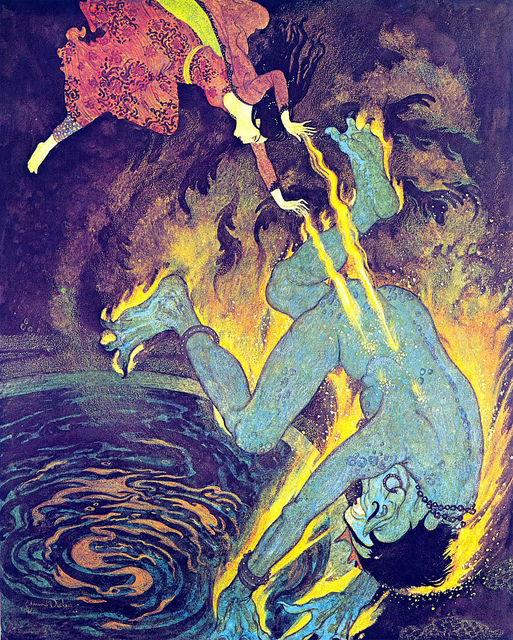
Nor is Lion King the only Disney film to borrow from the Bard. The treacherous talking parrot in Aladdin is named Iago, an obvious reference to the villain in Othello, but the genie’s yearning for freedom also recalls the spirit Ariel’s same yearning in The Tempest.

We’ve gotten so used to seeing Shakespeare’s plays set in different times and places that we take it for granted, but we don’t see the same kind of fluidity with the works of other great writers. I can’t imagine a production of Oliver Twist set in the world of Haitian voodoo doctors, for example, but that’s exactly the setting that Orson Welles used for his stage version of Macbeth. The critics who saw the production lavished praises on it, which paved the way for Welles to direct Citizen Kane.

Forbidden Planet poster – MGM, 1956


William Falkner named his novel The Sound and The Fury from the line in MacbethBand of Brothers comes from a speech in Henry V.

Hamlet is in a league of its own for the titles it inspired. David Foster Wallace’s novel Infinite Jest is taken from Hamlet’s speech about Yorick, the court jester who has been dead for 23 years when Hamlet encounters his skull. (Bold text added as update!) Hitchcock also turned to Hamlet for naming ideas and walked away with North by Northwest. The seminal visual-effects film What Dreams May Come also gets its name from Hamlet

We still use words Shakespeare coined like “assassination,” “cold-blooded,” courtship,” “critic,” “frugal,” “lonely,” “madcap,” “moonbeam,” “puking,” “rant,” “worthless,” and  ”zany.” He also gave us phrases like “all that glitters isn’t gold,” “remembrance of things past,” “to thine own self be true,” “salad days,” “tower of strength,” “pomp and circumstance,” and “forgone conclusion.”

My youngest sister requested that I also mention Shakespeare’s Julius Caesar and how the play gifted Western Civilization with the timeless phrase “it’s all Greek to me.” It is so very witty, you see, to use that phrase when someone is speaking in Greek. Consequently many Greeks who have heard this very phrase while speaking Greek feel an eternal debt of gratitude to the Englishman for that phrase and that phrase alone. I am not one of those Greeks.

Moving right along.

In a prison copy of Shakespeare’s plays at Robben Island prison, Nelson Mandela signed his name next to these lines from Juliet Caesar: “Cowards die many times before their deaths,/ The valiant never taste of death but once.”

Another quote from Shakespeare’s Julius Caesar made its way into the season 6 premiere of Mad Men. Yet another Julius Caesar quote was the inspiration for the title of The Fault in Our Stars, which was TIME Magazine‘s #1 fiction book of 2012.

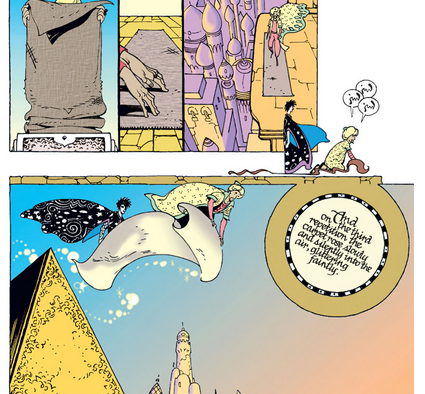
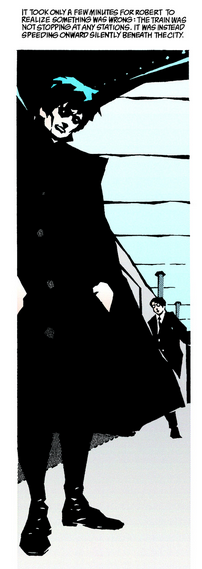
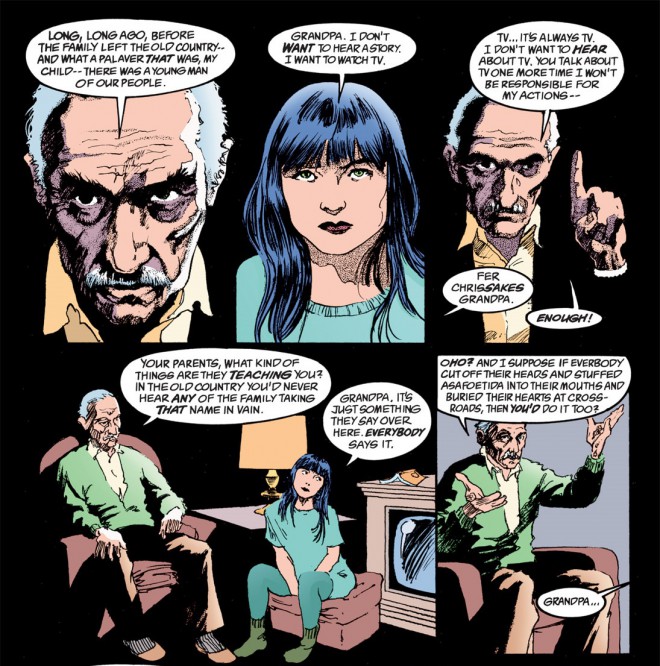
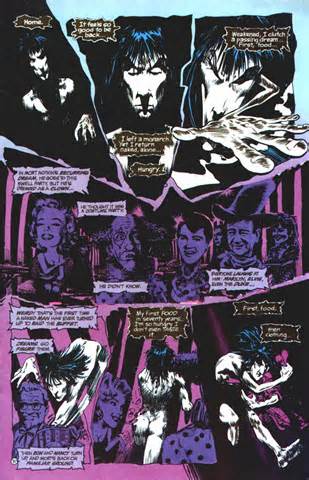
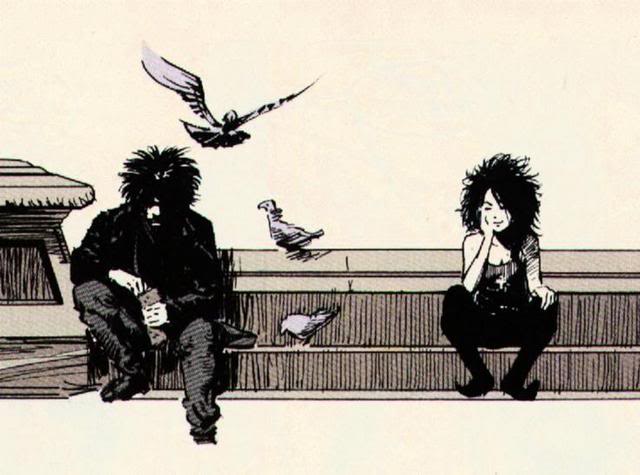
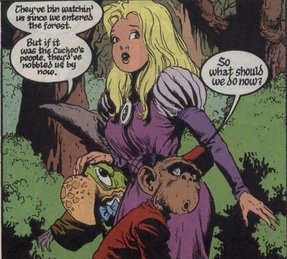
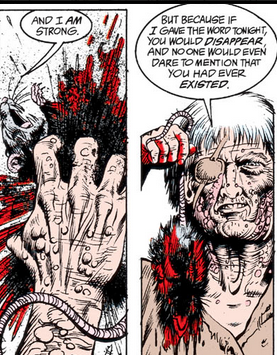
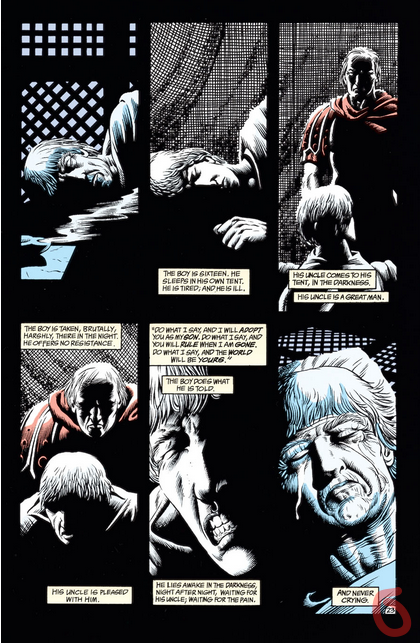
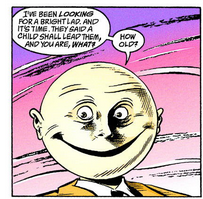
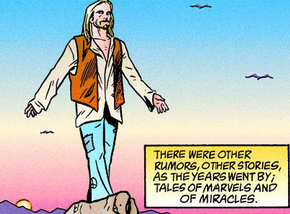
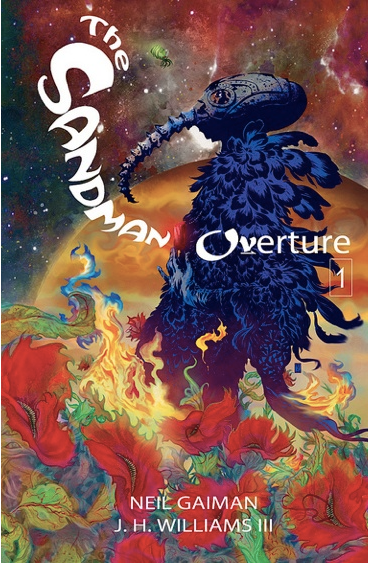
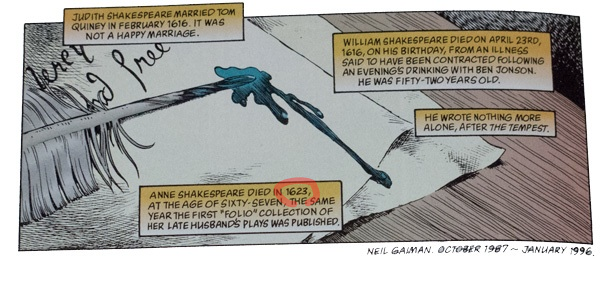
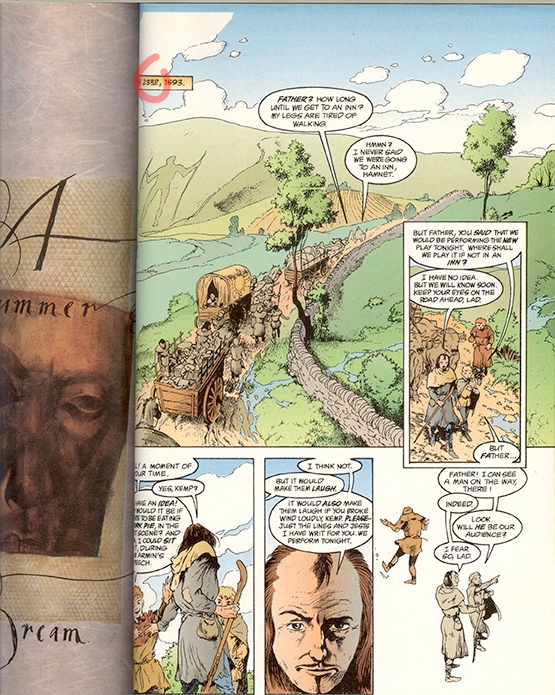
Shakespeare is a recurring character in The Sandman, Neil Gaiman’s award-winning graphic novel about the keeper of dreams. Woody Allen has attempted a Shakespearean adaption of sorts as has Ingmar Bergman, Roman Polanski, Baz Luhrmann, and Joss Whedon. Notably Joss Whedon chose to do Shakespeare right after his white-hot success from The Avengers, at a time when he could have probably done anything he wanted.

The Sandman: “The Tempest” – DC Comics, 1996


Russell Brand, Leonardo DiCaprio, Mel Gibson, Ethan Hawke, Anthony Hopkins, Bill Murray, Ian McKellen, Al Pacino, Natalie Portman, Patrick Stewart, Meryl Streep, and Elizabeth Taylor are a few of the actors who have performed Shakespeare.

Shakespeare in Love won Best Picture back in 1999 and then there’s that Taylor Swift song: “you were Romeo, you were throwing pebbles, and my daddy said stay away from Juliet.” You get the idea.

To paraphrase Clarence the Angel, each man’s life touches so many other lives, but some men touch more lives than others. Can you imagine the awful hole that would be left if Shakespeare did not exist?

There are those who claim that he did not exist, or to be more precise, that Shakespeare the writer as we know him did not exist and that his plays and sonnets were written by others like the Earl of Oxford. This idea was recently popularized in the film Anonymous, an idea that Bill Bryson valiantly assaults in his book Shakespeare: The World as Stage.

I won’t go into the arguments here, but Bryson examines and then mocks all the foolish assumptions necessary to discredit hundreds of years of  recorded history which all points to Shakespeare as the original author. Bryson is better known for writing A Short History of Nearly Everything, so he would probably make a fierce debating adversary. You can debate him on the topic if you wish, but I wouldn’t advise it.

The Oxfordian conspiracy theorists strike me as the Occupy Wall Street protesters of the literary world: driven by envy, they look for opportunities to debase greatness while self-aggrandizing each other.

Speaking of which, Shakespeare lived through the Guy Fawkes rebellion, and Guy Fawkes is a celebrated figure in occupier circles. As a reminder, Guy Fawkes was the Catholic revolutionary who tried to blow up the English Parliament. Nice guy. Suitably heroic for any movement to adopt, right?

Actually Guy Fawkes was mostly reviled throughout history—the English still celebrate the day when he was apprehended—but after Alan Moore referenced him in his graphic novel, V for Vendetta, Guy Fawkes gained a cult following. The graphic novel was adapted into a film, and the Guy Fawkes mask soon became a cultural symbol for protesters to wear when challenging governments or multinational corporations. The irony that each mask sold produces revenue for Time Warner, a powerful multinational corporation, is somehow lost on the occupiers.


Guy Fawkes – George Cruikshank, 1840


Shakespeare himself was born into a Catholic family when England was moving toward Protestantism, a dangerous differentiation in Elizabethan England. English Catholics were executed along with other enemies of the state for small provocations, and Shakespeare probably suspected that the death of his contemporary Christopher Marlowe involved political intrigue.

In Hamlet there is a scene where the Prince of Denmark stages a play and then watches the reaction of the king to test his guilt. (Shakespeare was doing the play within the play within the play, long before Charlie Kaufman tried it in Synecdoche, New York.) Presumably that scene had special resonance for Shakespeare, who was also in the business of producing plays for kings, queens, and nobles, some of whom were guilty of more crimes than others.

If Wall Street traders learned to watch the briefcase size of (former US Fed Chariman) Alan Greenspan for clues about economic fluctuations ahead, then it stands to reason that Shakespeare too might have learned to watch his theater patrons for clues about their motivations, just like Hamlet, especially if the patrons were powerful enough to have him killed.

The questions about the authenticity of Shakespeare’s prolific output are understandable though. If Shakespeare was able to accomplish all that he did during a turbulent time of transition, and without the help of modern conveniences, what excuses do the rest of us have?

That is not to say that we can all become Shakespeares with enough gumption or with a studious implementation of the laws of attraction. There is only one Shakespeare, and he was given a special gift, one that he refined with diligence and practice, but that does not mean we don’t have our own gifts to discover and refine.

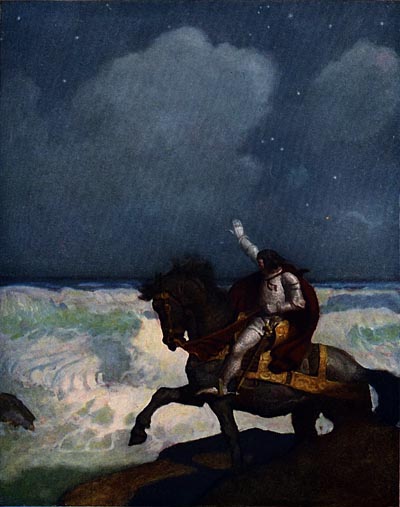
“It is the stars, The stars above us, govern our conditions.” Shakespeare wrote those words in King Lear, but Shakespeare’s own star has come to shine so bright, that it does not require much poetic license to apply the words to Shakespeare himself.

History suggests that at least on some occasions, Shakespeare did consider the influence of the stars on his decisions and not just those of his characters: the opening of his Globe Theatre was delayed until the new moon that came on June 12th, 1599. It was believed to be an auspicious day. I am inclined to agree; The Globe is now the best known theater in the world, and June 12th is also my birthday.

William Shakespeare came into the world just as England desperately needed a strong, unifying culture to counterbalance the internal  strife that came from severing ties to the Catholic church and from the threat of foreign invasions. That made conditions right for Shakespeare’s astronomic assent into the upper echelons of world culture. Whether Shakespeare was born great, achieved greatness or had it thrust upon him, heaven might’ve had a hand in it.

Shakespeare began his career in obscurity as an actor but through some happy coincidences or by the hand of fate, Shakespeare was welcomed as a performer into The Lord Chamberlain’s Men, a prominent theatrical company, first as a performer and then as a writer who would produce plays for the company to perform.  Before long, Shakespeare’s plays were being performed in front of crowds that included the nobility and even a king or queen on occasion.

Will Kemp, one of the Lord Chamberlain’s Men


At that point, Shakespeare could have contented himself with the decadent comforts that have consumed many a celebrity, but that is not what he did. It’s better when Shakespeare explains, so here’s an appropriate quote from Henry IV Part I, “O gentlemen, the time of life is short; To spend that shortness basely were too long.”

Shakespeare entertained his countrymen, but he also held a mirror up to some of the ugliness in his society and questioned the actions of those in power through veiled attacks. Recognizing as much Queen Elizabeth is said to have declared, ”I am Richard II, know ye not that?”

Remarkably Shakespeare produced one of the greatest tragedies of world literature, Hamlet, after the death of his only son Hamnet, who died at the age of 11. As historian Michael Wood suggests in his In Search of Shakespeare series, the death of a child often causes the parents to lose their faith in God or to drown their sorrows with whatever vice is at hand.

Somehow though Shakespeare remained prolific after the tragic loss of his son and then his father, who died in the year when Shakespeare was revising Hamlet.

 Hamlet und Horatio auf dem Friedhof - Eugène Delacroix, 1839


Hamlet declares to Horatio that “there is a divinity that shapes our ends,” but the play ends tragically with senseless loss of life, an ending that is possibly influenced by Shakespeare’s own sense of loss. If there is a divinity guiding the fates of Denmark’s denizens, it does not appear to be well intentioned by the end, and Hamlet’s initial speculation that the ghost of his father might be a “goblin damned” seems prescient.

It is a tricky matter to decipher whether the spirits at hand come bearing good or evil intentions. At least that is true enough in my own observations. Have you found it to be otherwise?

Whatever the case may be, the thread of fatalism in Shakespeare’s plays appears strongest in Hamlet, although some critics might point to the speech in Macbeth as a competing example:

Out, out, brief candle!
Life’s but a walking shadow, a poor player
That struts and frets his hour upon the stage
And then is heard no more: it is a tale
Told by an idiot, full of sound and fury,
Signifying nothing.

Remember though, that speech is given by Macbeth after he allowed his ambitions for power to lead him astray. His outlook is bleak because he has tainted his soul by spinning innocent blood. Macbeth has disrupted the natural order of things, and so Macduff must depose the corrupted king to set things right. The similarity in names is not a coincidence. Macduff is everything that Macbeth is not, a just leader and a force for good.

Macduff would not say that life is merely a tale told by idiot with no purpose. He has a sense of purpose that comes from being noble hearted.

The 1971 film adaptation of Macbeth directed by Roman Polanski uses a clever costume detail to get this across:

Let’s go back to Hamlet for comparison. In that play, the title character is not seeking to gain power for himself, but to avenge his dead father, the king. Uncertain about how to proceed after suspecting Claudius of murder, Hamlet spends much time deliberating but finally takes action against a perceived crime. In so doing he brings death to himself and those he cherishes.

Hamlet did try to endure the slings and arrows of outrageous fortune, but the stars did not align in his favor, so what’s the point of it all, right? Well, the play is subject to multiple interpretations. It helps to see it or read a few times.

Modern audiences are used to watching films like Inception several times in hopes of unravelling the mysteries of a story, and Hamlet set the stage for that kind of storytelling.

How reliable is Hamlet as a narrator after all? Is he merely pretending to be mad to trap Claudius as he tells us, or is his desire for revenge so overwhelming that his madness becomes very real? Laurence Olivier’s 1948 film adaptation of the play suggests that latter.

Also, to what degree do the circumstances at hand cloud Hamlet’s judgments? Hamlet’s mother Gertrude does marry Claudius shortly after Hamlet’s father dies, giving Hamlet reason to question her faithfulness to his father. “Frailty thy name is woman,” Hamlet exclaims when contemplating how quickly Gertrude changed lovers.

Notice that he makes a generalization about all women after suspecting the weakness of just one. Might that explain the motivation behind his callous command to Ophelia to “get thee to a nunnery” shortly after he confesses that he once loved her? Gertrude’s actions in the play might merit derision, but the same cannot be said of Ophelia. Whatever reason Hamlet has for his change of attitude toward her, it is not driven by anything she has done.

Ophelia – John Everett Millais, 1851


How certain can we even be that Claudius committed the crime he is accused of committing? The ghost tells us as much, but Hamlet himself acknowledges that a ghost might not be the most reliable of messengers. Later, Hamlet produces the play Mousetrap to test the king’s guilt, and the king reacts in conspicuous manner at a critical moment, but then his reaction might have been due to Hamlet’s unnerving stare. Hamlet does catch Claudius at confession, but then Hamlet might be close to delirium at this point, and Claudius might be merely harboring guilt about marrying his brother’s wife too quickly.

What really happened? I’m not sure. Clearly though Hamlet is not merely acting as a virtuous and impartial agent of justice, but his desire for revenge has tainted his actions to some degree. As the play progresses, notions of justice dissolve into thoughts of revenge. To quote Hamlet himself, “The croaking raven doth bellow for revenge.”

Claudius probably killed one man. Seeking revenge, Hamlet exponentially increases the death toll. He kills his enemy but also himself in the process. That’s a little different than the ending in Django Unchained, is it not? Shakespeare understood revenge fantasies, but he did not celebrate them with reckless exhilaration in the manner of some contemporary storytellers. 

Revisiting Shakespeare’s plays for this post, I was surprised by how often revenge comes up. Along with madness, love, and the rise and fall of those in power, revenge is a major theme. It is at the heart of Titus Andronicus, Shakespeare’s first tragedy, and it is a driving force in Hamlet, the Merchant of Venice, and the Tempest, but it also shows up in other, less expected ways.

Revenge is also a factor in Twelfth Night, although the zany comic action makes that hard to remember. In Romeo and Juliet, Romeo kills Tybalt to avenge the death of Mercutio, and the death of Tybalt is what dooms the lovers.

Richard III – London Films, 1955

(Laurence Olivier’s performance as Richard III remains unsurpassed.)


Shakespeare’s villains also seem to be motivated by vengeance, but that takes some additional explanation. Let us look at a portion of the opening monologue from Richard III, where Richard explains the reason for his villainy:

I, that am curtail’d of this fair proportion,
Cheated of feature by dissembling nature,
Deformed, unfinish’d, sent before my time
Into this breathing world, scarce half made up,
And that so lamely and unfashionable
That dogs bark at me as I halt by them;
Why, I, in this weak piping time of peace,
Have no delight to pass away the time,
Unless to spy my shadow in the sun
And descant on mine own deformity:
And therefore, since I cannot prove a lover,
To entertain these fair well-spoken days,
I am determined to prove a villain
And hate the idle pleasures of these days.

In other words, Richard laments being born a hunchback and feels that he has been deprived of a happy existence. Against this perceived wrong, he vows to take revenge on others by living as a villain. Aaron the Moor suggests as much in Titus Andronicus with his line, “Aaron will have his soul black like his face.”

Some critics interpret this line as proof of Shakespeare’s racism, that Shakespeare wants us to see Aaron as evil because he is black skinned, but I disagree. It strikes me as Aaron’s way of saying that he was born with black skin, and he was reviled for it, so he is determined to become the villain that others accuse him of being. In Julie Taymor’s production of Titus, Aaron’s face appears scarred from knife wounds, which supports the interpretation that Aaron became a villain to avenge the cruelties inflicted upon him.

Considering the dignity that Shakespeare gives to Othello, another dark skinned Moor, it seems unfair to conclude that Shakespeare was a racist. Yes he plays on stereotypes but then so does every comedy ever made. Do you think Tyler Perry’s Medea films or movies like Boyz n the Hood DON’T play on stereotypes?

Othello is one of the few characters in Shakespeare’s stories who tries to fight off the stereotype that threatens to stifle him. While Othello might be a Moor, he is also a skilled and noble leader. Adding to his appeal, Othello says of his new wife Desdemona, “I do love thee! and when I love thee not, chaos is come again.”

Othello Relating His Adventures to Desdemona - Carl Ludwig Friedrich Becker, 1880


Sadly, Othello is undone by the machinations of Iago, a vengeance-minded man who Othello believes to be honest and loyal. The source of Iago’s discontent is not clear, but there are implications that he is impotent and that he was passed over for a promotion. Just like Richard III and Aaron, Iago believes that he has been wronged  and commits to a life of villainy, of taking from others what was taken from him. Like the others, he maintains that commitment even to the point of ruin.

By the play’s end, Iago is condemned to die, but he has succeeded in pulling Othello back into chaos. The once noble Moor has reverted to the stereotype of a black man driven by violent passions. Ashamed when he realizes what he has been manipulated in to doing, Othello calls himself a “circumcised dog” and kills himself.

Tragic, but then that is probably why it is called a tragedy, I suppose.

In previous blog posts, I have noted that the venerable literary critic Harold Bloom does not share my appreciation for Harry Potter, nor does he buy into my interpretation of Oedipus Rex. At this point I have come to expect that any given erudite quote of his will somehow undermine my meticulously crafted theories.

Imagine my surprise then when I came across this Harold Bloom quote, “The most remarkable of Shakespeare’s achievements is that he is the only dramatist that we have in the entire history of Western drama who is equally excellent at comedy and at tragedy,” and the quote goes on, but that will do for now.

I cannot believe it. I agree! Surprisingly, that quote does not in any way undermine anything I have said. How refreshing and unexpected!

Since we have finally established common ground, I would like to respectfully point out to Mr. Bloom that even the distinguished Shakespearean actor Kenneth Branagh has played a part in the epic Harry Potter films. I don’t want to be pushy or anything, but maybe give it another viewing, OK? I hear it looks gorgeous on Blu-ray! Oh, and as it turns out, Shakespeare once lodged with a family on Muggle St., which is interesting because in Harry Potter the non-magical people are known as … Just think about it Bloomie, OK? That’s all I’m asking.

The Stonemason’s Yard – Caneletto, 1725


Mr. Bloom brings up a good point though. It is rare for a playwright to excel at both comedy and tragedy. It’s not just a matter of mastering a different technique. Comedies and tragedies involve opposing outlooks. A proper comedy has to end happily, so there is not much room for fatalism or nihilism. That is not to say that a story cannot combine elements of comedy and tragedy. Woody Allen is an example of someone who masterfully blends those two dramatic conventions. 

Ultimately though, storytellers must decide if the conditions and choices in their stories, if not in the universe at large, lead to celebration, union, and merriment or mourning, isolation, and destruction.

Earlier I paraphrased Clarence the Angel, so let me now quote from Frank Capra, the director of the film from which Clarence hails: “Comedy is fulfillment, accomplishment, overcoming.  It is victory over odds, a triumph of good over evil.” Tragedy is the opposite of that.

Michael Wood makes an insightful comment about Shakespeare in the “Lost Years” episode of In Search of Shakespeare that relates to the discussion at hand. He says Shakespeare “had a fabulous, almost chameleon-like ability to empathize with the other, good or bad. It’s not just Juliet or Othello that he’s good at. It’s evil people like Iago and Macbeth.”

While Shakespeare was never a king, he did rise from a bohemian actor to an influential playwright so he could relate to Henry V’s transition from a scoundrel to king. Similarly, while we don’t have any records of Shakespeare killing anyone, we can imagine that he would have faced some persecution growing up in a Catholic family when England was transitioning to Protestantism and that like Richard he might have wished, at one point, to be born into different circumstances.

Barring official confirmation from Shakespeare after we leave this mortal coil, we’ll never know which parts of his stories were based on his own experiences and which parts were entirely imagined. From the thematic vacillations of his stories though, it does seem as if he struggled for most of his life to determine whether the human experience was one of ultimate tragedy or comedy.

He would even vacillate within a play, leaving the audience uncertain about the kind of story they were experiencing until end. Take Romeo and Juliet for example. The star-crossed lovers die, but then he ends the story on a hopeful note: The prince chastises the warring families by saying, “See what a scourge is laid upon your hate, that heaven finds means to kill your joys with love.” To which the Capulet leader responds, “O brother Montague, give me thy hand”: the fighting between the families has ended, but the young lovers had to die for that to happen.

Baz Luhrmann’s Romeo + Juliet does not get the same kind of critical esteem as Franco Zeffirelli’s 1968 adaptation, but it does a better job of conveying Shakespeare’s fluid transitions from comedy to tragedy and back in the confines of a single play. Interesting too is the Christian symbolism in Luhrmann’s production, symbolism that you’d have to be asleep to miss. That seems to be a strange stylistic choice at first, but then there is something inherently Christian about a love that brings reconciliation in the dying.

Romeo + Juliet, 20th Century Fox, 1996


If Google did a version of Romeo and Juliet for one of their YouTube channels, I imagine that it would be plastered with Cesar Chavez murals! But then, why do Shakespeare when you can monetize more cat videos, right Google? Well OK, Google also hosts some of my videos, so they aren’t all that bad, but I’d like them more if they didn’t act like California hipsters all the time. They are based in California though, so therein lies the rub. Expanding the office in NY would be a step in the right direction, Google.

Now let’s get back to comedy and tragedy.

The Merchant of Venice is considered a comedy, but Shylock the Jew is a ruined man by the end, so there are some tragic elements involved. That is not because Shakespeare was an anti-Semite, folks. Shakespeare lived during an age when anti-Semitism was rampant, but with Shylock as with Othello, Shakespeare works to undercut, not to inflame, the stereotypes.

I have to admit that while Henry V is the Shakespearean character I most admire, Shylock is the character with whom I can most relate. He is certainly Shakespeare’s most sympathetic villain, if he can even be classified as a villain, and The Merchant of Venice adaptation with Al Pacino is Shylock at his most sympathetic, which makes Shylock’s villainy even more debatable.

This is Shylock’s best known speech:

“If it will feed nothing else,
it will feed my revenge. He hath disgraced me, and
hindered me half a million; laughed at my losses,
mocked at my gains, scorned my nation, thwarted my
bargains, cooled my friends, heated mine
enemies; and what’s his reason? I am a Jew. Hath
not a Jew eyes? hath not a Jew hands, organs,
dimensions, senses, affections, passions? Fed with
the same food, hurt with the same weapons, subject
to the same diseases, healed by the same means,
warmed and cooled by the same winter and summer, as
a Christian is? If you prick us, do we not bleed?
If you tickle us, do we not laugh? If you poison
us, do we not die? And if you wrong us, shall we not
revenge? If we are like you in the rest, we will
resemble you in that. If a Jew wrong a Christian,
what is his humility? Revenge. If a Christian
wrong a Jew, what should his sufferance be by
Christian example? Why, revenge. The villany you
teach me, I will execute, and it shall go hard but I
will better the instruction.”

Who can’t relate to that. I know I can.

I consider myself to be a person of faith, but the people who have made my life the most miserable have been other people of faith and seeming idealists. To be frank I’d prefer to do business with those who aren’t overly religious or dogmatic. If others are competent and capable of calculating that it is in their best interest to deal fairly with me, then there is less of a chance that I will get screwed in the name of Jesus.

Oh, I have been screwed in the name of Jesus, let me tell you. When I was younger and not strong enough to defend myself, religious kids laughed at me, excluded me, and threw things at me. The religious kids who did not harass me were content to stand by and watch with amusement. While defending me might have been charitable it would most certainly have eroded the coveted social status of the bystanders, and one does not throw away social status, not for mere charity. Everyone knows that.

Nor have I found that religious organizations are filled with people who are significantly friendlier and more considerate than their secular counterparts. There are some exceptions of course, and I have met a number of seemingly decent religious people, but then I have also met a number of seemingly decent secular people as well.

For the sake of the discussion, allow me to offer another story. A few years ago, a religious girl had requested that I do a glamour shoot with her, not as paid work, mind you, but as a gesture of kind-hearted charity. I agreed since it would be a chance to get a few interesting portfolio pieces.

I exchanged several emails with her and sent some reference photos to make sure that we were both on the same page. On the day of the shoot, I rented some lights and did exactly what we had discussed, imitating to a T the photos that we referenced, but she became tyrannical during the shoot and then refused to let me publish any of the photos. Nor did she think it was appropriate to pay me for my time or for the equipment that I had rented. Prior to that incident, she was the girl in my life who was most inclined to tell me that I should go to church more often. I haven’t spoken to her since.

I could give you more stories like that, but I won’t. I too have my flaws, but then I do not spend much time telling others how to live. I’m still trying to get my own life right.

I try not to dwell on past hurts, but they still come to surface from time to time. If an opportunity for revenge were to present itself I don’t know how I would react. I hope that I would do the right thing, but that is easier to do in theory than in practice.

Nativity – Piero Della Francesca, 1470


Going back to Merchant of Venice, Shylock has lived as an outcast and been condemned as a usurer for most his life, so his desire for revenge is understandable.

(In the Renaissance, a usurer was anyone who charged interest on lended money. This seems strange to us since our modern financial system is built upon the premise that borrowing and lending money involves interest. Back then, money was understood by the Church as another resource meant to be shared with those in need, and interest rates were seen as an interference to a just distribution of goods.)

In the play Shylock makes a legally binding arrangement with Antonio. Shylock will lend Antonio 3000 ducats, but if he is not paid back in time then Shylock will be entitled to a pound of flesh from Antonio. When Antonio loses some of his ships at sea, Shylock insists on being repaid in flesh, even though fulfilling the agreement would kill Antonio. As far as the law is concerned, Shylock is fully justified in his demands.

Merchant of Venice – Sony Pictures, 2004


Before we look at what happens next, let’s go back to a similar setup in Titus Andronicus. In that play Tamara, Queen of the Goths, and her sons have been captured by Titus, a powerful Roman general. Titus lost several sons in battle, and so by Roman tradition he is entitled to sacrifice the oldest son of an enemy.  Tamara begs him to be merciful, but he doesn’t listen. To paraphrase the words of a younger Al Pacino, “It’s not personal Tamara. It’s strictly business.”

A blood bath ensues. After her son is sacrificed, Tamara is hell-bent on revenge. She has her sons rape and amputate Titus’s daughter. Titus responds by killing Tamara’s two remaining sons and feeds Tamara a pie baked from their flesh. Just like in Hamlet, almost everyone dies in the end.

Titus – Fox Searchlight, 1999


Titus Andronicus is such a violent play that many critics consider it inferior to other Shakespearean plays.I see it as Shakespeare’s first attempt to resolve an internal struggle, one that continues through to Merchant of Venice. Shylock has a decision to make, much like that of Titus Andronicus, but this time something changes.

Enter Portia.

Portia is the love interest of Bassanio, and he had asked Antonio for money to woo her. That is why Antonio made the deal with Shylock.

Many suitors come to Portia’s home hoping to win her heart, but as stipulated by her father’s will, she will only marry the suitor who picks the right casket. There are three caskets to choose from, each made of a different material: gold, silver, and lead.

The correct  one is the lead casket, and it bears the inscription, “Who chooseth me must give and hazard all he hath.” It is worth mentioning that according to the traditions of the time, lead was the material that alchemists would turn to gold. In other words, true love has the same effect as the alchemist’s magic.

From the beginning of the play, Portia is set up as a reward for choosing wisely. The payoff for that comes when Portia, in disguise,  gives Shylock a choice in her famous courtroom speech:

“The quality of mercy is not strain’d,
It droppeth as the gentle rain from heaven
Upon the place beneath: it is twice blest;
It blesseth him that gives and him that takes:
‘Tis mightiest in the mightiest: it becomes
The throned monarch better than his crown;
His sceptre shows the force of temporal power,
The attribute to awe and majesty,
Wherein doth sit the dread and fear of kings;
But mercy is above this sceptred sway;
It is enthroned in the hearts of kings,
It is an attribute to God himself;
And earthly power doth then show likest God’s
When mercy seasons justice. Therefore, Jew,
Though justice be thy plea, consider this,
That, in the course of justice, none of us
Should see salvation: we do pray for mercy;
And that same prayer doth teach us all to render
The deeds of mercy.”

In spite of Portia’s plea, Shylock chooses justice over mercy. This forces Portia to declare that Shylock is entitled to a pound of flesh but not one drop of blood. Dejected Shylock leaves the courtroom a defeated man.

In contrast, Bassanio chooses wisely, as demonstrated by his selection of the lead casket back in Belmont. He chose true love and that allowed for grace and for happily ever after for him and his friends.

Portia and Shylock – Thomas Sully, 1835


And so, love disrupts the cycle of revenge. That theme resounds again in The Tempest, widely believed to be the last play that Shakespeare wrote by himself. (The Two Noble Kinsmen possibly came later but that was a collaborative effort between Shakespeare and John Fletcher.)

In The Tempest, Prospero causes a storm that shipwrecks certain designated travelers and brings them to a magic island. That sounds familiar. Where oh where, have I heard that story? Was it one of those reality TV shows? Maybe Survivor? I don’t know.

Anyway, Prospero is determined to get revenge, but then he changes his mind, partly due to the growing love between his daughter Miranda and Ferdinand, the Prince of Naples.

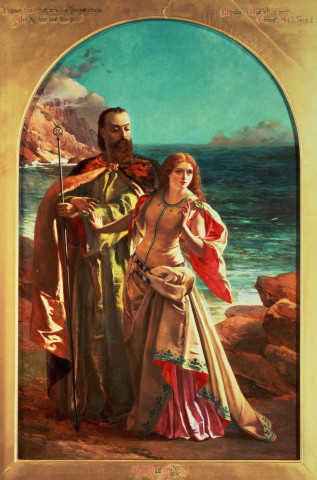
“The rarer action is in virtue than in vengeance,” Prospero concludes. With that he sets things right and then breaks his staff, often interpreted as Shakespeare’s way of saying goodbye to the magic that he created with his pen. This time the one seeking revenge doesn’t have to be stopped by someone else. Prospero himself changes his mind.

Once again love turns a potential tragedy into a comedy, at least in the fictional world, but sometimes reality is stranger than fiction. 

Shakespeare’s will famously left his wife Anne Hathaway the “second-best bed with the furniture.” There are lots of theories about this. There is even a book entitled The Second Best Bed. It has 137 pages. 


I checked out that book from the library, but I will not be reading it. Who has time to read 137 pages about a dead man’s will?

I just wanted to photograph it for you, so that you will know that such a book exists. That being said, if you take interest in that book and read it as a direct result of this post, then I’d love to hear your thoughts! I’ll buy the tea and crumpets for our discussion.

Some scholars have suggested that the children of a family would get the best items by tradition, so it would be understood that the best bed would not go to Anne. Others like Michael Wood argue that the best bed might have come from Anne Hathaway’s family, and so it might not have been Shakepeare’s bed to give away.

I’d like to think that there was something special about the phrase that only Anne would appreciate, much like how the lead casket in Merchant of Venice seems undesirable until you understand its significance. The interpretations that see Sonnet 145 as a love letter to Anne give some support to that belief. (“Hate away” is similar to in pronunciation to “Hathaway” and the line “And saved my life” sounds the same as saying “Anne saved my life.”)

The Last Kiss of Romeo and Juliet – Francesco Hayez, 1823


So did Shakespeare’s life end as a comedy or a tragedy? It’s hard to say for certain.

Harold Bloom believes that Hamlet is the play that best embodies the “internal truths about the human conditions” which suggests that human life is essentially tragic, even that of Shakespeare’s, but what if it doesn’t have to be?

Much like students of Shakespeare’s work, Harold Crick, the main character in Stranger than Fiction, spends considerable time debating whether the story he inhabits will end as a comedy or a tragedy. (Fun fact: Dr. Hilbert devises 23 questions to help Harold make the determination. That’s a veiled reference to Hilbert’s 23 problems, a list of 23 unsolved mathematical problems published by David Hilbert back in 1902.)  The literary figures in that film want a tragedy for artistic reasons, but Harold has his own ideas, and in the end it comes down to the choices that he makes, just as it does for all of us.

Speaking of choices, there is one more Shakespeare reference that I did not mention in the beginning. In Twilight Saga: Breaking Dawn – Part 2, the Cullens look to Shakepeare’s Merchant of Venice for clues about what to do regarding the impending war between the werewolves and vampires. Guess whose name is on that book? Why that would be our pal Harold Bloom!

Bloomie, if you have an exclusive deal with the Twilight franchise that prevents you from also supporting Harry Potter, then you should have just said so!  I promise to buy a poster to support your film but only if you agree to sign it with an encouraging line or two. How about something like, “The Circle of Life moves us all. All’s Well That Ends Well. Forever.”


It takes me a little longer to write the kinds of posts I prefer to write, and sometimes my schedule gets complicated, so I can’t promise to have new posts available on a consistent schedule. That’s why I encourage you to sign up by email. You can do that by clicking here.

If you’re following along by  email, you’ll know right away when I have a new post waiting for you.  It is very easy to unsubscribe, and you won’t receive anything unrelated to my blog.

Lastly, if you appreciate my writing, why not write a comment or share the post with a friend? It would encourage me to keep sharing some of my heart with you.

As always, thanks for reading and God bless.


(Mis)Adventures and Modest Proposals from SXSW

This story starts with The Little Prince. At the Louisiana Art & Science Museum in Baton Rouge there was a screening of The Little Prince, a computer-animated adaptation of the beloved children’s book. The book is a favorite of mine, so I was curious about the film, but I also had other things on my mind. Specifically, I was trying to put together a trip to SXSW, and it didn’t look like it was happening.

The Little Prince – nWave Pictures, 2010


To those who don’t know, SXSW is the abbreviation of South by Southwest, a big shindig in Austin Texas that blends aspects of interactive, film, and music festivals into one massive, hipster-friendly amalgamation. Because of the festival’s hybrid nature, many companies and creative types go to meet like-minded people, gain insights, and share the work they’ve done on recent projects.

The day was Sunday, March 11. The festival had already started, and I didn’t have any viable travel plans in place. Maybe next year, I thought.

Disappointed that SXSW seemed unlikely, my inclination was to stay in the house, but I had a strong sense that I should go see The Little Prince. I don’t know why I had that sense, but I tried to ignore it. It doesn’t always go so well when I listen to my sense about things. Without going into specifics, listening has recently led to heartache, betrayal, and financial difficulties.

To console myself, I was playing Civilization V on my laptop. Playing that game has killed a few hours, but it has never led to heartache, betrayal, or financial difficulties, so it is the safe choice, my bridge over troubled water so to speak.

Sid Meier’s Civilization V: Gods and Kings - Firaxis Games, 2012


I can spend hours playing that game. Managing a successful in-game civilization involves some thought, which is enough to keep me from thinking about the things that trouble me, and like filmmaking, Civilization is ultimately a game of logistics. (It’s not just UPS employees who heart logistics, folks!) Plus, all the decisions in the game set the stage for success or failure at the end, and it’s all about the end game, isn’t it?

That is true enough about life in general, but it also relates to the story at hand. I promise if you make it to the end, there will be a payoff, but it may not be the payoff that you want.

As to the game, my civilization was doing fairly well. I had taken out my aggressive neighbors who had been taunting me a few turns ago. “You think you’re so tough, King of Egypt? Well I just took your horse and iron resources. What do you think about that?” It was now time to annihilate the opposition before their armies grew back like the pestilent snake-heads of the Hydra, but then that sense I’ve been trying to avoid came back. “Nick, you really should go see The Little Prince,” it said. OK, OK. Just one more turn.

It ended up being a few more turns, maybe like 5-10, but you know, close enough. Honestly, I figured the sense would stop bothering me if I stayed focused on the game. How important could it really be to see an animated version of a story that I had already read? But again the sense came. “Nick you NEED to go. It is important. Hurry.”  OK, fine. Let me save the game.

I almost left right away, but I had to finish the turn. Those wily Egyptians had it coming after all.  Again, close enough, or so I thought.

Sid Meier’s Civilization V – Firaxis Games, 2010


As I was driving, I sensed that I should hurry, that I was behind schedule. I drove as fast as I could without being reckless. Soon I found a parking spot. I was within 5 minutes of when the show was supposed to start. That should do it, I thought. “No. Run.” Really? For a computer-animated short at the Planetarium?! “Yes.”

Fine. I ran to the entrance, and I got there just in time to see the security guard locking up the place. I knocked a few times, but she ignored me. Seriously?! I ran and I still didn’t get in? What was the point of that?

My sense returned. “You didn’t listen right way, did you?” Not exactly. “Next time don’t take so long to listen.”

Shaw Center, Baton Rouge


Since I was downtown, I figured I’d make the most of it. I ended up going to the LSU Museum of Art in the Shaw Center. To those who haven’t been to Baton Rouge, the Shaw Center is the building prominently featured, although digitally enhanced, in the upcoming film The Host, written and produced by Stephanie Meyer of Twilight fame.

The Host – Open Road Films, 2013


After the museum visit I walked around looking for a place to eat. They were doing a crawfish boil at Lucy’s, so I had some crawfish and some drinks, and I figured that would be the end of it.

At this point it was late Sunday evening, and I still had not made any SXSW plans.

A few days before the screening of The Little Prince, I had gotten my car washed in the hope that I would find someone to go with me to SXSW. I mentioned as much to my Facebook friends, but I got no takers.

Crawfish boil at Lucy’s


It was last minute, I know, but then I didn’t have enough days off from work until about the time when I started asking for a companion.

Normally I like to plan in advance, and this year I was not planning on going to SXSW. I had submitted Up to Date, the short comedy I directed, to the festival, but it did not get accepted. Admittedly it was a long shot, but not getting in was still disappointing, and I was not keen on going to a festival that would remind me of the rejection.

And yet, I kept seeing SXSW pop up. Some of my friends were going. I would randomly stumble upon stories about the festival. People near me would discuss it. And then I got an email from Paste Magazine.

I subscribe to a digital variety of Paste, so an email from them was not unexpected, but this particular email was about the SXSW lineup that they were hosted. The email informed me that someone important whom I had been trying to contact for a long time would be there and so would a band with whom I am friends. For someone like me, that doesn’t happen all that often. In fact, it was the first time.

Speaking of which, my first visit to Austin had been a few months ago, when I spoke at the Canon National Sales Meeting. It was the best response that I have ever gotten for a speech. In the days that followed the speech, people kept coming up to me to share how much they appreciated what I had to say. They would even interrupt my conversations to tell me as much. That’s never happened to me before. It was surreal.


Memories from the Canon meeting combined with the recurring SXSW references, and the email from Paste further fueled the possibility. Two problems stood in the way: I didn’t have enough days off, and I didn’t have enough money.

Back when I submitted my short to SXSW, I had requested a few days off, but I didn’t get enough consecutive days to make the trip practical. Had I gotten accepted into the festival, I would have petitioned for more days, but I did not see the need to do that for a festival that had rejected my short.

Now I had less than a week to ask for days off that had initially been denied for scheduling reasons. Somehow my supervisor made the schedule work out in my favor. A special thanks to Ray and to Canon for that.

Even with the time off, I still had to figure out how to pay for the trip. Ever since I directed a short comedy and had to replace the engine in my car, I’ve been in a precarious financial position. I got some help from family and financial institutions, but I wasn’t in a place where I could easily afford to attend a film festival with the costs of travel, lodging, and registration factored in.

After evaluating my situation more carefully, I figured that if I found one other person to go with me, then the cost might be more manageable, so I asked everyone I knew in the area. It is not easy for me to ask others for things, but I had a sense that I should ask, so I did. I went so far as to pack my suitcase in advance, so that I could be ready in a moment’s notice if someone confirmed interest.

I got a few maybes, but no one committed, at least not within the time frame I needed. I was so close. Too bad.  One more almost to follow a long string of almosts. I went to bed with a heavy heart. And yet the trip still lingered in my mind. It cannot be, I thought. “It can,” a small voice said.

I did the best I could and nothing happened. Besides, I cannot afford it. “You can,” the voice said. Then I got an idea.

I’ve never made a decision like this before and probably never will again. That’s why I’ll mention it. I thought, the only way I will even consider this foolish idea of going is if I wake up at exactly 3:20 AM. I never get up at that time, so I figured I was safe.

Why 3:20? It just popped into my head, but I’ve been seeing that number, along with its reflection, the number 23, quite a bit lately. I talk more about the significance of number 23 and 32 in the James Dean post, but the numbers also have a personal significance. On June 12th of this year, I turn 32. November 11th is another significant date, one whose significance I will explain later, but for now take the date of my birth and add it to another big day in my life, and you get 12 + 11 = 23.

Guess what time I woke up on Monday morning? It was not 3:19. It was not 3:21. It was exactly 3:20 AM. I did not set an alarm.

What are the odds that with just a few hours of sleep—I want to say less than four—I would wake up right at that time? Sixty seconds is a small window to hit when you’re exhausted and discouraged. Waking up right at 3:20 got my attention.

It looks like I’m going to Austin!

Street in Austin


Having experienced the consequences that come with delayed action, I got up and promptly explored motel options. I found a motel room for less than $70 a night, and it was only about a 30-minute drive from Austin. Not bad. I made reservations, sent directions to my phone, packed the car, and I was off!

Fun Fact: Only after I had arrived in Texas did I hear from Brittni, a friend from the band England in 1819. She wanted to come along, but by then it was too late. I had seen England in 1819 play in Baton Rouge before I left, and I asked the band if they knew anyone who wanted to carpool out to SXSW. Liam, one of the guys in the band, told me that he did know of one girl and that he would put her in touch with me. I waited a day or two but didn’t hear anything. Maybe next time Brittni.

While driving to Austin, I had that familiar sense that I should hurry. Great. If I get there just as the security guard locks the door, I will not be happy. It’s one thing when the destination is just a few minutes away. It’s another thing entirely when a six-and-a-half hour drive is involved. On top of that, the CHECK ENGINE light on my car was blinking throughout the trip, so I figured that there was at least a small chance that my car would break down at an inopportune moment.

Bike rack in Austin


That CHECK ENGINE light has been a constant for a while. I’ve had a few shops look at the car, and they’ve mostly indicated that the car itself is fine but that the electrical system which identifies errors is broken.  I’ve explained to the mechanics that the car sometimes makes strange rattling noises, but they’ve assured me that this is as it should be.

One repair shop did suggest that there MIGHT be a problem and that they MIGHT be able to fix it, but that it would cost around $1000 for them to take the car apart. The uncertainty in that offer was not persuasive to say the least.

Anyway, I had grown accustomed to the constant presence of the CHECK ENGINE light, but in the past few weeks it has started to blink on and off. Either the car is undecided about the veracity of the phantom problem or the problem is getting worse. Whatever the case may be, the blinking CHECK ENGINE light was not the fun-loving companion that I had hoped to have for the trip. Somehow though, I made it to my motel and then to Austin without breaking down.

I would get to hear the interview at the Paste Sennheiser Lounge after all. Before the interview started, I even had enough time to meet the two gals pictured before. It had been close, but it felt like I was on time for whatever it was that I was supposed to see and hear.

She was nice enough to give me her extra set of FireFox glasses. 


This was the first gal I met at the Paste Sennheiser Lounge. Her name is Anna. 


The interview I had waited for was about to start. I took my position in the spectator area, and Anna joined me. It was a confined space, which gave the interview an intimate feel.  I was close enough to get this photo:

The folks at Paste Sennheiser show their good taste by shooting all of their interviews with Canon equipment!


Yes, that is Carlton Cuse, one of the showrunners from Lost. He was in town to promote his new show. We had never met in person, but I had contacted him a few times on Twitter.

Now, people say all kinds of things on Twitter, so we should probably investigate to see what kinds of heinous things I said to Carlton, just to give context.

According to my records, this is the first time I made contact:

That was right after the season finale aired. I was one of the first, if not the very first, to provide feedback about the ending. OK, that doesn’t seem too malicious, but take a look at this, my second contact. I was particularly vicious with this one:

Hmm. OK, that doesn’t seem as bad as I remembered, but when I wrote it, I was saying it with a snarling monster voice, so pretty scary stuff. I guess we need more proof though, so let’s look at some additional examples from 2011:

See. That one. Did I write that because I was trying to pave a career for myself in the entertainment industry and was willing to work even as a production assistant for someone I admired? Seems plausible, but we’re talking about the guy behind Lost. Doesn’t it seem more likely that I was trying to get close to Carlton so that I could finally get answers to all my questions about the polar bears? Doesn’t it?

One last tweet from 2011:

These last two tweets don’t list the year because I backed them up back in March 2012, and then I deleted many of the tweets involving Carlton. Without getting into all the details, I deleted the positive things I said because I no longer believed them to be true, but I archived my comments; Lost was still a big part of my life and so were my efforts to communicate with the show’s creators.

Now that I have some distance from that time period, I can acknowledge that both Carlton Cuse and Damon Lindelof got an obscene amount of flack about the ending of the series. I liked the ending. I found it inspiring, one of the most inspiring things I have ever seen, comprable to the Giants Super Bowl win against the New England Patriots back in 2008.

It made me feel like anything was possible, but even if I did not like the ending, I would not have targeted the show creators with hateful rhetoric. If someone didn’t like the ending or didn’t get  all of his questions answered, then isn’t there still something to said about appreciating the journey that came before? I didn’t get the people who would support a show for so long only to turn on it based on one or two episodes.

Carlton and Damon were treated unjustly for months, even years, after the finale by a number of vocal Lost detractors, so I’m willing to give them the benefit of the doubt. The show did shine a bright beacon of light into a bleak media landscape, and the forces of darkness do not take kindly to that. The Empire always strikes back, and in the context of Lost it would seem that the strike came from a minion of hipsters and deadbeats with nothing better to do.

I would never have reached out to Carlton Cuse and Damon Lindelof in the way that I did if I thought Lost was just another show for them. Back then, listening to the official podcast of Lost and reading some of their comments about the show made me believe that they meant it. To convince me of that it takes either a group of enormously skilled con men or a significant, higher-than-usual display of sincerity.

With that context, let’s return to SXSW. The Paste folks didn’t do a Q&A with the audience but if they had, I would have asked Carlton something silly, like whether Carlton could elaborate on the significance of the Justin Bieber hat in the Lost mythology, a significance that has been suggested repeatedly by Damon Lindelof on Twitter.

After the interview concluded, I was just hoping to say a quick hello and to have Carlton sign my Lost Encyclopedia that I had brought along.

He didn’t even acknowledge me. I was standing next to one of his handlers, waiting politely for him to finish his conversation, but after he finished chatting with others nearby, Carlton walked past me and exited. I was just a few feet away.

Chessboard at NBC’s Revolution tent


“My feelings were hurt,” to quote Craig Mazin’s comments from the February 19th episode of Scriptnotes, the podcast about screenwriting that he does with John August. In that episode Craig talks about how awful it feels to work on something that is meaningful to you, that comes from the heart, only to have it scorned. It was one of the podcasts that I heard while driving in to Austin. I sensed that it was somehow important to hear it, but only a few days after the Carlton interview did I make the connection.

Carlton wasn’t dismissing work I had done; It felt like he was dismissing me. That’s not exactly the same thing that Craig experienced when critics savagely denounced his script Identity Theft, but I could relate to the feelings he expressed.

During Carlton’s interview and his post-interview interactions with people, I read his body language as indicating recognition but avoidance. I am not a body-language expert, but I do study the subject. I am trying to sustain a career in the entertainment industry after all, and there is a higher concentration of phonies and con men in the entertainment business than perhaps any other business on earth, so it is critical for me to read as much information as possible from others when opportunity allows.

I was so distressed by what I interpreted from Carlton’s actions that I grabbed my beer bottle and put it in my bag, thinking it was my camera. What beer was left got spilled into my bag. I’ve done some stupid things when alcohol was involved, but I’ve never done that.

Lest you think it was the alcohol talking, I can tell you that I had between 3-4 drinks over the course of two hours. While that is not a negligible amount of alcohol, it takes a bit more than that to get me to the point where I might mistake a bottle for a camera.

To be fair though, it is possible that I misinterpreted Carlton’s body language or that he did not recognize me. My Twitter photo does give some sense of who I am, but it was taken professionally, and everyone knows that a social media avatar doesn’t always give the most accurate representation of the person behind the account.

That’s why I’ve included this unedited photo I took of myself on the ride back from Austin. (The return trip was when I decided that I would write this post.)


That is obviously nothing like my Twitter profile! For example, in this picture I am wearing a different outfit and I am in a car, a stationary one. If strangers had just seen my Twitter profile, they might falsely conclude that I am someone who only enjoys standing against walls while wearing sweater vests. Au contraire, my friends! This photo is proof that I sometimes also enjoy sitting in cars while wearing full-length sweaters.

But, when I attended the interview I also had a five o’clock shadow and SUNGLASSES.  That is a very different matter. I will prove as much by showing you a photo of me with the sunglasses in question:


Had I not told you that I was in this picture, would you have known it was me? Very difficult to say for certain, isn’t it?

Superman was a genius for capitalizing on the cognitive dissonance that glasses can create. The rest of us would be wise to learn from his prescient insights pertaining to the emerging field of facial recognition.

I wasn’t wearing the glasses as a disguise though. I was wearing them because a gal I met at the Paste Sennheier Lounge gave them to me. In retrospect, I should have taken them off during the interview, but I was a little nervous about the prospect of meeting someone I had admired and someone who had been an important part of my life for years. It felt more comfortable to keep them on, but at the time I did not think about how the glasses might make me harder to recognize.

The sunglasses do introduce some margin of uncertainty about what really happened, so I will give Carlton a chance to make amends. Details to follow. Eventually.

The Carlton incident left me depressed for the rest of the day. I am a little different than a typical fan, but I didn’t think a hello was too much to ask. I tried to forget about that as Anna took me to some local hangouts around town, but eventually I realized that I had a beer bottle instead of a camera in my bag. I became sick with the realization that the day would probably be a miserable memory not just because of Carlton but because I would end up losing my beloved Canon G12.

That camera has gone everywhere with me, and I didn’t want to lose it just because I went out to hear some Hollywood guy talk about his new show. Surprisingly the camera was still where I left it at the Paste Sennheiser Lounge. No one had stolen it. What a relief.

Not that the day got much better. I checked the score of the Knicks game on my phone shortly thereafter. The Knicks got pulverized by the Golden State Warriors, 92-63.  That’s not a competitive NBA game, folks. That’s a problem from an advanced subtraction class in elementary school.

That’s also the least amount of points that the Knicks have scored all season, and that embarrassment had to come from a California team, didn’t it? The Golden State Warriors have a mascot of a bridge for crying out loud. It doesn’t get any tougher than a bridge, now does it?

That makes me think the classic Simon and Garfunkel song is ripe for a team-cheer update: “Like a bridge over troubled water, we will shoot layups!” To any fans of the Golden State Warriors, you are welcome to take that little ditty and claim it as your own. It is my gift to you.

The loss to the Golden State Warriors would be the Knicks’ 23rd loss of the season.

Chicken and unicorn waffle from Samsung Lounge


That day was not a success, but I was already committed to another two nights, so I figured I’d regroup at the motel and plan out the next day. Maybe there was someone else I was supposed to meet.

I knew that Jason Calacanis was at SXSW and that he had done a This Week in Startups panel there. I didn’t get to Austin in time for that, but I was still hoping to meet him in person. Jason is someone I admire for his unabashed entrepreneur ethos and his occasional inclination to tell the truth in gutsy ways.

We’ve shared interesting email discussions throughout the years, mostly my responses to his missives, although he has replied on occasion, but we have never met in person. Some of the things I have written to Jason have been negative, so I’m not sure that he would be interested in meeting, but then he does solicit feedback, and I wrote the negative things from a desire to see him do more of what he does best and as filtered through my own insecurities. That being said, I believe most of the things I’ve said to him have been positive, but you can check with Jason for his interpretation.

While I was planning out the day for March 12, I took a look at his Twitter feed and noticed that he was still referencing SXSW. Then I saw this:

Note the number 32 in that one there.

Yeah, Jason is a fellow Knicks fan, and a former New Yorker, and I suspect that he’s still a New Yorker at heart. Interpreting the number 32 as a good omen, I decided I would reach out to him with the Twitter handle for my production company:

Why would I use the @nsavidesPRO account and not @nsavides one for that? Why indeed?

I had created the @nsavidesPRO account a few months ago so that I could talk more about technical matters and industry-related topics without boring my less technically inclined friends, but then something happened that caused me to stop tweeting from my personal account.

Keep reading and you’ll find an explanation, but for now let us just say that @nsavidesPRO is a viable way to stay in touch with people at industry events like SXSW and that people like Jason seem to respond more quickly to tweets than to emails.

I did not hear back from Jason, but after re-reading his timeline I believe that he had already left Austin by the time I contacted him. He was also not feeling well during that time, and he is a high-profile figure who gets lots of Twitter mentions each day. It was disappointing not to hear back from him but not on par with what happened with Carlton Cuse, who was just a few feet away from me in a room with about 30 people or less.

It would have been odd for Jason to respond to me and explain why he couldn’t meet me without having to do the same for all of the other more important people who also could not get time with him. It would have been a trivial thing for Carlton to acknowledge me and give me a minute or two of his time before leaving.

Jason is a community-minded entrepreneur, but he is focused on turning a profit and being competitive. I don’t mean that as a slight. Profits make it possible for businesses to grow and to take care of their employees. In contrast, Carlton became a household name with a show in which the business types tend to be villains and which reiterates the “live together, die alone” theme from one season to another.

Based on the prior paragraph, you might conclude that Carlton has treated me in a much more considerate manner throughout the years. That is not the case. Jason has responded to my comments and questions on numerous occasions, and I’ve found his tone to be respectful even when he disagrees. Carlton has not even offered me a thank you or a hello, although he has had ample opportunities to do so.

Austin at Night 


Be that as it may, something about Lost, about the way Carlton carried himself, about a sense I had, made me once believe that Carlton might be a good man. In retrospect I can’t explain why I thought that. Maybe it was just due to the reality distortion field that comes with a big show like Lost. Maybe it was more about the shadows of the things that might be rather than the shadows of things that are. Hard to say.

In any case, I can’t imagine that I would draw similar conclusions about Carlton based entirely on his new show, Bates Motel, and I say that after watching the pilot. Shows about serial killers are not my favorite things to watch, but Bates Motel does seem to be a thoughtful, contemporary take on the origins of the Norman Bates character in Psycho. Only one episode has been released, so it is too soon to tell, but my guess is that a line from the pilot will be a recurring theme for the show, “no one is ever going to help us.” In other words, I’m anticipating the show to be an anti Lost and an anti Friday Night Lights concoction.

I set up the anti Lost part already, but let me take a moment to explain the anti Friday Night Lights aspect. On its surface, Friday Night Lights is a TV show about a competitive high-school football team, but the show seems more interested in how the citizens of a small town share the triumphs and tragedies of life with each other and in so doing grow stronger as a community. One of the writers and producers from that show is Kerry Ehrin, the other show runner alongside Carlton Cuse in Bates Motel. Just like in Friday Night Lights, Bates Motel is set in a small town, but I don’t expect the townspeople of Bates Motel to have many sympathetic qualities.

These days, it is not unusual for creative types to jump from one project to another one that seemingly undermines the one before. J.K. Rowling enthralled audiences around the world with the wonder, magic, humor, and love that she infused in her Harry Potter series, but then she followed that up with The Casual Vacancy, her ”adult” book that offers up a loveless, humorless, meandering story filled with sex and death. I’m sure someone in the world is preparing to bestow some prestigious awards on The Casual Vacancy for that very reason, but I lost some respect for J. K. Rowling because of it.

That’s not to say that there is no place in the landscape for a cautionary tale. It is conceivable that a show like Bates Motel could do some good if it draws attention to crooked things and warns people to avoid them. Hitchcock himself was a moralist, but then based on the pilot, Bates Motel aspires to be more explicit than Hitchcock’s films, and that is disappointing. Does the show have enough substance to justify its attempts to out-sexualize Hitchcock, or is it just another ratings-obsessed serial-killer show willing to do whatever it takes to compete in an over-saturated market?

I might not watch another episode of Bates Motel to find out. It will depend on what kind of a response I get to this post.

There are one or two more details about the SXSW trip that are worth sharing. Remember the band that I mentioned in the Paste email? They are the Last Bison. I knew them from when they performed at an art show in VA where we premiered the Alone in Space music video I directed. They were playing at the Paste Sennheiser Lounge on Tuesday, a day after Carlton was interviewed there. (Technically they played at midnight, so it was Wednesday morning, but you know what I mean.)

Most of the interviews and music events at the Lounge were free and open to the public, but the Last Bison show required a festival pass. While I was excited to hear my friends play, I was not about to pay a few hundred dollars for a SXSW festival pass, not when money was tight and my schedule allowed for just one more day in Texas. I tried a few different approaches to get a wrist band, but those all got shot down. Fortunately one of the guys from Paste got me a VIP pass. It helped that I approached him when he was talking to Last Bison.

Last Bison prepares to play a song at the Paste Sennheiser stage.


I mentioned the show from the nsavidesPRO account because I knew it would be a good show but also because I was hoping that someone would see it and attend. You see, there was someone else I was hoping to meet, but I could not be direct in this case. Not with her.

I cannot explain this part without going back to Nov 11, 2011. That was my first day as an extra on the film Pitch Perfect. The only reason I subjected myself to the monotonous hours of extra work was for the chance to meet Brittany Snow. I had spent years of my life trying to get her to be a part of a script I wrote, and back then I was infatuated with her, or least the facade that I saw from a distance.

Given the amount of time I spent trying to get her to be a part of my project and given that she is the celebrity responsible for the Love is Louder campaign, it did not seem unreasonable to think that she would be willing to spend a few minutes to say hello. Friendliness is, of course, a radical assumption when dealing with Hollywood celebrities, whether they are responsible for charitable outreaches or not.


Inside the Austin Convention Center


On my first day as an extra, I spent the day in observation. I thought I might have a shot at meeting Brittany at lunch, but they kept the celebrities in a separate area. The reasoning for that, I’m sure, is to ensure that their elegant dining experience is not sullied by seeing the unwashed masses.

On my second day as an extra, I figured I would be more bold, so I sent Brittany Snow, Anna Kendrick, and Rebel Wilson a message on Twitter requesting a group photo with them. The girls had plenty of downtime, and they could have accommodated my request in five minutes or less, but they ignored me. Not the end of the world, but it still stung at the time.

Now that I think about it, there is a certain pattern emerging in this story. How about that.

After watching Brittany conduct herself in public over the next few months, my infatuation began to fade. Upon closer examination, I generally found her movies to be schlocky at best and depraved at worst. (Update: after further reflection, I don’t believe that last line is entirely fair or precise. Instead of deleting my comment after having published it, which would be the easy way out, I will attempt a clarification. I haven’t seen every film or show that Brittany has made, but I do appreciate some of the things she has done like American Dreams and Hairspray. It is just that her films like Would You Rather, On the Doll, and Black Water Transit seem so awful and so contrary to the message of love that her outreach espouses that those films negatively impact my overall perception of her work. Also, I try very hard to distinguish between the way I feel about a person and the quality of work that he or she produces, but that is easier said than done.)

There are exceptions to every generalization, of course, and she is a talented actress, but there is nothing particularly loving about her body of films taken as a whole.

Nor have I seen her do anything to suggest that she has more than a surface-level understanding of love.  That is not such an unusual thing for celebrities who have grown accustomed to the unadulterated adulation from the world at large, but that kind of thing is not all that interesting to me, and I do have higher expectations from people who make a name for themselves with idealistic sloganeering.

It took me a while to realize that the thing I found most attractive about Brittany was that she reminded me of a girl I used to know. That was such a liberating thing to discover. That girl is gone. Brittany is not that girl. She never will be.

Street in Austin 


Needless to say, Brittany was not the one I was hoping to see at SXSW. I was so preoccupied with Brittany that it took me a while to notice that right nearby was a girl who meshed better with my sensibilities. She was pretty and intelligent and made movies I admired. She didn’t pretend to be perfect when she wasn’t performing but seemed to live with a refreshing honesty.

I didn’t want to entertain that possibility, not after the whole ordeal with Brittany, but as fate would have it, I directed a short comedy that featured Wes Largarde, one of the actors from Pitch Perfect.

I didn’t put out a special Pitch Perfect casting call. At the time, Wes was taking Lauren Michele’s acting class, a class that I was also taking. Some of us in the class had been talking about the possibility of putting together a short for a while, and those discussions were happening prior to his involvement with Pitch Perfect, if I remember correctly.

That said, Wes did give our production a legitimate connection to Pitch Perfect, and that made it harder for me to get the other girl out of my mind. Knowing that helped me to do the bravest thing I have ever done: I made the video below and sent it to Anna Kendrick on Twitter.


When I didn’t hear back from Anna, I locked the @nsavides account, and I made the video unlisted. Excluding the Twitter reference, I had only shared it with my sister and one other friend until now. For a while, I was opposed to sharing it after I didn’t hear back from Anna. Getting ignored in a public way hurts, but I don’t regret making the video.

When I was making it, I was so excited, so inspired, by the possibility that I could use my fledgling video abilities to make something that might lead to a relationship. It wasn’t just a promotional thing. To quote Craig Mazin again, “If it were cynical and lazy, believe me I would not have shed a single tear.” I meant it.

When I was still debating whether I wanted to make the video, I saw Anna Kendrick’s film End of Watch, and that was the deciding factor. After seeing that film, I had a dream in which we were happy together, and it was a beautiful dream, one that seemed so tangible. It was an insane dream, but if there was even a small chance that it could come true, then I figured it was worth a shot.

Whether or not things work with Anna, I am not ashamed of trying to do something meaningful in an open-hearted way. In the aftermath when I felt the heartache that comes from failure, from being ignored, I forgot about the feelings I had when I made the video, but I like those feelings. I want to live more of my life in that open-hearted way, and the video is a reminder of what that looks like for me.

As Pink might say, “Where there is a flame, someone’s bound to get burned, but just because it burns, doesn’t mean you’re gonna die. You gotta get up and try, and try, and try.” I’m not the world’s biggest Pink fan, but that song kept haunting me prior to the festival and all the way through my return home, so I felt compelled to include it here. Forgive me for that, Paste Magazine!

Spirit Family Reunion is a Paste-approved band. They were my favorite new band discovery. (Better?)


In case you haven’t guessed by now, and how could you not, Anna Kendrick was the girl I was hoping to see at SXSW. She was actually there, somewhere. I discovered as much shortly after I got the email from Paste. Again, it wasn’t the sort of thing I was looking for, but while I was reading up on the films at SXSW, I stumbled upon photos of her in relation to her film Drinking Buddies, which was premiering at SXSW.

I figured if she was interested, she would have said something about the video, but what if it was too risky for her to acknowledge me directly? What if she wanted a chance to see me in person? Then there was a chance, a slim chance, that she could have found my @nsavidesPRO account. In that case, there was also a chance, a slim chance, that she would have known where I was when we were in close proximity.

Restaurant interior in Austin 


It sounds like wishful thinking, I know, but I figured there must be some reason why I felt compelled to come to SXSW. What if she did come? I was so nervous about the possibility that I went to a nearby IHOP before the show in a futile attempt to relax. I ate a crepe, chatted about sports with one of the waiters there, closed my tab, and walked back to the Paste Sennheiser Lounge.

Last Bison did put on a great show, but I was somewhat preoccupied.  


Did she come? I don’t know. I thought, for a moment, that I spotted a familiar face or two in the crowd, but I wasn’t going to just approach right away, not after what happened with Carlton.

Psychologists have discovered that people have only a limited amount of willpower that they can use throughout the day, and it feels like courage is sort of like that: if you use it up and fail, then it takes some time before you can use it again, at least that’s how it is with me.

I figured I’d wait until the crowd tapered down to go and say hello, if the seemingly familiar faces were still there. They weren’t, but then it was a long shot, wasn’t it?

My last day at SXSW was not very productive. I mostly stayed in my motel and played Civilization. Very little chance of heartache there, and it saves money. More precisely, it keeps me from spending money, which is basically the same thing.

I was thinking I would go see a movie at the Alamo Drafthouse to end the trip. I had heard good things about Oz, and James Franco is captivating enough that I’ve written about him a few times, so it seemed like a fitting choice. Plus, I had recently seen an episode of Friday Night Lights where a couple went there for a date (I’m almost finished watching the show, but I still have about half a season to go), and I wanted to experience the iconic theater chain for myself. I even had a sense that I should go, but I was not thrilled about that sense.

Jason Isbell plays at the Paste Sennheiser stage. 


OK, fine. I’ll go, but only because I want to go and only after I finish a few more turns in Civilization. “Stop playing and go.” No I want to finish. I listened before, and it seemed pointless.

I did finish those turns, and then I headed to the theater. I got there a few minutes after they stopped selling tickets. That again.

On the drive back to Louisiana, I had plenty of time to reflect. What was the point of the trip? Why was it so essential to spend more money on one more seemingly fruitless endeavor?

I listened, at least as long I could before succumbing to despair, and what did that accomplish? I don’t know.

As I was driving on I-10 and pondering these questions, I came to a sign that said Exit 23, LA108, Industries. “You should take that exit.”

No. No. No. Not doing it.

“Reconsider.”

That is dumb. No way. Then I saw the fuel gauge. It was on the empty mark. The GAS icon was now glaring back at me alongside the trusty CHECK ENGINE companion. The pull of this particular number 23 was logical enough. (I saved the receipt as proof, but I won’t bore you with a photo of it.)

The trip wasn’t all bad. I did meet some interesting people, got to watch the trendsetters in action, and heard some great music, but I could do all those things back in Louisiana at a cheaper cost.

That’s when I realized that I had to write this. That’s why I had to go to SXSW.

Eventually I did get to see Oz. As it happens, the film revolves around whether James Franco’s character is a good man or merely a great one. Interesting.

The Little Prince - nWave Pictures, 2010


Earlier today, before I put the finishing touches on this post, I finally had the chance to go see the CG version of The Little Prince that I mentioned at the beginning. While the film showcases some polished character animation, and the planet of the shepherd Giant has some fun stylistic flourishes, the short lacks the depth of the book.

Still, by going to see the film, I learned that the Zeiss Model IV Star Projector on display at the Museum was used as a backdrop  in Rebel Without a Cause. Would not have guessed that.

Coincidentally enough, the first reference to The Little Prince on this blog happens in the James Dean post, and without James Dean’s involvement, Rebel Without a Cause would have been a black-and-white B picture probably forgotten by now. It all relates somehow.

More importantly though, after my visit to the Museum concluded, I stumbled upon a ceremony that honored the deceased and wounded veterans in the area.

Louisiana Memorial Plaza Korean War Memorial – Baton Rouge


What a sobering reminder that others have faced far worse. They didn’t have all the answers either, but they fought for the things they believed in, and sometimes that is all that is needed.

I wish this story had a better ending, but if it is just my story, then it probably won’t get much better. I warned you about the payoff, didn’t I?

At least I can aim to address the uncertainty about what really happened with Carlton, since the story hinges on that point; I will give him a chance to respond, and I’ll make him an offer that will clear up any ambiguities.

Here is my offer for Carlton Cuse: If you comment on this blog post, either to set the record straight or to discuss anything that I mentioned in this post and tweet a link to it, then I will watch every episode of Bates Motel season 1 and write about it. I will make the same offer if you simply tweet a link of this post to @annakendrick47.

There is no guarantee that I will like Bates Motel, but I might, and I will give it a fair chance to win me over. Alternatively, if you don’t respond, I will never watch another show that you produce or write, much as I might benefit from watching. Unfortunately, those are the only options I see for closure at this point.

It is quite possible that Carlton does not care what I think, but then his show is competing against a few other serial-killer shows. For example, The Following is another serial-killer show that also airs on Monday, albeit it on a different channel. How likely is it that two serial-killer shows on the same night will both succeed? Not very likely, I think.

Recently I did award The Following’s showrunner Kevin Williamson a Douchie, an award  given by The nsavides Blog to men and women in the entertainment industry who go above and beyond in establishing themselves as world-class Hollywood Phonies, but just to show that I’m a fair and open-minded guy, I will make the same offer available to Kevin Williamson, with one caveat:

Kevin, if you respond before Carlton Cuse, then I will agree not to watch or discuss any other TV shows that pertain to serial killers, at least for this current season. You get the better deal because I did not go out of my way to hear you talk about your show, and besides winning the Douchie is a dubious honor!

Carlton, I understand that it was your birthday recently, but then Kevin also had a birthday recently, so what better way to spread some birthday cheer? It seems like a reasonable enough offer, given the circumstances.

I am open to the possibility that I might have been wrong about The Following. Who knows, it could be a poignant, heart-warming classic in the spirit of Old Yeller and National Velvet! Well it’s probably not Old Yeller, but I’ll give The Following a fair shot if Kevin does respond first.

Sure, I disagree with Kevin about the significance of the Second Amendment, but he does have a healthy admiration for Taylor Swift, so maybe he’s not such a bad guy. Speaking of which, this is the first time I mentioned Taylor Swift by her Twitter handle:

This is when Kevin Williamson mentioned @taylorswift13 most recently:

Prior to that, he mentioned her on Feb. 10th. So, I mention her, and then he mentions her a few hours later, although he hadn’t mentioned her for about a month prior to that point.  What are the odds?!

By the way, anyone want to guess how old Taylor Swift is?

Does this mean that Kevin Williamson starts his day by catching up on all the tweets he missed from @nsavidesPRO? That would be flattering, Kevin! If that’s the case, thank you very much. I understand that my tweets pair well with coffee and donuts, and I’m glad to provide that service!

Maybe it is just an indication that Kevin and I are on the same wavelength or something. Hold a sec. Wait. Wait. No, I still kinda like the Second Amendment. Oh well. Your guess is as good as mine.

I’ll probably hold off on mentioning this to Kevin for a while, but Kevin, just in case you DO start your day by catching up on the tweets you missed from @nsavidesPRO, the offer stands.

Let me end with my favorite photo that I shot today:


The flags were there to commemorate the sacrifices of the veterans who served, and their colors add some hope to an otherwise dreary landscape. Sometimes that is enough. In the words of Simon and Garfunkle:

When darkness comes 
And pain is all around 
Like a bridge over troubled water 
I will lay me down 
Like a bridge over troubled water 
I will lay me down

It’s something to aspire toward, at least, while waiting for the answers that will clarify it all.


It takes me a little longer to write the kinds of posts I prefer to write, and sometimes my schedule gets complicated, so I can’t promise to have new posts available on a consistent schedule. That’s why I encourage you to sign up by email. You can do that by clicking here.

If you’re following along by  email, you’ll know right away when I have a new post waiting for you.  It is very easy to unsubscribe, and you won’t receive anything unrelated to my blog.

Lastly, if you appreciate my writing, why not write a comment or share the post with a friend? It would encourage me to keep sharing some of my heart with you.


As always, thanks for reading and God bless.


Oedipus Rex: the Defiler/Hero, A Story for Our Times

Writing honestly usually comes at a cost. I do not know what it will cost this time, but I sense that it will cost me something. For now I will ignore that sense.

I am writing this because it feels like I should, because some things need to be said, because in spite of it all I still believe that there is a good in this world greater than myself.

Apprehensive about what lies ahead, I recall the bravery of King Leonidas and press onward.

As a refresher, King Leonidas is the hero in the film 300 as well as the Frank Miller graphic novel upon which it was based. In spite of the heightened Mortal Kombat style in which finishing moves send the defeated ones into ravines of doom, the story is fairly consistent with recorded history.

300 – Frank Miller, 1998


In the Battle of Thermopylae, King Leonidas and the 300 Spartans, along with a few thousand Greek allies, really were vastly outnumbered by the invading Persian army. The Persian King Xerxes really did demand proskynesis, a form of god-like worship, from those he conquered, and there really was a Greek traitor who showed the Persians a path through the mountainside, which allowed the Persians to flank and decimate the remaining Greek forces.

Refusing to retreat, King Leonidas and his men fought to the death. The Greeks lost the Battle of Thermopylae but only after inflicting substantial damages to Xerxes’s forces. The story of King Leonidas’s heroic last stand spread throughout the land, offering inspiration to the beleaguered Greeks.

Shortly thereafter, the Greeks defeated the Persians at Salamis, a decisive naval battle. Had the Persians prevailed at Salamis, many historians believe that the Greeks would have become a conquered people, instead of a thriving civilization that would develop the democracy, philosophy, and dramatic traditions upon which Western Civilization was built.

There are two reasons why the story of Leonidas is a good introduction to the story of Oedipus. First of all, Greek drama in general and the Oedipus plays in particular developed in the years of peace that followed the Persian defeat, and men like Leonidas made that defeat possible.

Leonidas Monument at Thermopylae – 1955


Secondly, according to the ancient Greek historian Herodotus, King Leonidas was given a choice by the Delphic Oracle: either Sparta would fall or the king would lose his life. The king chose to die, a choice influenced by the Oracle. At least so it would seem, but one can never be too sure when dealing with oracles.

As we will soon see, the Delphic Oracle also plays a significant role in the story of Oedipus Rex. If you haven’t studied ancient Greek history, then the idea of the Oracle might seem a little strange. It sounds like something out of The Matrix. Actually, that’s exactly right. It is something out of The Matrix.

In The Matrix the Oracle calls Neo’s attention to the inscription above her kitchen door. It says “know thyself” in Latin.  That is the very inscription at the Delphic Temple of Apollo, where the Oracle resided.  (Why couldn’t it be written in Greek, Wachowskis? Why?!) Yeah, it would have been more accurate for me to say that The Matrix is like something out of Greek mythology, like say the story of Oedipus, for example. More on that later.

The Matrix – Warner Bros. 1999


While the Oracle of Delphi plays a part in many Greek myths, Delphi was an actual place in Greece, considered by the ancient Greeks to be the navel of the universe, and leaders like Leonidas, and later Alexander the Great, would travel there in search of divine revelation from the gods, specifically Apollo.  Think of a visit to Oracle of Delphi as a mix between a pilgrimage to a sacred site and a search for answers via an Oprah interview.

The myth of Oedipus predates the Greek poet Homer, and there are even passing references to the story in Homer’s Odyssey, but we know the story best from the plays of Sophocles.

Most people have at least heard of Sophocles’s play Oedipus Rex, but Sophocles also wrote Antigone, which tells the story of what happens to the children of Oedipus, and Oedipus at Colonus, which tells the story of what happens to Oedipus before he dies.

Actually, Oedipus Rex is the name of the play in Latin. In Greek it was known as Oedipus Tyrannus, but as Professor Donald Kagan of Yale University explains, the word “tyrant” did not have the same distinctly negative connotation to the Greeks that it does to us. That’s why we’ll stick with the more familiar Latin title, which translates as Oedipus the King.


Oedipus and the Sphinx


The plays were not exactly intended to serve as a trilogy in the way that Aeschylus’s Oresteia was. Sophocles wrote Antigone first, which happens last in the story chronology. He wrote Oedipus Rex a few years later. More than twenty years passed before Sophocles would write Oedipus at Colonus, and he died shortly after he finished writing it.

In spite of the distance in years, the plays do have a certain continuity, and the character arch of Oedipus does not end until Oedipus at Colonus, so to exclude that play from the discussion, as is so often done, is to get an incomplete sense of what the playwright intended. That would be like building complex philosophical arguments about the Harry Potter series by only discussing The Prisoner of Azkaban.

Who knows, perhaps some academic in the distant future will do that very thing, writing extensively about the Dementor complex, in which those affected imagine themselves to be attacked by soul-stealing spirits but are actually experiencing a sublimated wish to destroy the penis.

Until that joyous day, those so inclined can content themselves to read volume after volume about the Oedipus complex, but I wouldn’t recommend it.

To see the play as interpreted through Freud, check out Pier Paolo Passolini’s film Oedipus Rex (1967). The dreamlike qualities of that film make it worth watching, but it does have a heightened sexual awareness that goes beyond ancient Greek sensibilities. For the more classical retelling, watch Tyrone Guthrie’s 1957 version. Everyone in that production wears a mask, which is how historians believe Oedipus Rex was originally performed.

Still from Tyrone Guthrie’s filmed adaption of Oedipus Rex, 1957


Our society’s obsession with the Oedipus complex says more about our society’s distorted worship of sexuality than it does about the intentions of Sophocles. In ancient Greece, a son who had sex with his mother was a profane, unspeakable thing. In a Tarantino film, that profane thing becomes a greeting, an adjective, a gesture of respect.

You know Tarantino’s profanity of choice, I’m sure, so I’m not going to say it here. That’s not because I’m afraid of a word or because I don’t ever swear. I do swear on occasion, but I also aim for a certain level of civility when possible.

There are two more background details we should flesh out before diving into the meat of the story. In mythology, the god Apollo was associated with many things like medicine, music, poetry, and prophecy, but in the Oedipus plays of Sophocles, Apollo is associated first and foremost with light. To give but one example, here’s how the Chorus describes Apollo at the beginning of Oedipus Rex: “Phoibos Apollo, stretch the sun’s bowstring, that golden cord, until it sing for us, flashing arrows in heaven.”  This is critical to remember, because Sophocles communicates Oedipus’s feelings toward the gods in terms of light and dark imagery.

Lastly, Oedipus is the king of Thebes and a descendant of Cadmus, and ancient Greek audiences were well aware that Thebes was a city with an unsettling origin story and that the lineage of Cadmus was cursed.

Cadmus Sowing the Dragon’s Teeth – Maxfield Parrish, 1908


According to mythology, the story of Thebes begins when Cadmus’s men encounter a giant cave-dwelling snake. Since the snake is the son of Ares, god of war, it is not terribly surprising that the snake kills all of Cadmus’s men. In retaliation, Cadmus kills the snake and plants its teeth into the ground, from which grow ferocious warriors who fight each other to the death until only five warriors remain. With these five, Cadmus founds Thebes. Angry about the death of his son, Ares curses Cadmus and his descendants.

For a modern day equivalent, imagine a city founded from the blood of Lord Voldemort’s snake, Nagini. That’s not exactly an auspicious start, and that origin would linger in the back of our minds, no matter how charming and benevolent its contemporary leaders might seem. So it was with Thebes, but that’s enough background information for now.

Laocoön and His Sons – 25 BC.

(Professor Jennifer Tobin argues that this sculpture embodies the Hellenistic Period’s movement away from idealization and toward a more honest examination of what it means to be human. Sophocles paved the way for that aesthetic with his plays.)


Unless I mention otherwise, the passages I quote will come from Robert Fitzegerald’s translations of the plays. While there are newer, jazzier translations, the Robert Fitzgerald translations are still considered the classic ones, and a classic choice is the preferred choice here on the nsavides blog.

When Oedipus first appears in Oedipus Rex, he introduces himself to the supplicants seeking his aid by describing himself as, “I, Oedipus, who bear the famous name.” Put into the parlance of our times, it would sound something like this: “You’ve read the tabloids. You’ve seen the posters. Now experience the magic in person! Behold the celebrity who graces you with his presence.”

Here’s how the Priest responds to Oedipus’s entrance, “You are not one of the immortal gods, we know; yet we have come to you to make our prayer as to the man surest in mortal ways and wisest in the ways of God.” That sounds a little bit like deification, but that is just so strange and very different from how we treat celebrities today, right? Already the story seems implausible right off the bat, but let’s stick with it just to see where it goes.

It turns out the people of Thebes are dying from a plague, and they want Oedipus to do something about it. Being the consummate politician, Oedipus reassures his people by saying, “so, with the help of God, we shall be saved— or else indeed we are lost.”

Look at that. Oedipus sounds so pious when he is speaking in public. How nice. But is he really a pious guy? Well, let’s look at his later conversation with Tiresias, the blind seer and prophet of Apollo.

Tiresias is at first hesitant to answer Oedipus’s questions, but Oedipus persists. Pressed until his resistance collapses, Tiresias tells Oedipus, “you yourself are the pollution of this country.” That’s not exactly what Oedipus wants to hear. He responds by accusing Tiresias of “mystic mummery” and calls his revelations “damned abracadabra.”

Tiresias appears to Ulysses during the sacrificing – Henry Fusell, 1780-1785


Then Oedipus brings up the Sphinx that troubled Thebes before Oedipus came to town and asks why Tiresias did nothing to remove that threat from the city: “Your birds—what good were they? or the gods for the matter of that? But I came by, Oedipus, the simple man, who knows nothing—I thought it out for myself, no birds helped me!”

The birds that Oedipus references were used as a kind of divination back then. It’s not unlike looking to the stars for signs, as did the wise men who visited Christ, or as some of us do now when we check our horoscopes. Mock that tendency if you wish, but throughout history mankind has sought to understand the will of God through all kinds of discernible patterns.

Regardless of our contemporary thoughts on the matter, the ancient Greeks took the art of interpreting omens seriously, and Oedipus has just mocked that tradition while suggesting that the respected prophet Tiresias is nothing more than a kooky Professor Trelawney type.

Hmm. All of a sudden, Oedipus doesn’t sound so pious. Later the Chorus reinforces our growing perception that Oedipus’s lack of piety might be an issue: “Though fools will honor impious men, in their cities no tragic poet sings.” 

Mask of Dionysus – 2nd century BC


Not everyone agrees that Oedipus has a fatal flaw. Harold Bloom introduces a book on critical interpretations about Oedipus by saying, “Whether there is a ‘tragic flaw,’ a hamartia, in King Oedipus is uncertain, though I doubt it, as he is hardly a figure who shoots wide of the mark.” Oh, Bloomie! First you challenge my esteem for Harry Potter, and now this! Can we not agree on anything?!

I need a moment to compose myself. OK. That will do. So, Oedipus…

As the story progresses we learn that a drunk once told young Oedipus that he was not truly the son of Corinth’s king and queen. Whether driven by a desire to reaffirm his nobility or to know the truth, Oedipus visits the Oracle of Delphi and inquires about his lineage. Instead of answering his question directly, the Oracle tells him that he will kill his father and marry his own mother.

Determined to escape this fate, Oedipus refuses to return to Corinth. At a crossroad he meets King Laius of Thebes and his kingly procession. Oedipus is alone, but he insists that he has the right of way. When King Laius and his men refuse to yield, Oedipus gets angry and kills the king and all but one in the king’s procession.

As it turns out, Laius, king of Thebes, was Oedipus’s actual father. The king of Corinth had merely adopted Oedipus at a young age. By killing Laius, Oedipus turns Jocasta, Laius’s wife and Oedipus’s mother, into a widow, paving the way for the Oracle’s prophecy to be fulfilled.

When Oedipus comes into Thebes and solves the riddle of the Sphinx, one that no one else could solve, the Sphinx kills herself in dismay. So dramatic, that Sphinx.

(Fun fact for those of you not named Harold Bloom: in Goblet of Fire, Harry Potter is also presented with a riddle from the Sphinx. Does this mean that the Sphinx actually faked her death back in the days of ancient Greece so as to avoid a prolonged, potentially career-damaging association with Oedipus? The historical record is not clear on this point.)

Anyway, the people of Thebes see the Sphinx’s (supposed) demise as a favorable sign. They offer Oedipus the kingdom and Jocasta as rewards, both of which he accepts.

Oedipus and the Sphinx – François Xavier Fabre, ca. 1806-1808


By trying to defy the Oracle’s prophecy, Oedipus made it come true. From this we get the two central questions in the Oedipus story. The most commonly discussed one is the fate and free will question: Did Oedipus ever really have a choice, or  was his unfortunate situation predestined?

The second question is whether the hand of God is a benevolent or malevolent influence in the lives of men and women. Sophocles wrestles with both questions all the way through to the conclusion of Oedipus at Colonus.

To evaluate the Oedipus’s plight, let’s take a closer look at what happened at the crossroads.

Oedipus was by himself when he saw the king’s procession, but he still believed that he had the right of way. Suppose you were in your car and saw the President’s motorcade approach. Even if you were someone very important like a CEO, wouldn’t it be reasonable to assume that the President has the right of way, due to the authority of his office?

Oedipus didn’t think so. He was just a prince at the time, travelling through a foreign land with scarcely any proof of his nobility, but he still refused to yield the right of way to King Laius. Not only did he refuse to yield, but he killed almost everyone in the royal procession over what was essentially a non-issue, a blotch to his ego. Again this is very much unlike how celebrities act in today’s world, and so, dear reader, let us make a monumental effort to trudge onward by suspending all disbelief.

Perhaps Oedipus’s reaction was partly due to the curse from the god or war. But then again, if Oedipus had never visited the Oracle wouldn’t he have been better off? I’m not so sure.

Remember, inscribed on the entrance to the Oracle is the phrase, “know thyself.” Above all else, the Oracle is there to help her visitors attain self knowledge. For more insights into this conundrum, let’s consult the Oracle.

We don’t have the budget for an actual visit, so let’s just quote the Oracle from The Matrix Reloaded. She tells Neo, “you didn’t come here to make the choice. You’ve already made it. You’re here to try to understand why you made it. I thought you’d have figured that out by now.” OK, well that clears that up.

The Oracle from The Matrix – Warner Bros. 1999


Notably, the one thing that Oedipus did not do when he heard the Oracle’s ominous prophecy was to ask with humility how it could be avoided. Instead, he decided to defy the prophesy on his own. If you learn nothing else from this post, remember this part: Should you ever meet a verified oracle, say on Twitter or something, do not try to defy the oracle’s prophecy. The literature at large suggests that it does not go well for those who do.

Doubt my words if you must, but if you wake up and discover that you’ve become a Tarantino, don’t say I didn’t warn you. Speaking of Tarantino, I hear that he goes around punching people when they say things that displease him.

On the podcast “Crossing the 180,” the photographer Miller Mobley tells a story of how Tarantino asked to see his DGA (Director’s Guild of America) card when Mobley tried to give Tarantino some posing suggestions for the photo shoot that Mobley was running.

More than likely, a photographer would not have a DGA card, since most photographers do not also make a living by directing motion pictures. That was Tarantino’s way of saying that Tarantino does not take direction from photographers. Oh man, does it get more awesome than that?! But hey, the guy’s got a film nominated for a best picture, so bow down and worship. Or something.

Let’s get back to Oedipus though. He does have some issues, but he also is not lacking in admirable qualities. When his people lament of their sufferings, Oedipus appears to share their sorrows. He vows to find the source of the plague and tells his people, “I know that you are deathly sick; and yet, sick as you are, not one is as sick as I.” 

When he speaks that line, he is speaking as a statesman who hurts to see his people hurt, but that line takes on a whole new meaning by the end of the play when we learn that Oedipus’s profane marriage to his mother is the source of the plague. Oh those Greeks, and their double meanings! Sophocles is a master of double entendre, and he uses that technique throughout his plays.

Antigone – Frederic Leighton, 1882


In the play Antigone, Sophocles has Creon anticipate his later demise in a similar manner. Creon tells his subjects, “and as for the man who sets private friendship above the public welfare—I have no use for him, either.” At the beginning, Creon says that line as a warning to those who might defy the state. By the end of the play, that line condemns him as he mourns for his dead son.

Indeed there are several parallels between Oedipus and Creon. Both men start their respective plays as confident leaders, receive unwanted messages from Tiresias, act with impiety, and lose family members by the end of the play as a result of their actions. Oedipus though, shows a determined inclination to discover the truth, regardless of what it might cost, whereas Creon is simply concerned with how to effectively manage the kingdom. Compared with Creon, Oedipus seems the more admirable, but he suffers a far worse fate, at least in Oedipus Rex, which might explain why Sophocles felt compelled to revisit the story of Oedipus before dying.

Throughout Oedipus Rex, several characters try to persuade Oedipus to abandon his search for truth, but he persists even when he begins to suspect that he might actually be the pollution that plagues his city, as Tiresias had claimed. Oedipus could have continued to live in comfort while his people suffered, but that would have been the easy way out. Instead Oedipus continues his search until he discovers that his city is dying because “I am that evil man.” Most people never get anywhere close to that realization, although it is usually no less true.

It wouldn’t be fair of me to write this post without acknowledging my own shortcomings. There are many. Instead of going through a laundry list, let me share a quick story: When I was younger I would approach a group effort with the mentality that I was so smart and that everyone else would soon realize how smart I was and let me make all the important decisions.

At the time, I couldn’t figure out why those endeavors would dissipate into chaos and apathy, but I was poisoning the group’s potential with my outlook. I still consider myself an intelligent person, but now instead of focusing on myself, I aim to bring out the best in everyone involved and to encourage a healthy collaborative spirit. My group efforts have become more fruitful with that change in perspective.

I’m still not a perfect person, but at least now I am open to the possibility that I might be part of the problem. Fortunately, I’m not the only one willing to consider that possibility.


When I heard that Stephen King had written an essay about guns after the Sandy Hook massacre, I was a little nervous. I respect Stephen King as a writer, and a number of his books have been meaningful to me.  If not for the overindulgence of profanity and graphic sex in his writing, I would not hesitate to include Stephen King in a list of the 20th century’s greatest writers, but I was worried that his gun essay would be just another liberal diatribe, full of hot air and hypocrisy.

To my surprise, Stephen King begins his essay by acknowledging that a book he wrote under a pen name when younger might have been an “accelerant” in recent school shootings. Disturbed to learn that troubled kids had mimicked scenarios in that book, King asked the publisher to take it off the market.

A celebrity who acts like a human being: How unexpected, how refreshing. My political leanings are a little right of center and Stephen King is a little left of center, and I consider his verbal assaults on Glenn Beck to be childish, malicious, and unfair, but if Stephen King has the courage to look in the mirror before pointing fingers, then I will listen to what he has to say.

(As to Stephen King’s animosity toward Glenn Beck, it is worth mentioning that both men have more in common than they might care to admit. Both were, by their own admission, self-destructive alcoholics who are now committed to remaining sober. Both are also prolific writers who use their creative abilities to campaign for a better society based on how they interpret the world at large. Interesting isn’t it, how people can be the most vicious to others who are all too similar in all the wrong ways.)

That being said, guess who does not share Stephen King’s self-examining inclination? That’s right. Quentin Tarantino.  

Many of you have probably seen this video interview where Tarantino refuses to answer a question about whether there is a correlation between consuming onscreen violence and acting out in violent ways, but there is something peculiar about the video that is worth further exploration: http://bcove.me/sfugj0ba

Tarantino responds to Krishnan Guru-Murthy’s question by saying ”I’m not your slave, and you’re not my master.” Now, I noticed something when I watched that, but I didn’t want to jump to any premature conclusions, so I did some tests, and my suspicions were confirmed. Thank you, Photoshop.

Relative to Tarantino, at least, the interviewer is in fact a person of darker color. Since it is Black History Month, I’ve got to ask, is it Weinstein Company policy to handle difficult questions by suggesting that the people of color who ask those questions are slave masters, or is that just another Tarantino thing?

As to Tarantino’s nervousness in answering the question, perhaps he has good reason. After all, the Columbine shooters were big fans of the Tarantino penned film Natural Born Killers. They watched movie repeatedly before going on their 4/20 massacre and called the shooting day NBK day in their journals, named after the film’s acronym.

Maybe that’s not recent enough though, so how about this CNN discussion:


Here the discussion focuses around Chris Dorner, the guy who went on a rampage just a few weeks ago, shooting at innocent police officers and their families. One of the commentators, Professor Marc Lamont Hill, says, “It’s almost like watching Django Unchained in real life. It’s kind of exciting.” Yes, it is so exciting when the crazies kill innocent people, isn’t it? It’s just like watching a movie! But why did Hill specifically mention Django Unchained and not say The Nutty Professor, Bridge on the River Kwai, or Medea’s Family Reunion?

Well I don’t know. Might it have something to do with the ending of Django Unchained where Jamie Foxx blows away everyone with a certain panache while the soundtrack suggests that the killer is doing God’s work? Maybe Hill was actually thinking about the film’s message, which seems to be something like, there is injustice in the world, and the best way to deal with it is to go on a bloody shooting spree and kill everyone.

I’ll give credit where credit is due, though. Tarantino is a consummate stylist. His films have exceptional visual flair and crisp dialogue, but I find the substance of his films to be unfulfilling at best and pestilent at worst.

Even so, Tarantino doesn’t say one thing and then act in a completely contradictory manner. Tarantino may be many things, but a Hollywood phony he is not. The same cannot be said about guys like Kevin Williamson. In my recent James Dean post, I pointed out how ironic it was that Kevin Williamson, creator of the Scream franchise, would say this on Twitter, in response to the Sandy Hook shooting: “We need gun control. Stop defending your right to bear arms. You’re stupid,” but then I mentioned that I was willing to give him the benefit of the doubt because I liked his show Dawson’s Creek. I wrote that before reading this article:

http://www.hollywoodreporter.com/live-feed/creator-kevin-williamson-staying-course-409812

There’s a lot of jargony phrases and industry terms in there, so let me see if I can translate Williamson’s comments for the layperson. I’m not an expert translator, but I think this is about right:  ”Wait, you think I’m going to give up a lucrative gig just because there was another shooting? That’s a joke, right? Turn down the violence? Are you insane? Yes, my show is about a serial killer who inspires an army of serial-killer followers with his actions—HELLO, the show is called FOLLOWER for a reason!—but I don’t see how this relates in any way to the current shooting epidemic, and besides I’ve got mouths to feed, bro. Lots of mouths. I don’t even know how many mouths there are, because there are so many of them, but of course my prayers go out to all the victims.”


Kevin Williamson’s house, which he listed at $3.95 million in 2012 according to realtor.com


And so, without further ado, I would like to award Kevin Williamson the Douchie, the first award ever offered on the nsavides blog. The Douchie is given to men and women in the entertainment industry who go above and beyond in establishing themselves as world-class Hollywood Phonies. Congratulations to Kevin Williamson for being the first recipient of this distinguished dishonor!

At the time of this writing, it remains unclear if Kevin Williamson will be available to accept this award, but he will be notified.

Kevin Williamson tells us that we are stupid for believing in the Second Amendment. Tolstoy tells us that “Everyone thinks of changing the world. No one thinks of changing himself.” I don’t know about you, but I’d rather listen to Tolstoy.  It’s easy to blame others for the problems at large, but much harder to consider, as Oedipus did, that we might be the very pollution that plagues our cities.

When Oedipus discovers the truth, he takes Jocasta’s golden broach and stabs his eyes.  Then he orders himself exiled. He has finally come to a point of a self knowledge and takes action to purge his city of the pestilence he has brought upon it, but by blinding himself, Oedipus is also acting in defiance of Apollo, god of light. Shortly before he blinds himself, Oedipus says “O Light may I look on you for the last time!” Note that “light” is capitalized in the text.

When the Chorus asks Oedipus, “What god was it drove you to rake black night across your eyes?” Oedipus responds by saying “Apollo. Apollo. Dear children, the god was Apollo. He brought my sick, sick fate upon me.” Ironically Oedipus’s act of defiance makes him more like Apollo’s prophet, the blind seer blind Tiresias.

Oedipus – Ernest Hillemacher, 1843


It’s as if Oedipus is saying, “the only reason I am here is because I sought you out, Apollo. I consulted your Oracle. I tried to do right by my people, and you still brought me here. I would have been better off if I had never paid you any regard.” But without self knowledge, would he have been better off? That’s the real question, isn’t it?

Earlier, Oedipus thought of himself as the lucky one who survived, who solved the riddle of the Sphinx when no one else could. Before learning the truth, Oedipus declares, “but I am a child of Luck; I can not be dishonored. Luck is my mother; the passing months, my brothers, have seen me rich and poor. If this is so, how could I wish that I were someone else?” But by the end of the play, Oedipus has come to realize that he might not have been as lucky as he first thought.

“Ah, what net has God been weaving for me?” he wonders. Were all those seemingly fortuitous moments there just to ruin Oedipus, to turn him into a monster similar to how circumstances mold Walter White in Breaking Bad?  That is more or less what Oedipus concludes by the end of the play as he wonders, “Ah, if I was created so, born to this fate, who could deny the savagery of God?” These are not easy questions to answer, so Sophocles deserves credit for having the courage to ask them.

Breaking Bad Season 5 promo – AMC, 2012


Sophocles ends Oedipus Rex on a note of ambiguity, when the Choragos, the leader of choir, delivers the closing speech: “Let every man in mankind’s frailty consider his last day; and let none presume on his good fortune until he find life, at his death, a memory without pain.”

That ending, while poetic, does not seem to me a satisfactory conclusion to the questions raised in the play. My guess is that Sophocles felt the same way, and my argument for that is Oedipus at Colonus.

Wait a minute. There appears to be a breaking (fictional) development that might impact our discussion. Kevin Williamson has just tweeted about the Constitution once again. He writes “Time to act is now. Stop defending your freedom of religion. Scientology is for everyone, assholes.” The reason behind this new outburst remains unclear, but we will have more details for you as the story unfolds.

Not sure what that’s about, but I’m sorry about the interruption, folks. Anyway, there is a certain symmetry to Oedipus at Colonus that beautifully counterbalances, we might even say undoes, Oedipus Rex. Oedipus Rex tells the story of a powerful, arrogant, go-it-alone man whose actions bring a plague upon his city and cause him to be exiled from cursed Thebes.  With Oedipus at Colonus, we see a humbled blind man, dependent on his daughter, who comes to Colonus (the birthplace of Sophocles) so as to bestow a blessing upon Athens, the cultural center of Greek civilization.

It’s the Tale of Two Cities, ladies and gentlemen, and I don’t mean just Thebes and Athens. The Charles Dickens’s novel is an appropriate companion piece. Without going too deep down the rabbit hole, consider how Tale of Two Cities begins and how it ends.

A Tale of Two Cities – Classic Comics, 1942


Speaking of rabbit holes, the Matrix trilogy does share more than just oracles with the plays that compose the Oedipus Cycle: The main character chooses to discover the truth of his wretched state and in so doing becomes exiled from his home, suffers much, becomes blind, and dies a hero. The entire Oedipus Cycle deals with the fate/free will dilemma as does the Matrix trilogy, and the play Antigone anticipates the fight-the-power! ethos in the Matrix films. Niobe, one of the important characters in the later Matrix films, was also a noted character in Greek mythology who happened to be married to an early founder of Thebes.

How about that?

You know, I used to defend The Matrix Reloaded and The Matrix Revolutions as being meaningful additions to the story, but a certain friend callously dismissed my insights by suggesting that the only reason I would do so was because I must be one of those guys who wears sunglasses indoors and has a Matrix screensaver running on all my computers. Well, for your information I do NOT have a Matrix screensaver on my computers, but I do enjoy this animated gif:


Whoa. Eight hours have pasted since I wrote that last paragraph, but it’s just so beautiful! OK, well maybe it wasn’t exactly 8 hours, but if I’m ever bored, I’ll know where to go. (Thanks for the encouragement, “friend.”)

In preparation for this post, I went back and revisited the Matrix films thinking that they might relate. The films weren’t as enjoyable this time around, I have to admit. The first Matrix begins with a bunch of police officers getting killed. Toward the end of the film, security officers getting blown apart, with the aid of assault weapons, and Neo’s black trench-coat getup is too reminiscent of all the recent school shooters for the sequence to feel as fun as it first did.

The Matrix Reloaded also begins with security guards getting shot, so the recurring violence against authority seems like a deliberate choice, consistent with Neo’s closing speech in The Matrix: “I’m going to show them a world without you, a world without rules and controls, without borders or boundaries, a world where anything is possible.” 

You know, I’m glad that there are some rules in place, not because I am trying to oppress others but because some rules allow for a civilization to grow and prosper. Thou shalt not kill, particularly innocent children and police officers who protect the public, seems like a reasonable rule, for starters, and while the Wachowskis might rage against the machine, that machine, with its rules and boundaries, still allows them and their collaborators to recoup the enormous investments of time and money that went into developing their groundbreaking series.

Then there is the occasionally heavy-handed political commentary. When Agent Smith meets with Cypher, who is there to betray Morpheus, Mr. Smith calls him Mr. Reagan and asks if they have a deal. Cypher responds, “I don’t want to remember nothing. Nothing! You understand? And I want to be rich. Someone important. Like an actor.”

Hmm. Cypher’s name in the matrix is Mr. Reagan, and he wants to be an actor. That could be anyone really! Maybe it’s a veiled reference to a powerful shogun in feudal Japan who was involved in Kabuki theater, maybe a Shakespearean actor in Elizabethan England who played  a part in King Lear. We just don’t know! Yeah …


(Reducing the former actor and President, Ronald Reagan, to a selfish sellout is a cheap shot, even if you don’t like his politics. Consider this excerpt of a letter that Reagan wrote to his son, a letter which can be found in its entirety at BrainPickings.org and in the book Reagan: A Life in Letters:

“Some men feel their masculinity can only be proven if they play out in their own life all the locker-room stories, smugly confident that what a wife doesn’t know won’t hurt her. The truth is, somehow, way down inside, without her ever finding lipstick on the collar or catching a man in the flimsy excuse of where he was till three A.M., a wife does know, and with that knowing, some of the magic of this relationship disappears. There are more men griping about marriage who kicked the whole thing away themselves than there can ever be wives deserving of blame. There is an old law of physics that you can only get out of a thing as much as you put in it. The man who puts into the marriage only half of what he owns will get that out. Sure, there will be moments when you will see someone or think back to an earlier time and you will be challenged to see if you can still make the grade, but let me tell you how really great is the challenge of proving your masculinity and charm with one woman for the rest of your life. Any man can find a twerp here and there who will go along with cheating, and it doesn’t take all that much manhood. It does take quite a man to remain attractive and to be loved by a woman who has heard him snore, seen him unshaven, tended him while he was sick and washed his dirty underwear. Do that and keep her still feeling a warm glow and you will know some very beautiful music. If you truly love a girl, you shouldn’t ever want her to feel, when she sees you greet a secretary or a girl you both know, that humiliation of wondering if she was someone who caused you to be late coming home, nor should you want any other woman to be able to meet your wife and know she was smiling behind her eyes as she looked at her, the woman you love, remembering this was the woman you rejected even momentarily for her favors.” Does that sound like the advice of a sellout to you?)

Also, in The Matrix Reloaded when the Architect discusses humanity’s mistakes, George W. Bush’s face appears next to images of Hitler and other brutal dictators. Ah yes. Hitler tried to eradicate the Jewish people from the face of the earth. Stalin and Chairman Mao killed millions of their own people, but that George W. was quite a devil. While facing an unprecedented terrorist attack, he increased government surveillance and led a war against an Iraqi dictator who would routinely torture and kill his own people, and President Bush didn’t even respond to the unexpected devastation of Hurricane Katrina all that fast. Let us burn his effigy!

Much of The Matrix is thoughtful and inventive, but unfortunately the political discourse sometimes has all the sophistication of a myspace blogger who cites John Stewart and Michael Moore as influential historians. Contrary to what some might think, it is possible for liberal-leaning Hollywood to produce a film with an evenhanded political outlook. Steven Spielberg’s film Lincoln is an excellent example of that.

I didn’t write all of that as someone who hates the Matrix series. It used to be one of my favorite film trilogies, and there are still many things about it that I admire, including the animated gifs that the film has spawned, which as we’ve already discussed, can offer countless hours of enjoyment. But, since I’ve been discussing the negative influence of some films, it seems only fair to critique even the films that I like.

The Matrix Reloaded poster – Warner Bros. 2003


I’m not saying that the Matrix trilogy has no redeeming value, just that it has some less-than-ideal parts. The goal is not to get challenging art banned but to get artists to be more mindful about how their work might affect society.

School shootings and other atrocities aren’t going to fade away until we stop turning a blind eye to problems just because those problems might originate with dazzling films or charming celebrities.

Speaking of turning a blind eye, no reporter I have read thus far has asked Brittany Snow, the celebrity behind the Love is Louder movement, how her films embody, even remotely, the ethic that she has turned into a small merchandising phenomenon. Take for example her latest offering to cinema audiences, the torture-porn flick Would You Rather, a film she executive produced and stars in.

Is there a hidden heart in the film’s poster, because I just don’t see it.

Would You Rather poster – Periscope Entertainment, 2012


I’ve struggled to write honestly and from the heart about the things that trouble me without being heavy handed, but getting the tone right for the topic at hand might go beyond my abilities. Be that as it may, I knew that I had to say something, whether or not I could articulate my thoughts in any polished way.

As to Would You Rather here are some choice quotes about it: “an instant contender for feel-bad movie of the year” and “This movie is so F’ed up!” I do not plan to see the film, so I cannot be entirely certain, but I doubt that it has much to say about the overwhelming power of love. Come to think of it, other Brittany Snow films like 96 Minutes, The Vicious Kind, Black Water Transit, Finding Amanda, On the Doll, and John Tucker Must Die don’t seem all that preoccupied with love either.

It’s true: Not every film will embody an artist’s deepest held convictions, but at this point Brittany Snow has achieved enough success to be selective about her projects, and yet her films still tend to have a conspicuous absence of love.

How many disturbed young people will see films like Would You Rather and be inspired to do twisted things? I have no idea, but I don’t see how that film will have a positive impact on the world.

Talking about the power of love is admirable enough, but only when actions speak louder, and at this point the most loving thing that a celebrity like Brittany Snow can do for the world is to stop making movies like Would You Rather. If Stephen King can change his ways, then so can other celebrities. In theory.

I don’t want to be the guy who speaks out about a group trying to do something positive, but how effective can a group about love be when its leader is making a profit by dumping films like Would You Rather into theaters? The things we do or don’t do to make a living will have a far greater impact on the world than the token hours we contribute to our charities of choice. I wish I could support the Love is Louder movement. I really do. Maybe someday it’ll be different, but right now all I see is a front that distracts attention away from bigger issues.

With open eyes and a heavy heart, I’ll return the discussion back to our blind, soon to be hero. In Oedipus at Colonus when Oedipus is asked about past crimes, Oedipus asserts his innocence. This is somewhat surprising considering that Oedipus declared himself to be that evil man in Oedipus Rex, so let’s look at two different translations for clarification. The Robert Fitzgerald translation that we’ve been using thus far says, “And yet, how was I evil in myself? I had been wronged; I retaliated; even had I known what I was doing, was that evil?”

The newer translation from Robert Bagg and James Scully says, “Yet, tell me: how is my nature evil—if all I did was to return a blow? How could I have been guilty, even if I’d known where my actions would take me while I was living them?” In the Fitzgerald version, Oedipus doesn’t clarify how he was wronged, but in the newer translation Oedipus claims that he was struck first. In both versions of Oedipus Rex though, Oedipus explains that he retaliates in anger after being driven off the road, not after being hit.

It does make a difference if Oedipus killed the king’s men in self defense or in anger at having to yield the right of way. Did Oedipus change his story or did Sophocles? Or, is the Fitzgerald translation more accurate? Whatever the case may be, Oedipus does assert his innocence throughout the play, which makes the play more challenging to process.

When Oepidus declares, “No I did not sin!” in Oedipus at Colonus, he brings to mind Sophocles’s earlier play Antigone, where Antigone defends herself by saying “I have done no wrong, I have not sinned before God.” Antigone says this to justify her attempts at giving her brother a proper burial, considered a sacred obligation to the dead, in spite of Creon’s decree.  Of all the main characters in the Oedipus Cycle, Antigone seems to be the one least worthy of reproach, so it is significant that Sophocles chooses to make Oedipus’s self defense reminiscent of Antigone’s.

Antigone in front of the dead Polynices - Nikiforos Lytras – 1865


My interpretation is that Oedipus was born into a cursed city, tainted by the god of war, and he was innocent in so far as he did what anyone else in his position would have done. That brings to mind Christ’s prayer on the cross: “Father forgive them, for they know not what they do.” Put differently, how could Oedipus have done otherwise before seeing the truth about himself?

Still, by emphasizing the innocence of Oedipus in his last play, Sophocles does seem to be tilting the fate/free-will balance toward fate, but then Oedipus hasn’t exactly mellowed in his old age. He curses his sons with the vituperative spirit of a fiery young man, although that seems appropriate considering how the play ends.

At the end, Oedipus is led to a sacred grove and dies, bestowing a blessing on Athens and achieving a union with the gods that causes an onlooker to describe his death as “a cause for wonder” (Bagg and Scully translation). After this happens the Chorus concludes the play by saying “Now let the weeping cease; Let no one mourn again. These things are in the hands of God.”

At last Sophocles answers the questions raised in the earlier plays. The hand of God was not a savage force that Oedipus feared but a benign one that made Oedipus’s harmonious relationship with the divine possible. That gives context to the curses that Oedipus inflicts upon his sons.

Oedipus’s sons had tried to keep him in Thebes, and they did not tell him about the prophesy that his body would bring a blessing to the city in which it was buried. In so doing they were trying to obstruct the divine will. Now that Sophocles has revealed the hand of God as a force for good, then it seems just for those who stand in its defiance to be cursed.

Oedipus at Colonus - Jean-Antoine-Théodore Giroust, 1788


With the ending of Oedipus at Colonus, Sophocles becomes the most mystical of the Greek tragedians. Euripides mentions the gods in passing, but as a framework to explore the conflicts between rival human factions. Aeschylus does examine the tension between God and man, but he is far more wary of the divine influence than is Sophocles.

In both the Oresteia trilogy and Prometheus Bound, Aeschylus suggests that heaven’s influence is primal, even malevolent, and must be resisted.  In other words, don’t expect an Aeschylus play to end by celebrating the hand of God at work.

Yep. The faith/reason dilemma was just as heavily contested back then as it is now. Don’t just take my word on it though.

Aeschylus wrote a trilogy for Prometheus, but the last two plays were lost to history. Feeling compelling to address this deficiency, the English poet Percy Shelley wrote Prometheus Unbound, which was also the name of Aeschylus’s missing play that once concluded the Promethean trilogy.

Shelley also wrote his version of Prometheus Unbound in response to, or at least influenced by, his wife’s novel Frankenstein: or, The Modern Prometheus, which was published in 1818, two years before Prometheus Unbound. In Frankenstein, the benevolence of the monster’s creator is called to question. Percy Shelley takes that creator ambivalence a little further. In the introduction to Prometheus Unbound, Shelley sings the praises of Prometheus while favorably comparing that title character to Satan.  No one will ever accuse Shelley of being subtle in his allegiances!

Aeschylus is not as militant in his views, but as is obvious to Shelley, Aeschylus does not side with the gods.

Seeing that Sophocles does side with the gods, it seems appropriate that Oedipus’s most tender moment comes right before his ascent into heaven. He tells his two daughters, “I know it was hard, my children.—And yet one word frees us of all the weight and pain of life: That word is love. Never shall you have more from any man than you have had from me. And now you must spend the rest of life without me.” The man whose profane marriage defiled his city ends his life by sharing his purest, most sincere, expression of love with his children. How’s that for poetic symmetry?

The Slave Ship – J. M. W. Turner, 1840


That moment is not unlike the burst of color at the end of Matrix Revolutions when harmony has been restored. As it happens, the Matrix trilogy, unlike the film 300, also concludes by embracing faith.

With Oedipus at Colonus, Sophocles has turned a tragedy into a fairy tale, and I mean a fairy tale in the classical sense and not in the revisionist variety as embodied by Shrek. In Shrek the monsters come to accept their monstrosities as part of their identities, and so the fair maiden chooses to revert to her monster form in the end. That is an anti fairy tale. It doesn’t necessarily make for bad drama, but I’d rather live out the classic variety.

I too am capable of monstrous things, but I don’t want to end my time on earth as a monster. I too haved polluted the vitality of my community, but I want to leave the world a little better; I want to leave being better: I want the classic fairytale ending.

Venus and Mars – Sandro Botticelli, 1483


If that involves sharing my life with a girl who can help me get there, then all the better, but things don’t always work out that way. So, to quote a Bruce Springsteen song, “I’m countin’ on a miracle.” It’s in God’s hands now.

Let’s end with a classic quote from the anti-Tarantino, Dr. Martin Luther King Jr. As it happens, the quote can be used as a makeshift summary for both Oedipus Cycle and the Matrix trilogy. As it also happens, there is even a character in Django Unchained  named Dr. King. So, why not? “Free at last! Free at last! Thank God Almighty we are free at last!” Someday.


Addendum:

✦If you’d like to explore more of the mythology behind Greek drama or just mythology in general, I recommend this book, one of the best books on mythology that I have read (an affiliate link):Mythology: Myths, Legends, & Fantasies.


✦To learn more about Ancient Greece, check out this free 24-part series on iTunes U from Yale University: Ancient Greek History by Donald Kagan.


✦ To those following along from the last post, the 23 enigma seems to originate in or be popularized by Robert Shea and Robert Anton Wilson’s Illuminatus! novels. Fun fact: one of the main characters in that trilogy is Saul Goodman, a character who also appears in Breaking Bad as a not so good lawyer.


✦ Who wants to guess how many people the Architect claims are necessary to rebuild Zion? 

The Matrix Reloaded – Warner Bros. 2003.


What does it mean? I have no idea.


✦ Lastly, there is this:


It takes me a little longer to write the kinds of posts I prefer to write, and sometimes my schedule gets complicated, so I can’t promise to have new posts available on a consistent schedule. That’s why I encourage you to sign up by email. You can do that by clicking here.

If you’re following along by  email, you’ll know right away when I have a new post waiting for you.  It is very easy to unsubscribe, and you won’t receive anything unrelated to my blog.

Lastly, if you appreciate my writing, why not write a comment or share the post with a friend? It would encourage me to keep sharing some of my heart with you.


As always, thanks for reading and God bless.


I Wish I Was (Sort of) More Like James Dean


This is the end
Hold your breath and count to ten
Feel the earth move and then
Hear my heart burst again
For this is the end

To the uninitiated, that is the beginning of the theme song from the 23rd James Bond film. To quote Adele, Skyfall is where we start, but how exactly does James Dean relate to the latest iteration of James Bond?

Well, James Dean does have a name that is not unlike that of England’s secret agent man, but it is not just that. The number 23 also has a certain significance to the James Dean story, but it is not just that. I’ll explain eventually.

James Dean at Palm Springs in Speedster 23F - March 1955. © Chad White 

(This photo has exclusive copyright use in the book James Dean At Speed by Lee Raskin. Special thanks to Mr. Raskin for allowing it to be included here for educational purposes.)


To explain I will reference another film in which James Dean was not involved. The film in question does involve another James though, well actually Jim, as in Jim Carrey, but Jim and James are interchangeable names as far as most people are concerned. That is not to say that I will also be discussing Jimmy Dean, the maker of assorted sausages. Jimmy Dean sausages, while delicious, do not relate to the story at hand.

This is not going to be the typical James Dean write up, but for the first time ever on the nsavides blog, I have something to offer the hobbyist and professional numerologists out there! So gather around and tell your friends, well if you have friends who happen to be numerology enthusiasts, that is.

From the “Torn Sweater” series – Roy Schatt, 1954


For three years after his death, James Dean received more fan mail than any other living star at the time. Thousands of fans have made a pilgrimage to his tombstone in Fairmount, Indiana, and the annual James Dean Festival is still a well attended event.

In the 1970s a businessman in Japan commissioned a James Dean sculpture memorial to be placed less than a mile from where James Dean died, testifying to James Dean’s global appeal.

His admirers are not even limited to the past and present. In the future, Starfleet Lieutenant Commander Tom Paris will list James Dean as one of 20th-century-Earth’s greatest actors. We know this because the fates have given us Star Trek.

Photo credit: incendiarymind
break

Dean helped to crystallize the emerging youth culture, giving rise to the notion that teenagers were somehow separate from the culture and values of their parents. Prior to James Dean, teenagers dressed like they this:


Now they dress more like this:


John Lennon said, “I suppose you could say that without James Dean, the Beatles would never have existed.”  Plus, James Dean’s brand of sensitive masculinity made possible the careers of actors like Jake Gyllenhaal, Ryan Gosling, and James Franco. (Acknowledging the debt, James Franco played Dean in the 2001 made-for-TV biopic. More on that later.) Nicholas Cage went so far as to thank James Dean first when he won his Oscar for Leaving Los Vegas.
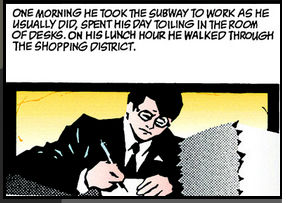
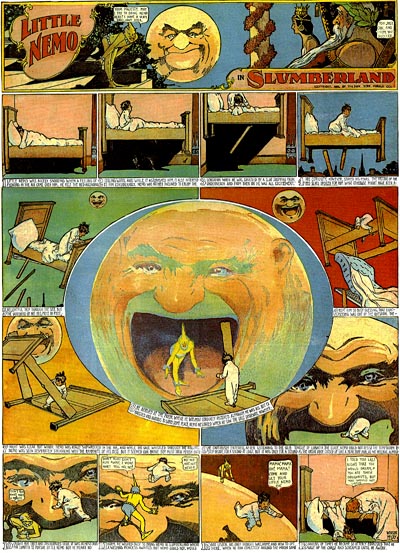
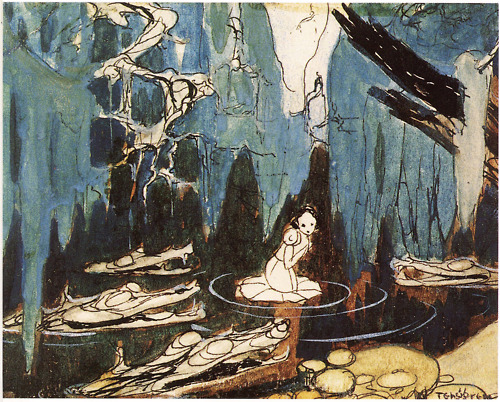
I could spend pages exploring the influence that James Dean had on others, but instead I will focus mostly on the influence that he had on me. It’s more personal that way. The work from others that I find most compelling is the personal sort, so I hope that you can forgive me for talking about myself in the context of a screen legend.

My intention is not to convince you that I am the next James Dean. I am in many ways very different. To state just one obvious distinction, I am still struggling to find my way in the world and to refine my abilities, whatever they may be, while James Dean is widely regarded to be among the finest actors of his generation.

Rather, my intention is to explore the universal appeal of James Dean by exploring his impact on me. The personal approach sometimes illuminates truths that would otherwise remain hidden, and that’s the goal here.

With that said, I have done some research, and I will discuss his films in detail, so even if you care very little about me, you might still learn something. Fair enough?

James Dean with cousin Markie – Dennis Stock, 1955. © Dennis Stock/Magnum Photos


James Dean was involved in a handful of TV productions, but he made only three films before he died. I will discuss all three, so I encourage you to watch them before proceeding. They are all masterpieces, arguably some of the best films ever made: East of EdenRebel Without a Cause, and Giant. Go ahead and watch Skyfall as well. I will discuss that one too.

Before going further, I should mention that this is my first substantial writing project after two incidents that crippled my creative capacities for days, and I’m still a little sore.

The first incident is the recent Newtown shooting. Why should I spend so much time writing something of limited appeal, when there is such evil in our midst, I wondered. I was working on this subject before the shooting, but after it happened I found myself wondering, “Can a celebrity from the 50s still be relevant in times like these?”

The best I can do for an answer is to say that it feels like I should still write and that I get something out of writing even if no one else does.

As it happens, James Dean was 24 years old when died, the same age as the shooter at Newtown. (Correction: the shooter at Newtown was actually 20 years old. An initial report I had read listed him as being 24.) One young man left only devastation in his wake. In stark contrast, James Dean left the world with thousands of admirers. Maybe there is something relevant about James Dean even in our troubled times, after all.

Guess who else is 24? That would Adele, singer of Skyfall.

James Dean with rifle in Fairmount – Dennis Stock, 1955. © Dennis Stock/Magnum Photos


The second incident in question is hard to describe succinctly, but let us just say that I spent years of my life pursuing a possibility close to my heart only to see it crumble and devolve into a situation where people I once admired and depended on to do the right thing went out of their way to hurt me with maliciousness. At the very least they were indifferent to the anguish they caused me.

It is not quite the same thing as losing a child in a horrific shooting, I know. The affected families are stronger than I am. I don’t think I could be gracious to others, in the way they have been, after my child had been shot. I admire their resilience, and I will keep them in my prayers.

Nor did I get shot off a train while plunging into a watery abyss as happens to James Bond at the start of Skyfall, but that’s sort of how it felt. My heartache is small in the grand scheme of things, but that doesn’t make it sting any less. Even so, I am back on my feet again. Bear with me:  My aim is still a little clumsy, but I’m doing the best I can.

James Dean with Dad in wartime uniform


To say that the James Dean films involve father issues is putting it mildly. Take out the drama with dad in East of Eden and Rebel Without A Cause and you have no story. I will even make the case that father issues are also part of Dean’s character in Giant, although that is less apparent.

It is almost as if Dean’s appearance in the popular TV sitcom Trouble with Father early in his career was meant to foreshadow the direction his career would later take. As I will point out later in this post,  that’s not the only time when James Dean’s work somehow foreshadows later events in his life. Sometimes reality is stranger than fiction.

Was it just shrewd branding on Dean’s part that drove him to pursue roles that involve daddy issues? Wes D. Gehring, one of Dean’s biographers, seems to think so. In his book Rebel With a Cause, Gehring quotes locals from Fairmount, Indiana, who describe James Dean as a happy-go-lucky kid. Gehring builds his case by referencing James Dean’s more calculating moments: he asked his agent whether dating someone would help his career, some of his friends observed him acting differently when around fans, and so on.


When James Dean was still alive, he was associated with authenticity, a sort of real-life extension of Holden Caulfield from  J.D. Salinger’s novel Catcher in the Rye (1951).  If James Dean was just another Hollywood phony though, then that would severely undercut much of what he represents, so let’s explore that possibility.

Hollywood phonies are everywhere, and complicit media companies expand their influence. This music video  from Evanscence is here to illustrate:


Since we’re on the subject, let’s talk a little bit about the celebrity reaction to the horrible Newtown tragedy. I was saddened when I heard about it, and I spent some time reflecting on what happened. What can we do better as a society? What can I do better? I had lots of thoughts, but scoring political points or insulting others not involved was the last thing on my mind. Not so for certain celebrities.

Here is the solution Kevin Williamson offered on Twitter: “We need gun control. Stop defending your right to bear arms. You’re stupid.” Got to say, that’s not the most persuasive thing I’ve ever read.

While I agree that having some nuanced laws about guns can be beneficial, Connecticut already has stringent gun control laws on the books, some of which the shooter broke.

Kevin Williamson happens to be the creator behind the massively profitable Scream franchise, a series so violent that it almost received an NC-17 rating. The Scream mask was a popular Halloween costume for years, and it gave a certain cultural cachet to dressing up as and pretending to be a serial killer.

Where do those crazy kids get all those crazy ideas? Since Kevin Williamson mentions an obsession with serial killers on his Twitter profile, perhaps he has some special insight on this.


But hey, the killers in Kevin’s films use knives, whereas the killer used a gun in Newtown. That is different.

I’m not saying that violent films cause violent crimes, but they can influence killers, just as anything can. Advertisements don’t cause you to buy things, but they do influence your buying habits. To argue that advertisements influence choices but films and music do not is just wishful thinking. Look at all the kids who imitate the styles and mannerisms of the celebrities on the big screen. Imitation doesn’t stop at style, folks.

Remember, the shooters at Columbine watched Natural Born Killers repeatedly before going on their killing spree. For whatever reason they chose not to prepare by watching Disney’s Pinocchio or Mozart’s Così fan tutte.

Back in the day, I did enjoy Dawson’s Creek, so I will give Kevin Williamson the benefit of the doubt, but perhaps more self reflection and less finger pointing is in order. I say that as someone who has done quite a bit of soul searching lately myself.

In regards to Dawson’s Creek, I’m curious if the name is a reference to Dawson High in Rebel Without a Cause. It would make sense. Dawson’s Creek brings to mind Rebel Without a Cause in the way it explores the struggles of suburban teenagers while striving for a sense of innocence.

Still from Rebel Without a Cause – 1955


And with that we are back to James Dean. As far as I can tell, James Dean never pulled a Kevin Williamson. The closest he came to that sort of thing was participating in a public safety video about driving carefully even though he had a tendency to speed, but he acknowledges his racing background in the spot. To urge caution is not quite the same as insulting others for believing in a core Constitutional right.

Anyway, I do understand Wes D. Gehring’s apprehension about James Dean. I’ve been fooled by celebrities on more than one occasion, but I don’t believe that James Dean was just another Hollywood phony.

While presenting his interpretation of Dean, Gehring downplays the fact that  James Dean lost his mother at the age of 9. When she died, James was sent to live with his aunt and uncle in Fairmount. That’s when his father Winton severed ties. While James would try to reach out to him over the years, Winton kept his distance.

Gehring acknowledges as much, but he treats it as a mere trifle. Yes, his mother died when James was young, and yes his father wanted nothing to do with him after she died, but look at how happy he was growing up in Indiana, Gehring argues.

James Dean, New York City –  Dennis Stock, 1955. © Dennis Stock/Magnum Photos

The photo was part of a photo essay Dennis Stock did for LIFE magazineAlong with Dean’s 3 films, Stock’s photos played a significant role in turning James Dean into the cultural icon that he’s become.


I don’t buy it. For one thing, Gehring is himself from Indiana, and he paints the state as a bucolic little place where it is basically impossible to be unhappy. Sounds like a great state to visit, but surely it is possible to be unhappy even in small-town Indiana, even without the neighbors noticing.

Most of the time when people are unhappy, they go out of their way to hide that information from others. If that weren’t true, think how easy it would be to predict divorce: “Oh Beatrice, thank you for the lovely Christmas card, but you look like you’re going to throw up when you’re standing next to your husband. Have you seen a doctor?”  Etc.

Nor is it not surprising that James Dean had a manipulative side. You could say that actors are in the manipulation business, after all. Ask me on a good day, and I might say that actors are in the business of telling the truth in imaginative ways, but that opinion is subject to change depending on the actors with whom I interact.

Show business is a very competitive business, and when your very survival seems threatened by powerful forces beyond your control, it becomes more challenging to always take the high road. Still, it is an oversimplification to reduce James Dean to a Machiavellian careerist.  Consider that James Dean did not attend the East of Eden premiere in New York, even though his absence greatly displeased Jack Warner, the studio mogul who could make or break his career.

James didn’t attend the East of Eden premiere, but some people still came. 


Some celebrities perk up when doing behind-the-scenes interviews. These moments are gifted to them by the very Muses that grace Mount Helicon, they believe. For after all, they are bestowed with the divine opportunity to talk about themselves and their dedication to their craft, both of which are glorious. James Dean is not like that in his interviews. He has this indifferent manner that comes across as something like, “I could care less about this. This is not what I want. Not really.”

That could be just an act, sure, but there are a few stories out there that suggest otherwise.

Leonard Rosenman, the composer for Rebel without a Cause, tells a revealing story about  how James would keep asking him to play basketball. Rosenman was not a sports guy, so the requests irritated him. One day he got angry and demanded to know why it was such a big deal to play basketball. Jimmy tried to explain by saying, “It’s like you want your father to play ball with you.” This made Rosenman angrier, and that was the breaking point of their friendship.

I can relate to that.

I was in college, studying film at Boston University. I had a hard time connecting with most of my professors, but one of my film professors made me feel like he wasn’t just doing a job; he seemed to care about us in general, and me in particular.

That professor wasn’t one of those bores who only talks about obscure and pretentious films. He also spent some time discussing the notion of a moral universe and how dramas reinforce or test that notion in various ways. I had not encountered anything quite like that before, and I was captivated.

As fate would have it, he was also who expanded my appreciation for Cameron Crowe’s films and my first professor to discuss how our relationships with our fathers can shape our lives in significant ways.

At the time, my relationship with my father was non-existent at best. If pressed to describe a key childhood memory with him, I would describe an empty office. Some guys talk about how disappointed they were when their dads could not make it to see them play a big game. I don’t remember my dad coming to see any of my games. Maybe he came to one when I was 11 or 12. I’m not sure.

It’s not that he was too busy or  travelling somewhere for work. He was at home, but he preferred to spend the weekend sleeping. That’s how he spent every weekend. Literally every weekend. The times we did interact were either confrontational or filled with superficial pleasantries.

I didn’t realize until years later that my dad was doing the best he could, that he treated me the way he did in large part because he never got over the unjust treatment his family inflicted upon him when he was younger.

Anyway, when my professor challenged us to consider our lives in context to our relationships with our fathers, I finally had some way to explain why my relationships with others tended to be distant or non existent. This gave me some hope, and as a result I came to see my professor as a kind of father figure.

When I asked him to read a screenplay I had written, I wasn’t really asking him to read it because he was well connected. I was asking him to take some interest in something I did, but at the time I could not admit that to him or even to myself.

That interaction went badly. It ended in an email where he told me that it would be best for both of us if we never spoke to each other again. He was half right about that: It was better for him, I think. Several months later I went to the Cannes Film Festival as student volunteer with Kodak. I drank so much that I ended up in the hospital. At the time I convinced myself I did that because it didn’t work out with a girl, but it was not about a girl. Not really.

James Dean doing his best Marlon Brando – Dennis Stock, 1955. © Dennis Stock/Magnum Photos


I haven’t read every James Dean book out there, but I read a few of them and watched a few documentaries. I couldn’t find a single one that provided a satisfactory explanation as to why Dean’s father Winton stayed away. The James Dean biopic with James Franco that I mentioned earlier made this the central dramatic question. Almost everything in the film matches exactly with the information I discovered about James Dean, but as far as I can tell, Winton’s explanation in the film is a fabrication. The film suggests  as much in the closing credits: “Most of this film was based on fact… some was an educated guess.”

Still, I was relieved to discover that not everyone shares Gehring’s skepticism about James Dean. Mark Rydell, the director of the James Dean biopic had this to say,  “The truth of the matter is that Jimmy was haunted throughout his life, his short life, by his need for a father.”  William Bast, Screenwriter and friend to James Dean, echoed that sentiment, “The roles he was getting were very much related to his actual life and to his psychological involvements.”

My take on Dean is that he became synonymous with authenticity because his work did not contradict the things he said or the way he lived his life and because he had the courage to expose his wounds in his work. He didn’t do that from the start of his career, but he grew into that capacity over time.

James Dean’s first taste of acclaim came when he performed A Madman’s Manuscript for the National Forensic League while he was still in school. No, contrary to what you might have heard he was NOT doing a speech from the popular AMC show about advertising men.


James Dean might have been ahead of his time, but he wasn’t that far ahead! His Madman monologue was instead taken from a segment in Chapter 11 of Charles Dickens’ The Pickwick Papers. He would go on to perform that monologue at the national level. There he lost on a technicality, but his interest in the performing arts had been cemented.

While Jimmy did not have the good fortune of being in Mad Men, his first appearance on television was for this Pepsi Cola commercial:


“Pepsi Cola hits the spot! More bounce to the ounce! More bounce to the ounce!” Oh right. I guess we should get on with it. Sorry about that. It is a catchy jiggle though, right? I think even Don Draper might approve.

Dean’s TV work hints of the greatness to come. His fluidity and dynamic range is apparent even in his early roles, and TV work gave him the experience to knock it out of the park when he would move on to film.

While none of Jame Dean’s work on television is considered masterpiece quality, he did get the chance to act alongside future President Ronald Reagan in ”The Dark, Dark Hour,” which he filmed after East of Eden. To be fair, television was still considered a new medium at the time. It would take another decade or two before TV would seriously compete with film for artistic laurels.

Since James Dean did share time with Reagan onscreen it seems appropriate that Dean’s one notable political comment is virilely  anti-Communist in nature: “I hate anything that limits progress or growth. I hate institutions that do this, a way of acting that limits [creativity, or], a way of thinking. I hope this doesn’t make me sound like a Communist. Communism is the most limiting factor of all today: if you really want to put the screws on yourself.”

That James Dean had a good head on his shoulders. Sorry comrades, James Dean was no spread-the-wealth occupier.


James Dean was just 23 years old when he made East of Eden, and that’s the film that first made him famous. Incidentally, Bob Dylan, a big James Dean fan, was 23 when he released “Subterranean Homesick Blues,” the first song that made him famous. (That’s the one with the notecards in the documentary Don’t Look Back.)

Here’s a fun fact: Don McLean’s song “American Pie” has a line in it that is widely interpreted as a reference to Bob Dylan’s enthusiasm for channeling Dean: ”The Jester sings for the king and queen in a coat he borrowed from James Dean.” Let’s take a look:

James Dean – Walking Down Street – Roy Schatt, 1954


The Freewheelin’ Bob Dylan – 1963


Can you spot the similarities? Remember this post is not just about James Dean, but about the influence he had on others, and I think it’s fair to say that Bob Dylan borrowed more than just a coat from James Dean. Writer George Perry went so far as to speculate that Bob Dylan was thinking of James Dean when he wrote “Forever Young.”

Although he was just 23 at the time, Dean delivered a powerful, gut wrenching performance in East of Eden, the film billed for good reason as “The Searing Classic of Paradise Lost.” Film critic Pauline Kael said of the film “a boy’s agonies should not be dwelt on so lovingly: being misunderstood may easily become the new and glamorous lyricism.”

The scene where Dean’s character Cal Trask falls apart when his father rejects the money Cal earned is one of the most powerful scenes ever put to film, and the power comes from the vulnerability that James brings.

James Dean’s big scene with Raymond Massey in East of Eden, 1955.


This was something new. Up until that time, leading men were the strong and stoic types like Humprey Bogart, the charming gentleman like Cary Grant, or the likable everyman like James Stewart. But the wounded young man who weeps uncontrollably when cut to the core? That was different.

Like James Dean, Marlon Brando came from the Actor’s Studio in New York, co-founded by East of Eden director Elia Kazan, but Brando’s interpretation of method acting was more volatile, more agressive. James Dean’s interpretation involves more vulnerability, but he still comes across as masculine, and that was what made his performance all the more astonishing.

While Dean’s Cal is called bad by the other characters, he is dressed in all white for most of the film. This is intentional. As Eli Kazan explains, “I wanted to show that a boy whom people thought was bad was really good.”

James Dean as Cal Trask in East of Eden, 1955. 


That is not to say that Dean is playing every scene with seeping emotion. Go back and watch the scene with him and Julie Harris in the meadow. Julie’s character Abra teases Cal about the other girls in his life, to which he responds with bemused nonchalance, but as Abra tells him about her own background his attitude changes somewhat. It isn’t until she declares that she doesn’t like her father’s new wife much because “she’s a woman” that James Dean has to move away.

Abra has just told Cal that she can relate to him because he cares more about winning the affection of his father than the affection of another girl, although he has never admitted as much. Now that he feels exposed, his playful swagger is gone. It’s a brilliant moment handled with subtlety.

There is also some interesting subtext in the film that is worth mentioning. Cal goes to a businessman Mr. Hamilton to borrow some money, and he ends up standing in front of locker 23 as he negotiates. Mr. Hamilton is taking a shower and then dries off. When Cal approaches, Mr. Hamilton says ”Don’t get so near me. I don’t want to get all hot again.” Mr. Hamilton is still in the process of getting dressed as he delivers that line. Hmm.

Even in that scene James Dean adds little physical flourishes, like rubbing his nose against the locker in a seemingly casual way that nicely complements the scene. It’s the kind of gesture that most actors wouldn’t bother with because it seems so trivial, but it is exactly right for the moment.

Later in the film, Cal’s mother wonders why Mr. Hamilton would go into business with Cal even though Cal doesn’t have much experience. “Maybe he likes you,” she says. Hmm.

Jo Van Fleet plays mom to James Dean in East of Eden.  Note how her hat makes her look kind of witchlike.


Abra’s speech at the end ties it all together: “It’s awful not to be loved. It’s the worth thing in the world. Don’t ask me how I know that. I just know it. Makes you mean and violent and cruel, and that’s the way Cal felt all his life. I know you didn’t mean it to be that way, but it’s true. You never gave him your love. You never asked him for his. You never asked him for one thing. You have to give him some sign that you love him, or else he’ll never be a man. He’ll just keep on feeling guilty and alone unless you release him. Please help him. I love Cal, Mr. Trask, and I want him to be whole and strong, and you’re the only one who can do it. Try. Please Try. ”

James Dean and Julie Harris – East of Eden, 1955


Abra (cadabra), the girl works her magic, and Mr. Trask does ask his son for something. The implication is that Cal will finally heal and become the man he was meant to be. Not every critic likes the ending, but I do. It gives the James Dean needed closure that he never quite found in his real life.

You know, there’s another film where the girl helps the guy become a man. In that one she’s removing a pink mask from his face. Which one is it again?  It’s Sky something … Sky Captain? Skydive? Skyfall? Wait, that’s the James Bond one.  Oh well.

Thanks to the fantasy that filmmaking allowed, James Dean had a brief sense of reconciliation with his father, albeit a fictional one.  When East of Eden finished shooting, James Dean was found crying.  ”It’s over,” he lamented.

Opening to Rebel Without a Cause.


In Rebel without a Cause, it is not just James Dean’s character, Jim Stark, who has father issues. It’s the central hangup for Judy (Natalie Wood) and Sal Mineo (Plato) as well.

When Judy goes to kiss her father, he slaps her away. We are meant to understand that is the reason why she bemoans, ”I’ll never get close to anyone.” Plato goes so far as to keep a photo of his dad in his locker. After school he rushes home, eagerly anticipating a letter from dad. When the letter finally arrives, it reveals the dad’s lack of interest, and Plato is heartbroken.

At the beginning of the film, Jim is in custody and his father tries to understand why. “Don’t I buy you everything you want,” he asks Jim, as if that should be enough to keep Jim out of trouble.

Later when Jim is in crisis, he goes to his dad looking for guidance, but his apron-wearing dad offers little of substance, reiterating his appeasing approach to parenting: “Did I ever stop you from anything,” he asks Jim. That’s not what Jim wants to hear.

Jim Backus plays dad to Jim – Rebel Without a Cause, 1955. 


When his overbearing mother returns, Jim pleads with his dad to defend him: ”Dad stand up for me.” Intimidated by mother, dad does nothing, and Jim leaves angry and determined to resolve things on his own.

Because his dad won’t stand up for him, Jim has to go and do something reckless to feel more like a man. Because she is scorned by her dad, Judy is cruel to Jim, even though he is trying to be nice to her. Jim has to prove his affection comes from strength before she lets her guard down.

Still from Rebel Without a Cause – 1955


In the end, it takes the death of Plato for Jim’s father to finally stand up for Jim. Only then does he tell his devastated son, “Jim, you can depend on me. Trust me. Whatever comes we’ll face it together” and “I’ll try to be as strong as you want me to be.” He helps Jim stand up, and they walk away together. Just like in East of Eden, the dad finally takes action to help his son become a man.

How refreshing to watch a film about teenagers that is actually interested in their inner lives. In contrast, today’s typical teenage films are all spectacle and sex: When will the hot girl strip? In Act I, Act II, or Act III? Which horny douchebag will get to bang her? Ah, progress! Right?

To quote the new James Bond film, “Sometimes the old ways are the best.” What else would you expect from a film that quotes from Shakespeare’s The Tempest?!

(Not all the contemporary teenage films are like that. In the Twilight series, the story is driven by relationship dynamics rather than stripper enthusiasm, which is why I defend the series in spite of the flack my guy friends give me.)

In Rebel Without a Cause Dean once again plays the vulnerable tough guy, and once again his outfit is symbolic. Dressed in red, white, and blue, James Dean is the all-American boy, the face of troubled teenagers in suburbia everywhere, and his performance is even more fluid than in East of Eden.


Watch how he goes from drunken confusion to tender concern as he covers the toy monkey at the beginning of the film. Watch how quickly he goes from tears to laughter and back as he spots Plato’s mismatched socks at the end of the film.

In the observatory scene before Plato gets shot, the three kids reimagine themselves as a happy family. Remember that song, “Jack and Diane” by John Mellencamp? When John does his best James Dean, he’s imitating James at the observatory.

Rebel’s screenwriter Stewart Stern explains that the observatory scene is meant to represent a kind of Neverland, where Jim and Judy become Peter and Wendy, and Plato assumes the part of the lost boy. It’s as if they have to escape the phony material-minded world of their parents to be able to envision a happy family.

Dylan does his best James Dean.


It is interesting though that the three kids reimagine themselves as a happy family, as opposed to bohemian revolutionaries living on a commune. That brings to mind something Natalie Wood said in an interview. She explained that James Dean was not entirely a rebel but that he also craved the kind of connection that comes with a traditional way of living. Composer Leonard Rosenman agreed: “Jimmy had actually a kind of conservative fantasy about what he wanted to do. He wanted tranquility, he wanted to create in some way, he wanted to be a kind of an intellectual.”

Observatory scene in Rebel Without a Cause, 1955. 


It seems that James Dean did some experimenting as far as relationships go, but he also appeared to be distraught when things did not work out with his girlfriend Pier Angeli. Her mother insisted that she marry a respectable Roman Catholic instead, and James Dean is reported to have revved his motorcycle loudly in protest when she and Vic Damone emerged from the church as newlyweds.

One more story about Rebel, and then we’ll look at Giant. Jim fights a guy because he calls him chicken and then agrees to take part in a dangerous race. Back to the Future fans will recall that was also what riled Marty McFly into racing, which caused an accident that ruined his future. Thanks to a warning from Doc, Marty goes back to 1955 in an effort to make things right. Notably, 1955 was the year that James Dean had his tragic accident, so it is a bittersweet tribute.

Why didn’t James Dean get a warning? Why didn’t Jimmy get a chance to change things? Actually, I think he did. We’ll get to that soon enough. Hang in there, numerology enthusiasts!

Giant was Dean’s last film.  This time, he plays the bad guy, Jett Rink. There he is below, covered in black oil, ready to stain the world with his impetuous disdain.

James Dean as Jett Rink in Giant, 1956.


The oil Jett discovers on his land makes him part of the nouveau riche, but Jett never learns manners, never overcomes his racism, and so he ends the film as he begins: alone. Early in the film, Director George Stevens introduces Jett in a few shots like the ones below.

This shot of a festive crowd is followed by…


this shot of Jett alone:


The last time we see James Dean is in a scene that looks like this:


This has been called Jett’s “Last Supper” scene, a haunting description since it would be the last time audiences would see James Dean in a film.  Filming for that scene concluded on September 10th, 1955. In less than a month, James Dean would be dead.

That shot does provide interesting contrast to Di Vinci’s painting, does it not?


When he is still a ranch hand working for the Benedicts, Jett sees the inherent racism and points it out to Leslie, played by 23-year-old Elizabeth Taylor. It is not that Jett is himself opposed to racism. He perpetuates racism when he becomes a wealthy tycoon. Rather, he is merely looking for a way to undermine Bick Benedict.

Toward the end of the film, Jett is trying to seduce Bick Benedict’s daughter, but the seduction is half-hearted. So much so that the girl has to ask if he is actually proposing. This is how James Dean is lit when he proposes:


That might be the most unromantic lighting for a wedding proposal ever captured on film. Jett seems to be more interested in marrying her because it would give him access to the Benedict family and not for any romantic reason. It’s his last attempt to undermine the Benedict family, a family that he could never really join.

In that way Jett Rink is like Mordred, the illegitimate son of King Arthur. As a reminder, Morded was the stain on Camelot, the result of Arthur’s incestuous relationship with his half sister, brought about by dark magic. Camelot had become a place where might fights for right, so Mordred could never be apart of it. Angered by his exclusion, Mordred vowed to destroy his father and the kingdom he built, but in so doing Mordred destroys himself in the process. That is Jett Rink to a T.

“Sir Mordred” – H. J. Ford, 1902


So even Giant involves a conflict with father, although it is not as explicit as in East of Eden and Rebel Without a Cause. But then we do see hints of the father-son conflict in the clashes of acting styles between classically trained Rock Hudson and method actor James Dean.

The father-son conflict was more apparent behind the scenes between James Dean and George Stevens. Before going to work on Giant, James Dean had only the highest praise for George Stevens: ”George Stevens, for my money, is the greatest director of them all – even greater than Kazan.”  (I agree with James that George Stevens is one of the greatest directors of all time.)

On set, it was a different story. James would throw tantrums and storm off set when he felt that George Stevens was taking too long to set up.  In the James Dean biopic with James Franco, there is speculation that the tension arose because George Stevens somehow reminded James Dean of his own father. That seems plausible.

Jame Dean’s last day on Giant was September 23, 1955. Here’s where it gets interesting. Two credible sources claimed to have warned him about driving his new Porsche 550 Spyder on that day.  


James Dean at Mobile Station, Sherman Oaks on the day of the accident. photo by Rolf Wutherich, 1955


Here’s what George Stevens claims he told James Dean that day: “‘You can never drive this car on the lot again; You’re gonna kill a carpenter or an actor or somebody.’ And that was the last time I saw Jimmy.”

And then there is that quote from Alec Guinness, mentioned in his autobiography, Blessings in Disguise. Keep in mind this autobiography was published in 1985, long after Guinness had achieved critical acclaim as an actor, so he had very little incentive to fabricate something like this.

When James Dean showed Alec Guinness his new sports car, here’s what Alec Guinness said: “‘Please, never get in it.’ I looked at my watch. ‘It is now ten o’clock, Friday the 23rd of September, 1955. If you get in that car you will be found dead in it by this time next week.’” 

One week later, James Dean died in a car crash. Why didn’t you listen to Obi-Wan Kenobi, James? Why?


According to those who knew him, Alec Guinness was not inclined to give such pronouncements. A few months later, Alec Guinness was formally received into the Roman Catholic Church. He does not strike me as a dishonest man, but how strange the James Dean story becomes if Alec Guinness told the truth. 

The guy who hit James Dean was Donald Turnupseed, an ex-sailor. At the time Donald Turnupseed was 23 years old.

Have you started to notice how often the number 23 appears in the James Dean story? It showed up enough that I revisited the Jim Carrey’s film The Number 23, a film The New York Times dubbed Carrey’s “accidental comedy.” That’s what I do for you, ladies and gentlemen. I will watch even an accidental comedy to bring you the insights that you’ve come to expect on the nsavides blog!

The Number 23  is only so so as a film, but it draws attention to the enigma of the number 23 that predates the film, and that is more interesting than the film itself.

Before exploring the significance of the number 23, here’s a quick overview of numerology: Ancient cultures believed that numbers have certain mystical associations, sort of like how astrologers look to the stars for clues about destiny. Pythagoras, known to geometry students today for his Pythagorean theorem, believed in numerology. Even Biblical scholars note the recurring appearance of certain numbers throughout the scriptures. Darren Aronofsky’s film Pi explores that tradition in more detail.

Still from Pi – 1998


If we grant that there is indeed a Creator, or even a guiding force like karma that orders the universe, then it does not seem to be such a leap to consider the possibility that certain patterns might be woven into the fabric of it all.

In regards to the number 23, it is the first prime number that contains two consecutive prime numbers, and it has a way of showing up in the course of human events: Each parent contributes 23 chromosomes to a new child, Julius Caesar was stabbed 23 times, William Shakespeare was born and died on April 23rd, The Titanic sank on April 15th, 1912 (4+1+5+ 1+9+1+2),  and the Hiroshima bomb was dropped at 8:15 AM (8+15 = 23). September 11, 2001 also adds up (9 + 11 + 2 + 0 + 0+ 1) as does the Apollo 13 launch on 4/11/70 (4+1+1+1+9+7+0), and Apollo 13 was the 23rd American manned space mission.

\\

Some basketball guy seemed to favor the number 23 as well.


Superstruct, the massively multiplayer forecasting game created by the Institue of the Future, predicted that human kind would be extinct in 23 years, and yes the number 23 does show up once or twice in the TV show Lost.

Mathematician John Nash, the man profiled in Ron Howard’s film, A Beautiful Mind, was obsessed with number 23, as was author William Burroughs. The Number 23 was the 23rd film directed by Joel Schumacher, and Jim Carrey believed in the number enough to name his production company JC23 after it.

James Carrey does his best James Dean.


Notable Bible passages involving the number 23:

Numbers 23: 23 Surely there is no enchantment against Jacob, neither is there any divination against Israel: according to this time it shall be said of Jacob and of Israel, What hath God wrought! 

Numbers 32: 23  But if ye will not do so, behold, ye have sinned against the Lord: and be sure your sin will find you out.

And of course, there is Psalms 23, a favorite Psalm to people of faith going through difficult times or facing the “valley of the shadow of death.”

Here are a few more notable instances of the number 23 in the James Dean story:

Winton Dean was 23 years old when he met Marion, the gal who would become James Dean’s mother. She died when Dean was 9 at 422 23rd St. Santa Monica, CA.

James Dean was born at the Seven Gables apartment house, 320 East 4th St. in Marion, Indiana. An inverted number still counts to those initiated in the 23 enigma.

In the James Dean 2001 biopic, James sends a package to his father at 815 6th St., Santa Monica, CA (8+15 = 23). A few sources I referenced suggest that Winton’s address was actually 814-B 6th St. It is possible that the film got this detail wrong. Winton’s predecessors did move to Indiana back in 1815, so perhaps the address got mixed up with the family history.

James Dean talking with Ed Kretz at Palm Springs, March 26, 1955. photograph by Gus Vignolle


On Sept. 23rd, 1952, exactly three years before the warning from Alec Guinness, James Dean meets Maila “Vampira” Nurmi, the actresses who played the undead host on The Vampira Show and Plan 9 from Outer Space.

On March 23rd, 1955 James Dean shot his screen test for Rebel Without a Cause with Natalie Wood and Sal Mineo, the only film in which James Dean almost dies in a car crash.

On the day he died, James Dean had just finished shooting Giant and was driving to a race in Salinas, which is where East of Eden was set, so his life ended while travelling to the place where his superstar status began. It gives his career an eerie circular quality. The eeriness doesn’t end there.

James by a tombstone of his ancestor.  - Dennis Stock, 1955. © Dennis Stock/Magnum Photos

Note that Cal, the first name on the tombstone, was also the first name of Jame Dean’s character in East of Eden.


The two actors that James Dean most admired were Marlon Brando and Montgomery Clift. In his first film, East of Eden, James got to work with Elia Kazan, the director who turned Brando into a star and directed him to an Oscar award for On the Waterfront. In his last film, Giant, James got to work with George Stevens, the director who turned Montgomery Clift into a star and directed him to an Oscar nomination for A Place in the Sun.

James Dean looks a little nervous when his idol Marlon Brando visits ‘East of Eden’ set. 


Remember that public service announcement about driving carefully that I mentioned earlier? James Dean shot it while working on Giant, the last film he made before he died:


At the end of the PSA says the words that will forever haunt his story: “Take it easy drivin’… the life you might save might be mine.”

Dennis Stock the photographer responsible for the famous James Dean New York photo was supposed to ride with James to Salinas, but he changed his mind at the last moment.

Incidentally, Dennis Stock also took this photo of James Dean while doing the photo essay for LIFE magazine:

Dennis Stock, 1955. © Dennis Stock/Magnum Photos


Dennis strongly objected to doing photos of James Dean in a coffin, but James suggested it. Initially James was clowning around in the coffin, but then he grew serious, and that’s when the photo was taken. Here’s what Dennis had to say about it:

“Everything had gone out of Jimmy by then, all the showmanship, all the cuteness. There was nothing there other than a lost person who really doesn’t quite understand why he is doing what he is doing. That’s not a moment to underestimate.” James Dean would be dead in less than 8 months from when that photo was taken.

With all of these coincidences, it is almost as if the story had been scripted by Warner Brothers, the studio that made all three of the James Dean films, but that is unlikely. The studio limited its promotional efforts in response to the tragedy. Studio head Jack Warner was concerned that the accident would hurt the box office:  ”Nobody will come and see a corpse,” he worried.

Again, two reputable sources claimed to have warned James right before the accident. If an accomplished director like George Stevens and an up-and-coming actor like Alec Guinness both warned you on the same day not to do something, wouldn’t that at least give you pause?

There is evidence to suggest that James Dean even believed in the power of intuition. He once said this to his girlfriend Liz Sheridan about a part for which he auditioned: “I have the strangest feeling. I can’t explain it, but I know I am gonna get it. It’s the strangest feeling I ever had about a job.” He found out later that he did in fact get the part in the play See the Jaguar.

Why didn’t you listen to Alec Guinness, James? Why?

It’s not like the race in Salinas was so important that he couldn’t afford to miss it, but there was something about racing that James could not resist. Before Giant, James Dean had a part in the TV series Crossroads, and once again that seems appropriate.

I believe that James had come to a figurative crossroad in his life, in addition to the literal crossroad where the accident happened. I believe that if James had listened to the warnings, had stepped away from racing for a bit, had stopped running from whatever it was that he was trying to escape, then maybe, just maybe, his life would have taken a different turn.

I can’t prove that, I know, but I can point out all the notable coincidences that surround his death.

Photo copyright John Edgar/Edgar Motorsports,  Santa Barbara, May 27, 1955


At one point in his life James Dean did confess that, “racing is the only time I feel whole.”  I doubt James would have said that if he wasn’t running from something.

When you’re driving fast you don’t have the luxury of thinking about the things that bother you. You have barely enough time to react to the road ahead.

I can relate to that.

When I was in high school, I accidentally flipped my car into oncoming traffic because I wanted to see how fast I could take a curve. I didn’t know how to get close to people so I would compensate with sensations, and going fast is quite the sensation. It was a mostly empty road, but I missed hitting an oncoming car by a few seconds. For whatever reason, no one got hurt; the car flipped back on to the right side of the road and then slid into a ditch.

These days I try to be a little more cautious, a little more considerate of others, but it is not so easy when my heart is breaking. In case you’re wondering though, I decided I would not drink for the next two months as a preventative measure. That happened after I saw the Denzel Washington film Flight, so that’s one example of when watching a film influenced someone, in this case me, to do something sort of positive.

It’s never been particularly easy for me to get things right, but I am trying.

James Dean plays the congo on the farm. – Dennis Stock, 1955. © Dennis Stock/Magnum Photos


As my detractors will surely point out, I am no James Dean. I don’t want to be. I’m not going to take up smoking, start playing the congo drums, or buy a motorcycle so that I can better imitate him. At best, I could only ever be a second-rate James Dean. I’d rather be a first-rate Nick Savides, but while I’m figuring out how to get there, I don’t see the harm in looking to James Dean for inspiration.

I do connect with him in some ways, in his need to get close to a father figure, in his propensity for speed. James Dean wrote in his journal,”Who am I? I don’t want to be alone. I don’t want to be different. I need people, but I keep pushing them away.” I get that too.

From the “Torn Sweater” series – Roy Schatt, 1954


The Little Prince was one of James Dean’s favorite books. Reading it made him cry. I love that he would give such significance to something that others would dismis as a mere children’s book. When I was a kid, my uncle gave me his copy as a present. It took me a few years to really appreciate it. Now it would be one of the things in my room that I’d grab if my apartment was on fire.

My copy of ‘The Little Prince’


The thing I most admire about James Dean is his generosity in sharing his deepest wounds. By revealing his loneliness, he helps us to feel less alone. By revealing the pain from his absent father, he helps us realize our own need for a father’s affection. His films prod us toward reconnecting with our fathers, if they are still alive, and challenge us to be better fathers, if we have kids.

For most of my life, I was the exact opposite of James Dean: I would do everything possible to avoid showing others how I really felt. It took me so long to get to the point where I could live with an open heart, but then things fell apart, and now it feels like I’m back at square one.

It is possible that if I stay angry about what happened, then the bruises will fester into something ugly. There’s nothing unique there. Everyone faces difficult things, some of us face more difficult things than others. James Dean lost his mom and, for all intents and purposes, his dad at a young age. That could have crippled him as a person if he allowed it to do so, but instead it transformed him into an icon.

The mad islander in Skyfall, played with relish by Javier Bardem, is a testament to what can happen to someone consumed by the hurts of the past. From a distance, mad islander types might look alluring, but get up close and personal and you’ll see a monster, rotting from the inside.

My dad never learned how to get past the wounds that his family inflicted on him when he was a young man. He didn’t become a monster in the mad-islander sense, but he couldn’t be the dad I needed him to be, and that made growing up a little harder.

I don’t know if James Dean ever got over the wounds of the past. I never meet him, and there is only so much I can conclude from a distance. He was courageous enough to face his hurts in his work, but maybe he couldn’t do that in person. James Dean was, after all, known for being difficult on some sets and was nicknamed “the little bastard” by a few of his co-workers. He had that painted on his Porsche, so he wasn’t entirely opposed to the nickname.

James Dean died while driving his “Little Bastard” Porsche. © Sanford Roth/Seita Ohnishi


Back in December 2010, I wrote a positive piece on Cameron Crowe, but I recently read Kicking & Dreaming, a book about the band Heart that was co-written by Cameron’s ex-wife Nancy Wilson. It now seems possible that I was very wrong about Cameron Crowe. In the book, Nancy describes Cameron as someone who was romantic only when they first met and who became detached and more preoccupied with work over time.

As their marriage dissolved, Nancy reveals that she grew more cynical about love: Their marriage ended as anything but a Cameron Crowe film, she confesses. For those keeping score, Kicking & Dreaming was published on Sept 18, 2012  (9 + 1+ 8 + 2 + 0 + 0 + 1 + 2 = 23).

To be fair, an ex-wife is not the most impartial of commentators. Then again, I’ve tried to get in touch with Cameron Crowe for over a year, and from my perspective, he did not treat me in a particularly considerate manner. That’s disappointing, considering how important treating others with consideration is in his films.

In spite of all that, I don’t get a sense that Cameron Crowe is a bad guy. Maybe there is a good explanation, so I will reach out to him to see if I got it wrong or if he wants to set the record straight. I am still a fan, albeit it a more skeptical one.

My point is that someone’s body of work and public persona do not necessarily equate to a person’s character. Maybe James Dean was a good guy. Maybe he wasn’t. I never had the chance to get close enough to find out the truth. That’s why I said that I sort of want to be like him in the title.

I am less ambivalent about wanting to be more like the friends and family who have revealed themselves to be people of character when I see them up close.

Much of what I’ve learned about what it means to be a good man, I’ve learned by watching my uncle, the one who gave me his copy of The Little Prince. (At one point, I proposed doing a blog post about him, but he wasn’t keen on the idea.) I want to be more like him, definitely.

Celebrities are captivating, and occasionally they can make our lives better by sharing their gifts and talents, but they don’t have all the answers either, and they don’t care about us in the way that friends and family can, but it can be hard to remember that when they look so shiny and larger-than-life from a distance.

Still, this post was mostly about James Dean, so let’s say goodbye to him by remembering him at his best: “I’m trying to find the courage to be tender in my life. I know that violent people are weak people. Only the gentle are ever really strong.” With that quote, James Dean brings to mind King David, the original poet warrior who understood, as James Dean did, that the mighty ones are actually those who can approach the giants without armor, even if that means being susceptible to pain, be it physical or emotional.

James Dean with cousin Markie – Dennis Stock, 1955. © Dennis Stock/Magnum Photos


We can guard ourselves against pain, and live empty, guarded lives. Or we can embrace life in an open-hearted way, even though there is a real chance that something will come along and knock us down. It might take me a while to live in a truly openhearted way again, but I still opt for the second option.

James Bond has the supernatural ability to get back up and keep fighting even after falling from the sky into a watery tomb. The rest of us need some help in getting back up after life knocks us down. Fortunately there is help to be had, if we look for it in the right place.

While taking in some of the coverage from Newtown, I came across Craig Scott. He’s the brother of Rachel Scott, the first girl who got shot in the Columbine massacre. She’s the one who got shot because she acknowledged her faith in God.

If anyone has an excuse for letting the wounds of the past turn him into a monster, it is Craig Scott. Hateful kids, whom he had never harmed, robbed him of his sister and his friends. Had some punks done that to my sister, I don’t know that I could escape a life hell-bent on vengeance. Craig Scott has instead dedicated his life to reaching out  to schools throughout the country, so that he can spread his sister’s belief that a little kindness can go a long way. Everything about his life backs up his outreach. How’s that for authenticity?

Here Craig Scott talks about the Newtown tragedy, how he prevented another school shooting through Rachel’s Challenge, and how our society can counteract such evil.

In this video posted on Aug 23, 2009, Craig Scott reflects on the 10-year anniversary of Columbine:


Learn more about Rachel’s Challenge by visiting the link below:

http://www.rachelschallenge.org/big-picture/about-rachels-challenge


Columbine could have turned him into a monster, but for some inexplicable reason Craig Scott walked through the valley of the shadow of death and emerged as the man who saves lives.

To paraphrase James Bond, “everybody needs a hobby, and Craig Scott’s hobby is resurrection” but Craig doesn’t claim to do it on his own. It is his faith that Craig Scott credits for helping him stand tall even at skyfall.

It was faith too that helped King David write the 23rd Psalm. And so today we can say, “Fear not: for, behold, I bring you good tidings of great joy, which shall be to all people. For unto you is born this day in the city of David a Savior, which is Christ the Lord.”

It takes me a little longer to write the kinds of posts I prefer to write, and sometimes my schedule gets complicated, so I can’t promise to have new posts available on a consistent schedule. That’s why I encourage you to sign up by email. You can do that by clicking here.

If you’re following along by  email, you’ll know right away when I have a new post waiting for you.  It is very easy to unsubscribe, and you won’t receive anything unrelated to my blog.

Lastly, if you appreciate my writing, why not write a comment or share the post with a friend? It would encourage me to keep sharing some of my heart with you.

Merry Christmas everyone, and God bless.


Giving thanks to Artists and Organizations

So many artists and organizations are out there doing interesting things, but it takes more than a cursory glance at their work to appreciate fully what they have to contribute. In today’s busy world, not everyone has time to do that on their own, and thus many artists and innovators go unappreciated. Fortunately for you, noble reader, the nsavides blog is here to help.

Below are links to a few of the artists and organizations I’ve profiled on the nsavides blog, arranged from newest to oldest. I hope you’ll find something of interest, someone for whom you can give thanks. On that note, I wish you and your loved ones a warm and festive Thanksgiving. Cheers!


1. Martin Scorsese

The iconic NY director is known for his gangster films, but he also has a spiritual side that you might have missed: http://blog.nsavides.com/2012/11/02/scorsese-new-yorker-cinemas-dostoyevsky

BREAK

2. Zappos

This online shoe company has developed a legendary service reputation. Here’s what happened when I decided to find out for myself if their service lives up to the hype:

http://blog.nsavides.com/2012/06/06/zappos-happiness-in-a-hopeless-place-a-love-story

BREAK

3. John Ford

The man who turned the Western into a well respected art form around the world was also a great American. Here’s why: http://blog.nsavides.com/2012/03/04/john-ford-tough-guy-filmmaker-american

BREAK

4. Will Eisner

The godfather of today’s graphic novels showed us that comic books can be more than children’s books: http://blog.nsavides.com/2011/12/01/will-eisner-graphic-novel-godfather-dreamer

BREAK

5. J.K. Rowling

Why the Harry Potter series is better and has more depth than “adult” novels from critically acclaimed writers like Philip Roth: http://blog.nsavides.com/2011/10/29/spooky-goodness-of-harry-potter

BREAK

6. George Stevens

This director of classic films like Swing Time, Shane, Giant, A Place in the Sun, and The Greatest Story Ever Told is not widely considered to be one of the world’s greatest directors. Here’s why he should be:

http://blog.nsavides.com/2011/05/03/the-fight-to-canonize-director-george-stevens

BREAK

7. Cameron Crowe
This esteemed director behind films like Say Anything, Almost Famous, and Jerry Maguire makes being optimistic look cool again: http://blog.nsavides.com/2010/12/23/rock__roll_warrior_for_optimism

BREAK

8.  Small Giants

In this seminal business book, Inc. editor Bo Burlingham makes the case that successful businesses can also be soulful and considerate: http://blog.nsavides.com/2010/07/06/small-giants

BREAK

9. Pixar

Pixar is the only movie studio in the United States that has a 100% track record of producing hits. This might have something to do with it:

http://blog.nsavides.com/2010/04/11/an-ode-to-the-super-genius-of-pixar

BREAK

10. Target

The company shows us how to have good taste without being snobby about it: http://blog.nsavides.com/2008/11/08/why-target-doesnt-feel-corporate

Scorsese: New Yorker, Cinema’s Dostoyevsky

There is a scene in Martin Scorsese’s film Gangs of New York where Leonardo DiCaprio, who plays Amsterdam Vallon, is running from John C. Reilly.  This is appropriate, since Reilly’s character Jack Mulraney aims to kill.

Amsterdam approaches Jack from behind and attacks. After a violent struggle, Amsterdam strangles the man to death. During the scuffle they knock down a few wooden supports, causing a work canvas to fall. After the dust settles we realize that we are in a church.

That’s a Martin Scorsese picture in a nutshell: Front and center is a violent, gritty struggle for survival, but watch closely and you can’t help but notice the underlying religious elements. It makes sense coming from a guy who once said, “My whole life has been movies and religion. That’s it. Nothing else.” And you thought you knew Martin Scorsese. So did I.

Photo of young Martin Scorsese


Scorsese is an iconic filmmaker who transformed the cinematic landscape. No self-respecting film critic or semi-literate filmmaker will deny his influence.  For good or for ill, he paved the way for shows like The Sopranos and filmmakers like David Fincher and Quentin Tarantino.

As readers of my blog should know, I’m not the world’s biggest Tarantino fan. He does some interesting things, but his films consistently get higher ratings from filmgoing hipsters than classic, more substantial films, and that annoys me. You can see what I mean by visiting this Top 250 films list as rated by IMDB voters: http://www.imdb.com/chart/top. Needless to say, the chance to explore a key cinematic predecessor of Tarantino was not reason enough for me to write this.

Scorsese doesn’t quite get the Tarantino treatment from filmschool scene kids, but he comes close. Movie posters of films like Goodfellas, Taxi Driver, and Casino still seem to be fairly well represented in college dorm rooms across the country. That usually suggests to me an oversaturated influence. Nothing wrong with that, but why write about it?

After all, who would argue that Scorsese isn’t a great filmmaker? Plus, I’m not someone who is wowed by graphic violence, but there is more to Scorsese than the way he uses violence.

I started to realize as much when I saw his name appear on commentaries for classic films like Red Shoes and The Tales of Hoffman, both of which are dream-like meditations on art, beauty, and love. They are excellent films, but they’re not the ones you’d expect to excite a master of the gangster-film genre.

Tales of Hoffman – 1951


Then I remembered that Scorsese also made Kundun, a film that surprised me with its Eastern sensibilities. That must have been quite an undertaking for a decidedly Western filmmaker. Scorsese himself acknowledges as much when interviewed by Richard Schickel, “It is antithetical to what we know as Western drama, but does everything have to be Western drama?”

Later I came across interviews where Scorsese would make knowing, appreciative comments about opera. So, the “you talkin to me” street-smart filmmaker is an opera enthusiast? Who would have guessed that?

Then along came Hugo, and that film swept me off my feet in a way that few other films have. Add to that Scorsese’s endorsement of the Canon C300 and his recurring interest in New York—I work for Canon, and I was born in New York—and it felt like he was someone I had to write about.

Scorsese on Canon’s Cinema EOS line


When I say that I had to write about him, I don’t mean that I merely wanted to write about him. I mean that I couldn’t resist the inclination to write this even if I wanted to.

I did resist for a while. I had seen many of Scorsese’s films already, and the idea of seeing them again was not that appealing. I respect the craftsmanship that goes into Marty’s pictures, and many of them are masterpieces, but that doesn’t mean I enjoy watching them all.

His films tend to be long, filled with unsympathetic characters, and prone to end in anti-climactic, even unresolved ways. Besides, I don’t take much delight in seeing people pummeled onscreen, especially when women are the ones being beaten.

Raging Bull -1980


In a Scorsese picture, it is almost guaranteed that someone, often a woman, will get a beating, and the violence isn’t choreographed in the whimsical manner of a classic Hollywood barfight. It is staged to look as gritty and realistic as possible.

As if it isn’t shocking enough when just an ordinary woman gets beaten, in Raging Bull  the woman who gets a beating is pregnant. Everyone gets a beating in that film, whether they deserve it or not, and at a certain point that violence does become exhausting to watch.

Nor am I thrilled by incessant swearing, and there are copious amounts of it in Scorsese’s work. Swearing has its place as I discuss here, but its incessant use in films has coarsened our culture. Even when I go to the mall these days, I hear some kid swear at his mom or at his friends. It wasn’t always like that, and filmmakers like Scorsese have helped to suburbanize casual swearing.

It’s not that I’m a complete prude. I enjoy watching The Godfather, for example. The violence in that film is carefully balanced with a sense of family and tradition. We first see Michael Corleone as a likable youth with a moral center, which gives his descent into the mafia a tragic, operatic quality. In a Scorsese picture though, it’s not unusual to enter an entirely unsympathetic world right from the start, making the decay more dissonant.

Mean Streets – 1973


In my resistance to writing this, I reasoned that it is already a challenge for me to stay on my feet without letting negative circumstances get the best of me. Why make it harder with a steady diet of cinematic carbon monoxide, exquisitely prepared though it might be? Still, it felt like there was a reason to proceed and that there was something about Scorsese I needed to discover, so I immersed myself into his films, even though I was fairly certain that watching Scorsese’s films back to back would negatively affect me.

Sure enough, I was more prone to angry outbursts and more likely to succumb to lust shortly after watching some of his pictures. That was enough of an issue that I tried to avoid his more violent films on days when I had important meetings planned. I also resorted to balancing his films with more positive ones, so that the darker things in Scorsese’s films would not overwhelm my psyche.

That mentality is not the norm when discussing films, so allow me a moment to expand on it. As a society, we readily accept the idea that we should be mindful about what we eat, especially before strenuous physical activity like a marathon, and in Super Size Me, Morgan Spurlock showed us the deleterious effects of bombarding our bodies with fast food on a daily basis. Why then are we not also mindful of the media that we consume, when it can significantly influence how we live our lives?

Taxi Driver – 1976


That’s not to say that Scorsese’s films should be avoided at all costs, only that it is best to proceed with caution. In order to discuss these ideas more thoroughly we’ll need to broach the topic of censorship and whether an artist should aim merely to satisfy himself or to also serve his community.

I will address these challenging topics later in this article, but before I do that I’d like to categorize Scorsese’s work in a more precise manner. Up to this point I’ve been discussing his work in a general way while alluding to Marty’s more violent pictures. That’s not the only kind of film he makes though.

Scorsese on set for The Aviator – 2004


This is an oversimplification, but for the sake of our discussion I’ve broken his films into 4 main categories: violent struggle for survival, music appreciation, film appreciation, and search for spiritual meaning. His films usually don’t fit neatly into one category but overlap in several. Still, it’s a good starting point.

Most of this post will be focused on Scorsese’s violent films since that is what he is best known for, but I will address each category at least briefly. The categories do represent a unique aspect of Scorsese that is important to acknowledge when trying to get a fully fleshed out overview of his work.

First, the violent films. Cape Fear, Casino, The Departed, Gangs of New York, Goodfellas, Mean Streets, Raging Bull, and Taxi Driver obviously fit here, but so too does a character drama like Alice Doesn’t Live Here Anymore. In that the violence is mostly verbal, but there are still a few pushing matches, and anxiety about survival is ever present.

Alice Doesn’t Live Here Anymore - 1974


The characters in these violent films are vicious  and lacking in manners. The men gallantly spit ethnic slurs at opponents, abuse the less powerful and treat women like objects for their gratification.

The women aren’t much more admirable. They tend to be treacherous, status-minded, and inclined to sleep around to get what they want, specifically material comforts or power.  Maybe there’s a reason no one ever called a Scorsese picture a showcase of sugar and spice and everything nice.

No, It’s not a particularly admirable world that Scorsese conveys in those films, but it does have an aura of authenticity. That’s the New York school of storytelling on display, and Scorsese is Mr. New York.

Most of his films—even his period films like Gangs of New York and Age of Innocence—are set in New York. He was born there in 1942 and lived there most of his life. That’s also where he witnessed firsthand the ugly, unglamorous nature of mafia violence. The New York Film Festival influenced him as a child and advanced his career by supporting his films. And you know that classic Sinatra song, “New York, New York”? It actually originated in Scorsese’s film of the same title.  (Appropriate that Scorsese is the one who’ll be helming the upcoming Sinatra film, right?)

The title song from New York, New York – 1977


OK. So Scorsese is connected in many ways to New York, but what do I mean by the New York school of storytelling, and how is that different from the Hollywood style? I’ll elaborate with this aphorism I heard a while ago: When a New Yorker frowns and hits you with an f-bomb, he really means hello. When a Hollywood type smiles and say hello, he really means “f@#$ you.”

I was going to use the actual swear words, both above and throughout this piece, to make a point and to convey my antipathy toward Hollywood hipsters, but I thought better of it.  Truth be told, I felt like my initial, more caustic tone was not coming from a good place but from my anger at perceived slights from Hollywood types.

My conscience was bothering me about it, so I promised God that this story would be free of swear words if the Giants prevailed against the loathsome division rivals that are the Cowboys. The Giants won, so there won’t be any actual swear words in this post, much as that might disappoint Mr. Scorsese. To quote a Budweiser commercial, “it’s only weird if it doesn’t work.”

Anyway.

Said differently, the New Yorkers tend to deal with what is, with the grimy reality at the hand. That sensibility can be traced back to the New York artists who brought about the Ashcan School movement in the early 1900s, although you could make the case that the New York sensibility predates even that.

Stag at Sharkeys – George Wesley Bellows, 1909


In contrast, the Hollywood types tend to deal with what could be. They are more likely to offer happy endings, to toss around ideals like love, and peace, and diversity. In my experience though, the Hollywood types don’t have the fortitude to back up their ideals with meaningful action. They are just as power-minded and conniving, perhaps more so, than their New York counterparts, but they lack the honesty to admit as much.

Let me give you an example. Say you’re a Hollywood type who believes in diversity. Tell me more about how you’re open to dealing with people from both sides of the political spectrum. Also, were you amused when they put a decapitated George W. Bush head in Game of Thrones, even though it had nothing to do with the medieval fantasy world of Westeros?

Those are the tactics of thugs. If you can’t admit as much, then don’t ask me to come and sing Kumbaya by the campfire.

Over time I’ve moved closer to the New Yorker sensibilities. I can’t imagine that I would be heartbroken if I got a closer look at the Mad Men team and realized that they were actually self-serving, power-minded pigs. That’s an oversimplification of their superlative New York show, but it’ll do for now. My point is that if showrunner Matthew Weiner and company are even the slightest bit more virtuous than the characters on their show, then I would be pleasantly surprised.

The Hollywood types, on the other hand, seem to offer up high-minded, box-office pleasing ideals that they refuse to embrace when the cameras stop rolling. That is heartbreaking to discover.

I’m generalizing, based on my limited observations. If you’re a Hollywood type, you can prove me wrong or man up and be direct when you confront me. This is one of those rare times when I would be very happy to be proven very wrong.

I used to be more fond of the Hollywood types. Frank Capra, Walt Disney, and George Lucas are of the Hollywood school, and they were the ones who got me interested in filmmaking. If my path had crossed with those guys, maybe I’d feel differently. Hard to say.

To tie it back to Scorsese, the opening credit sequence of Mad Men does have some similarities to Scorsese’s Casino, does it not?

Mad Men – 2007

Casino opening-credits - 1995


Let’s talk about those credits in Casino.  All that fire, all that red, right after DeNiro’s car blows up, it’s almost as if it is meant to convey something, like say … hell. Casino is not the only film where a wash of red tints the guilty. It also happens in Mean Streets, Goodfellas, Taxi Driver, Color of Money, The Departed, Gangs of New York, and New York, New York just to name a few.

In New York, New York there is an interesting variation of this motif. DeNiro’s character is acting badly, so naturally he’s in a red room. Then he is escorted out through this corridor:

New York, New York – 1977


Right after that the film dissolves right to a billboard of a … and it’s right on the … Well, I’m not telling. You have to look it up for yourself and draw your own conclussions, but when I saw it I thought, “well what are you trying to say there, Mr. Scorsese? Naughty, naughty!”

In Bringing out the Dead, the significance of the color red is the most conspicuous. People on the streets are dying from a potent drug mix called Red Death. Nic Cage visits one of the drug dealers and the walls of the dealer’s apartment are covered in red paint. Oh and there’s that movie poster:

Bringing out the Dead – 1999


More so than any other filmmaker who comes to mind, Scorsese excels at revealing what hell on earth looks like, and he does it in a very deliberate manner.

In Mean Streets, Harvey Keitel’s character Charlie muses to himself, to us, or to God, ”It’s all bulls#!% except the pain. The pain of hell. The burn from a lighted match increased a million times. Infinite. Now, ya don’t f@#$ around with the infinite. There’s no way you do that. The pain in hell has two sides. The kind you can touch with your hand; the kind you can feel in your heart… your soul, the spiritual side. And ya know… the worst of the two is the spiritual.”

Again, my apologies to Mr. Scorsese for not including the actual swear words. What can I say? I really wanted to see the Giants win, and a deal is a deal.

Throughout Mean Streets, Charlie is running his finger over flames. It’s a poetic way of explaining that his character is trying to get as close to hell as he can without getting burned. It doesn’t work out so well for Charlie.

Compare that to a quote from Scorsese about his own excesses in Peter Biskin’s book Easy Riders, Raging Bulls: ”It was a matter of pushing the envelope, of being bad, of seeing how much you can do. Embracing a way of life to its limit. I did a lot of drugs because I wanted to do a lot. I wanted to push all the way to the very, very end, and see if I could die. That was the key thing, to see what it would be like getting close to death.”

Scorsese ended up in the hospital a few times after overdosing on drugs and came close to killing himself. Is it any surprise then that so many of his characters are self-destructive, suicidal drug addicts? Scorsese has been divorced three times, and his first marriage lasted only a year. Is it any surprise then that dysfunctional families are the norm in his work? He did, after all, modify the Cape Fear script to make the family more dysfunctional so that the story would better suit his sensibilities.

I mentioned earlier that some of the Scorsese films had a negative affect on me when I rewatched them. Might they not also negatively affect others? Might a director’s inclination to push the limits in his own life come across in his work, and might that not also influence others to do likewise?

Vhing Rhames helps to bring a drug addict back to life in Bringing Out the Dead. 


When a filmmaker like Scorsese pushes the envelope to gain acclaim, our society tends to applaud that. When a troubled young man pushes the envelope to gain acclaim by imitating what he sees on the big screen and killing people, we are shocked.  I’m thinking specifically of Aurora, but this applies to more than that.

Don’t get me wrong. I believe there is value in self expression and even in exploring the darker motives of human behavior. For example, Scorsese’s films serve as a handy primer on the kind of treacherous behavior that might be encountered while pursuing a film career.

Let’s not forget that showing the ugly side of things can take some courage, since most people prefer, when possible, to avoid the ugly truths about themselves and their communities. The real world doesn’t always offer a happy ending, at least not in this life, and Scorsese doesn’t shy away from stories that acknowledge as much, even though it means that his film might make less money.

Nor does Scorsese rely entirely on glamorous people or sexy moments to fill his stories. In Bringing Out the Dead he shows us feeble people close to death and believable drug addicts, neither of which are pleasant to behold. In films like Alice Doesn’t Live Here Anymore, much screen time is given to the irritating antics of the young boy like his snotty nose sniffs and his annoying, failed attempts at humor.

Alice Doesn’t Live Here Anymore – 1974


Other filmmakers would edit those moments out, but Scorsese builds his stories around them. Again, that’s the New York approach on display.

Stories of go-it-alone types like New York, New York, Taxi Driver, Raging Bull, and After Hours  are also distinctly New York minded. After all, too many New Yorkers have learned the hard way that it doesn’t pay to rely too heavily on others.

The reality is that everyone’s looking out for himself first and foremost, and if you can’t do the same, then you won’t last long in the mean streets.  Is it sufficient though merely to show the reality at hand even if that means it might make things worse in the world at large?

In a “Fresh Air” interview with Terry Gross back in 2002, Scorsese suggests that it is: “In my mind, you know I think it is very important to depict this lifestyle, and you have to show the downside, and this is the downside of it, and you have to be honest with it. I just think you have to honest with the portrayal of violence, not glorify it but just put yourself in that position to understand the brutality of it,” and I grant him those points.

Scorsese on set for Taxi Driver – 1976


I will add too that it is not possible to get a sense of what it means to human unless you take into the account the villainy as well as the majesty. It’s just that there is a danger of spreading evil when you aim to merely examine it. There is also something to be said for a civil society, one in which people treat each other with respect, where husbands and wives love each other, and families are happy.

I wouldn’t want to do something to eat away at the tenuous social fabric just to satisfy my own desires for self expression. I am not somehow denying truth or stifling my creativity by using the bathroom in private and not relieving myself in a public place.  I am doing so out of respect for others and out of a desire to inhabit an enjoyable space. It’s sort of like that with what I choose to include or exclude in the art I produce.

Contemporary artists tend to place self expression above all else, even to the detriment of society, but artists and statemen need not be at odds.  I’ve mentioned this quote from Old-Hollywood, award-winning director Rouben Mamoulian before, but it bears repeating: ”I feel the judgement on a film is if a person who sees it leaves the theater a little better person than he was when he walked in”

Rouben Mamoulian


If films make for better citizens then noble artists and statesmen have a common goal, but that kind of thinking has gone out of fashion. Why is that?

In sports, we want to see a coach do his best to get a win for the team but not to do so by compromising the safety of the players. The professional leagues are constantly reviewing the rules of their respective games to ensure that the players are protected. You don’t hear players lamenting freedom of expression violations when they are not allowed to throw bats at the spectators.

Question a filmmaker’s actions though, and you might get a response like this: “You can’t censor me man. Ever heard of freedom of speech, you Nazi?”  Although Scorsese faced censorship challenges in his career, he strikes me as being more thoughtful than that, but I wouldn’t say the same thing about some of his proteges.

But those censorship Nazis, like that Will Hays who oversaw the bygone Production Code, what deplorable excuses for humanity they were. Right?

Actually I ran across some footage of the guy in doing research for this. He seemed rather charming, the kind of old-world entertainer who might break out into song at any moment just to make you smile.

Will Hays


But listen to what this monster said, “The code sets up high standards of performance for motion picture producers. It states the considerations which good taste and community value make necessary in this universal form of entertainment: respect for law, respect for every religion, respect for every race and respect for every nation.”

You heard the man. He wants to respect the law and every religion and nation! He is a Nazi if I ever saw one! Wait, he wants to respect everyone, AND he values good taste? Hmm … that doesn’t sound so bad, but what does he really mean? That must be some kind of Nazi code!

As if we needed more proof of that, look at the films made when the Hays Code was in effect: Casablanca, Gone with the Wind, Citizen Kane, The Searchers, and Lawrence of Arabia. How did people live with such sparse and oppressive cultural contributions? Now that the Nazi has been vanquished we can enjoy American Pie, Saw, and Tarantino’s Deathproof! Ding Dong the Witch is Dead, people! Well, that one was also made during the Production Code, but you know what I mean.

I guess the Hays Code is a relic of the Hollywood school of storytelling, not the New York school. What can I say? I’m conflicted in my allegiances.

Some of this might seem like a digression. It is, sort of, but I don’t know how to do a full assessment of Scorsese’s work without looking at the way the landscape has changed because of his influence, and thanks to Scorsese filmmakers are now more inclined to depict vice in an explicit manner.  

Scorsese on set for Taxi Driver – 1976


Remember, when Taxi Driver first came out the film’s graphic violence was deemed by a few critics to be shocking and morally reprehensible. Now that style has become commonplace, and films that explore the lives of psychopaths and snipers have increased, as have real-life mass shootings.

I’ve spent some time addressing my reservations about Scorsese’s work, but that does not mean I lack admiration for his work. I’m just conflicted in my admiration.

Here are some of the attributes of a Scorsese picture that I do admire:

His attention to detail is astonishing. He carefully calibrates shoe style, hair cut, and shirt collars to perfectly convey character.  His ethnic groups aren’t caricatures but astutely delineated approximations. To evoke the style of a certain era and in the spirit of authenticity, Scorsese will even resort to more cumbersome, antiquated technology as he did with the color processing on the Aviator or with the effects in Hugo.

Martin Scorsese featured in an American Express commercial


You see Scorsese’s love of cinema and dedication to excellence in the complexity of his shots. It’s as if he challenges himself to find the most elaborate way to convey a certain plot point to the audience, and then he refuses to move on until he gets that moment exactly right.

Think of the classic Steadicam shot in Goodfellas, the shot in Color of Money that follows the pool ball into the pocket or the one where Tom Cruise makes the shot without looking, the introduction to Paris station in Hugo, or the heavily choreographed fight sequence that opens Gangs of New York. How interesting our world would be if all of us put that kind of effort into our own work, cinematic or otherwise.

I opened this piece with a scene from Gangs of New York, but let’s take a closer look since it is important part of Scorsese’s work, and it does much to clarify his work at large.

Gangs of New York – 2002

In the commentary, Scorsese talks of the film affectionately as a kind of origin story for his mobster films and for his beloved New York City.  The Five Points, where the film takes place, was a real neighborhood in New York, and it was no walk in the park. When Dickens visited it he found it to be worse than anything he’d encountered in London.

In spite of his affection for the city, Scorsese resists the urge to romanticize New York. Instead he dramatizes the ugly parts, showing us in a heightened way the racism amongst rival ethnic groups, the rampant street violence, the aversion to President Lincoln’s reforms,  the corruption of Tammany Hall, the strong-arm voter tactics of the time, the damage done by rivalry between fire departments, the way the soldiers were coerced into fighting in the Civil War, the rowdy blackface performances and circus spectacles, and the decadence of the opium dens. That’s weeks of American history packed into one dramatically compelling, occasionally savage, film.

American Express commercial featuring Robert DeNiro, Directed by Scorsese – 2004


Those are not qualities most of us want in our cities, but there is value in acknowledging their existence. Assuming that the corrosive reality does not somehow corrupt the observer, which is a legitimate risk, then seeing the ugliness of things as they are can lead to corrective action. 

It is worth mentioning too that the film came out in 2002, and the film  concludes with a kind of time lapse of modern day New York. It ends with a skyline of the Twin Towers.

Daniel Day-Lewis’s Bill the Butcher is the savage villain at the heart of the story. He doesn’t hesitate to kill those who stand in his way, but he does not try to kill Leonardo DiCaprio’s Amsterdam Vallon when he first learns of his treachery. Instead he allows him to raise an army against him because he admires his “murderous rage.” Bill the Butcher goes so far as to suggest that there is something inherently American in a savage struggle for survive, and Scorsese seems to agree.

Bill the Butcher, Gangs of New York – 2002

It’s not exactly how John Ford would phrase it, but it is a valid interpretation of American history. Is it the one we want to pass on to our kids though?

That said, if you strip away all the spectacle of that film, you’re still left with a morality tale. Over at Satan’s Circus (that’s the actual name of the hideout) you have Bill the Butcher—a murderer, racist, and schemer—and his assortment of rogues, corrupt officials, and pickpockets. On the other side is Amsterdam Vallon, oppressed Irish immigrants, liberated blacks, and believers of democracy. Want to guess where they are headquartered? That’s right. At the new church they’re building.

This quote from Amsterdam is their rallying cry: “The past is the torch that lights the way. Where our fathers have shown us the path we shall follow. Our faith is the weapon most feared by our enemies. For thereby shall we lift our people up against those who would destroy us.”

Faith: There it is again. It’s not in the pristine, easy-to-digest form that some of us have come to expect from our spiritual leaders, but it is there nonetheless. If you don’t acknowledge its presence, there is only so much depth you’ll take away from Scorsese’s films. It’s sort of like reading Dostoevsky’s Crime and Punishment because you’re looking for a terse psychological thriller: You’re missing the point, and so you’re better off consuming the fast-food equivalents.

Scorsese’s film Last Temptation of Christ was definitely not an easy-to-digest film for many religious types. The film caused such controversy that Scorsese received death threats for it and had to travel with bodyguards for months after the film was released.

Scorsese on set for Last Temptation of Christ – 1988


From what I saw and read of them, the protesters were acting from an impression that Scorsese was this infidel Hollywood type who was trying to desecrate a faith dear to them. While I can understand their reactions, that’s not the impression I got of Scorsese in my exploration.

Scorsese himself explains that when a studio head asked him why he wanted to make the film, he replied by saying “I wanted to get to know Jesus better.” In his film, he shows Christ as a man who sees the ugliness in the world but wants to transcend it, who starts to sense that he has a higher purpose in this world but must grapple with the ever present, pulsating temptations that try to distract from that purpose.

There were one or two shots that I could have done without, the ones that added fuel to the controversy without adding much to the story, but overall I embrace the film as a personal, courageous exploration of faith.

In the film, Christ does imagine what it would be like to raise a family and be sexually intimate with Mary Magdeline, but he chooses instead to avoid that option and face the hardships that come with his divine destiny. Spoiler alert: He dies. To say that Christ was tempted is not inherently blasphemous, but the merit of the idea’s execution is open for debate.

Scorsese acknowledges that the film was his way of exploring what it might be like to be both God and man, and what man isn’t tempted by a beautiful woman, Scorsese implies. Did it really happen that way? Who knows, but it is a personal look at Scorsese’s own struggles with faith, much in the same way that Matthias Grünewald painted Christ as if he were afflicted by the same plague that was ravaging Europe when Grünewald was painting.

Isenheim Alterpiece – Matthias Grünewald, 1512-1516


It may not be historically accurate, but it gets across a greater truth: Christ was a man of sorrows who suffered much and faced temptation similar to what we’ve all known. Neither Scorsese’s nor Grünewald depiction of Christ matches the pleasant, air-brushed Jesus who is brandished by those who want to keep things comfortable.

Martin Scorsese often puts himself in his films in interesting ways, and notably in Last Temptation of Christ, he uses his own voice for that of the Devil in the wilderness. Scorsese has repeatedly quoted parish priest Father Francis Principe’s critique of his films that he shows “too much Good Friday and not enough Easter Sunday,” so it is almost as if Scorsese is acknowledging his own death-bringing tendencies that can, if fully embraced, lead himself and others astray.

Still, it is only fair to point out that Scorsese is far more reverent in his treatment of the Dalai Lama. At no point in his film Kundun does the young Dalai Lama violate the tenets of Buddhism, although presumably he would have been tempted to do so, much like Christ was. This might be due to Scorsese’s reverence toward a religious tradition of which he is an outside observer. Kundun also came several years after Last Temptation of Christ, so Scorsese’s feisty defiance of religious conventions may have mellowed somewhat.

That being said, the taboo-breaking aspects of Last Temptation of Christ still testify to the subversive side of Scorsese. Then again Doestoyevsky had a subversive streak too. After all, in Crime and Punishment it is Sonya the prostitute who brings the message of God’s grace to Raskolnikov. Well…nobody’s perfect!

There is something to be said for being spiritually minded but also acknowledging the struggle, instead of whitewashing reality. If only the saintly and the immaculate were to speak of spiritual matters, then the rest of us would despair at being so far from the ideal.

It’s sort of like how Director of Photography Michael Chapman was encouraged by seeing Scorsese’s rough storyboards. As Chapman explains, their unpolished nature reminds him that, contrary to how he might appear from a distance, Scorsese too is mortal.

Scorsese’s storyboard for New York, New York – 1977


In our spiritual struggles through life, most of us need to see the rough sketches, the works in progress of others. It is reassuring to see that others too are struggling, and if others can prevail in their struggles, then perhaps we too will someday find the grace to get past ourselves.

Hugo is based on a children’s book, but it is still very much a film about spiritual struggle.  As Hugo explains, “everyone searches for purpose. Maybe that’s why broken machines make me so sad. They can’t do what they’re meant to do. Maybe it is the same with people. If you lose your purpose, it’s like you’re broken, like Papa George. Maybe we can fix him.”

I first saw that film when I was getting the devastating, thoughtless treatment from a few Hollywood types. I was at the point where I was seriously questioning my interest in working in an industry where people can transition so effortlessly from smiling at the cameras to being monstrous when they’re off, but the optimism of Hugo, its celebration of filmmaking and of the power of cinema at its best reinvigorated my career aspirations, for a few months at least. It is by far my favorite of the Scorsese pictures, but ironically enough it is also the most Hollywood in its sensibilities.

Scorsese on set for Hugo – 2011


Usually Scorsese is not so rosy in his movies about filmmaking. In the commentary track for Casino, Marty suggests that the casino bosses were not unlike studio executives. I can only imagine the kind of studio executive who would be flattered by the comparison, but I’m sure he’s out there somewhere.

In the Aviator, director-producer Howard Hughes is a visionary but also a self-destructive narcissist driven to madness. I know  that one is based on a true story, but it is worth mentioning that Hughes is the only famous filmmaker that Scorsese has chosen to profile.

Says Scorsese, “It’s a fascinating story for me because he’s the richest man in the world, yet he’s not safe from himself.” Would you want to spend months of your life working with that kind of man? And yet, someone’s got to do it and get paid handsomely for the trouble. Otherwise films wouldn’t get made.

King of Comedy – 1983


In The King of Comedy, the Jerry Lewis character, Jerry Langford  is the typical dismissive celebrity jerk when he isn’t doing his routine, and the only way that Robert De Niro’s character, Rupert Pupkin can get any respect from him is when he threatens Jerry with violence. Then again, Rupert is willing to kidnap Jerry just to get a chance at fame. Ah, show biz! Regardless of where your sympathies lie, the film does not exactly make you want to dive right in to the worldwide web of entertainment, but it is honest. 

Then there is The Color of Money. There are many films that talk about filmmaking under the guise of a different subject, but they do so in a subtle way. Not Color of Money. It’s about as direct as it can be about its preoccupations.

When Tom Cruise’s Vincent gets angry that Paul Newman’s Fast Eddie Felson was feeling up his girlfriend for the sake of a con, Fast Eddie responds by saying, “I’m acting. It’s acting.” His girlfriend adds, “Hey look Vincent, when you go into movies and you see people kissing, what do you think, they go home together? They’re professionals, Vincent.”

The Color of Money – 1986


The reality is that actors do go home with each other after working on a film shoot and that the acting  they do can strain relationships, especially when ambition and desire for money are the driving forces behind those relationships. In the film, Fast Eddie is actually partnering with Vincent’s girlfriend to manipulate him into compliance.

Fast Eddie tells Vincent, “Human moves, kid. You study the watch, but I study you.” That’s as concise of a description as you can get of a film director at work.

Vincent goes along with Fast Eddie because he is intrigued by the opportunity but also because he looks up to Eddie and sees him as a kind of father figure. Eddie though sees Vincent as just a potential paycheck. It is heartbreaking enough when Vincent starts to realize this, but it is even more so in context of the 1961 film The Hustler.

The Hustler – 1961


The two films are 25 years apart in production, but the Color of Money is still a legitimate sequel to The Hustler, directed by Robert Rossen. In the Hustler, Paul Newman also plays Eddie Felson, but in that one he is the apprentice to Jackie Gleason’s Hustler. ( A neat casting choice to allow Newman to revisit the character, right?) As an apprentice, Paul Newman is the earnest young man, but the Hustler is gaining influence with him. Realizing that she’s losing him, Eddie’s saintly girlfriend pleads with him to choose love, but he chooses the life of the hustler instead.

Fast forward to the Color of Money. Eddie is a broken, miserable man, but he is still trying to turn Vincent into a version of himself. Eventually Vincent gets better at running cons, as Eddie obsesses over how to get back in the game and get bigger than ever. The film ends with no one finding satisfaction, and by then it is clear that the color of money isn’t green; it is red.

Scorsese’s music films tend to be a little more optimistic, and that probably has something to do with the role of music in his life. Says Scorsese at the beginning of his documentary The Blues: Feel Like Going Home, “I can’t imagine my life or anyone else’s without music. It’s like a light in the darkness that never goes out.”

The Blues – 2003


Similarly in Bringing out the Dead, when Nic Cage is trying to resuscitate someone he asks the family, “Do you have any music? Music. I think it helps if you play something he liked.” (The family looks for a Sinatra album to play.)

The choice of music adds distinct vitality to Scocerese’s troubling violent sequences in films like Mean Streets and Who’s that Knocking at My Door. And yes, Scorsese was using music as counterpoint long before Tarantino ever tried it. In films like Gangs of New York and The Departed, the music gives texture to the ethnic communities on display.

Scorsese’s documentary film The Last Waltz is considered by many to be the definitive rock concert film, although I wasn’t familiar with it prior to preparing for this post. When I saw the list of musicians involved, I figured that they had a strong music budget to be able to include a wide range of songs, but the list pertains to musicians who were actually IN the film as performers!

Here are just a few of the musicians who perform along side The Band in the film: Bob Dylan, Eric Clapton, Joni Mitchell, Muddy Waters, Van Morrison, Emmylou Harris, and Neil Young.

The Last Waltz – 1978


To have all those performers in one place to send off The Band gives the film a surreal quality. It’s almost as if the musicians sense that their time on earth with each other is limited, so they’ve got to make it count. It’s the Last Supper of a fading generation’s Rock ‘n’ Roll legends, and what a supper. 

In Scorsese’s documentary George Harrison: Living in the Material World, there is a similar ethereal sense, contrary to what the title suggests. The film begins by showing all the distractions that the Beatles faced: the fame, the drugs, the girls, and so on.

It’s as if the film is trying to convince us how unlikely it would be for someone to find a spiritual path amidst all that, but that’s what George Harrison did. He retreats from the material world, seeking spiritual fulfillment instead, and so it ends well for him. I don’t want to spoil it, but it is one of the most transcendent endings of a Scorsese film, up there with the ending of Last Temptation of Christ and the Last Waltz

George Harrison: Living in the Material World – 2011


Let me close with Scorsese’s Age of Innocence. That one took me a while to classify in relation to his other films. It’s not quite a vicious struggle for survival. Nor is a romance or a story of a spiritual awakening. It’s more like a story of a spiritual journey that almost was, but one that didn’t quite work out.

The film makes us believe that Daniel Day-Lewis’s Newland Archer would be happy sharing his life with a certain woman, but society does not agree. This discourages him, and so he keeps the lady at a distance, but he does not give up entirely on the prospect.

In a fateful moment that resonates throughout the film, he tests fate. “He gave himself a single chance,” the narrator explains. “She must turn before the sailboat crosses the limerock light. Then he would go to her.” 

Age of Innocence – 1993


What happens next changes his life. Was it his fault? Was it hers? Society’s? Hard to say, but clearly something that should have been wasn’t. Newland tries to forge a new life, but he is never quite the same after that.

The film ends on a poignant note with Scorsese’s dedication to his father, who died on the same year of the film’s release. The story does parallel in some ways the details I’ve read of Scorsese’s childhood, so I wonder how close to home the film hits.

Further reflection on Age of Innocence put the rest of Marty’s films into perspective. Scorsese’s main characters tend to be on some kind of spiritual quest, but most of the time they don’t get it exactly right. They are instead led stray by one thing or another, by violence, by sex, by social pressures. Whatever it is that gets them, it doesn’t let go easily, and more often than not, the characters don’t find their ways back.

They cling to their distractions, and in so doing they place themselves in a hell on earth of their choosing. If only someone had been there to help them get it right, but that’s not usually how it goes with a New York state of mind.

Hugo – 2011


It takes me a little longer to write the kinds of posts I prefer to write, and sometimes my schedule gets complicated, so I can’t promise to have new posts available on a consistent schedule. That’s why I encourage you to sign up by email. You can do that by clicking here.

If you’re following along by  email, you’ll know right away when I have a new post waiting for you.  It is very easy to unsubscribe, and you won’t receive anything unrelated to my blog.

Lastly, if you appreciate my writing, why not write a comment or share the post with a friend? It would encourage me to keep sharing some of my heart with you.


As always, thanks for reading and God bless.

Regarding a Car Crash and a Comedy

I’ve been in a couple of car crashes, but the crash to which I’m alluding this time is just an almost crash. My engine was destroyed, but no one else was hurt this time. More on that later.

My first version of this story began with an attempt at humor. I am writing about a comedy I directed after all, so a joke or two wouldn’t be out of place, but I wrote that version before my car broke down, and that changed a few things.

In retrospect I didn’t like the original tone. It was a crutch to avoid being more sincere.

Tone is tricky to get right, and I’ve wrestled with it here for quite a while. On the one hand, I’m talking about a comedy, but also about a sense of purpose which is not a topic that is best served by a flippant or whimsical approach.

I remember listening to Michel Gondry talk about making Eternal Sunshine of the Spotless Mind. He mentioned an ongoing effort to bat away Jim Carrey’s comedic impulses to get to the truth of the moment. It’s sort of like that.

Below is a promo I made for the short. It is the only hint of comedy that you will find in this post. I figured it is only fair to let you know what you’re in for right from the start.


Once again I am attempting to write something that I sense I should write without understanding why exactly, and once again I am doing so under some protest.  I felt the same way about the last post I wrote, which was about becoming porn free.

After reading that one, some people thanked me and shared stories about how porn had destroyed their relationships, but others went out of their way to mock me or tempt me for sharing something so personal. That hurts.

I mention that because I suspect I might get a similar reaction with this post. It’s disheartening to anticipate that something personal you are working on will probably bring about more heartache in new and unexpected ways.

Why then should I press onward when it would be more comfortable to just take it easy, especially if the rewards seem less likely than the drawbacks?

I guess it comes down to this sense that things will work out for me eventually if I just stay the course a little longer. It is odd to place much significance in something as intangible as a sense, but in the past my senses have been right in a lot of surprising ways, so I’ll listen once again.

I don’t know how much longer I can keep doing that though. I can only take so much grief before I lose the capacity to stay the course.

With that said, I sense that Up to Date, the short comedy I recently directed, is at the center of a crossroad in my life. Whether it succeeds or fails, the short will influence the course of my life in a significant way, I’m fairly sure.

Woman Holding a Balance - Vermeer, 1662-1663


It is not that I think our short is the best short ever made. We worked hard on it, and I’m proud of what we accomplished with the resources that we had, but it isn’t Lawrence of Arabia or any other polished Hollywood blockbuster for that matter. It’s just a little comedy with some personality, made with affection.

In the grand scheme of things, I don’t expect the short to have a big impact on the cinema landscape, but I think it might have a big impact on how my life unfolds.


A few weeks ago, a friend of mine asked me to share some of my thoughts about the project, so rather than rehash that piece, I’ve included the link here to give some context:

http://dramalogue.org/2012/08/02/staying-up-to-date-filmmaker-nick-savides-talks-creative-frustration-and-meaningful-connections

Since then I’ve faced some difficult personal and financial challenges. Most notably the destruction of my car engine has strained my finances to a point of instability. Long story short, if all the effort that went into the short doesn’t lead to something sufficiently positive, then I doubt that I will have the resources or the heart to try again, at least for a very long time.

I don’t give up easily, but I can’t keep pouring time, money, and effort into projects that don’t go anywhere, and I’ve been trying to make things work for years. I might still help out on other people’s productions or do some tinkering here or there, but it will be hard to justify the same commitment that I’ve given to my recent projects if the short fails.

The Floor Scrapers – Gustave Caillebotte, 1875


It’s not the end of the world. If it is not meant to be, then it is not meant to be. After all, my abilities might be better suited elsewhere, and so realizing as much could do me some good.

I like working in film and find it enriching, except when I don’t. I have met incredible people and had some memorable times, but I’ve also encountered some of the most dismaying, inhuman, unbelievable treatment of my life along the way. Here I’m talking about my experiences outside of the production for Up to Date. I was privileged to make Up to Date with friends, and that made it a mostly enjoyable affair. It doesn’t always work out that way.

There is a tired bit of industry advice that goes something like this, “if you want to succeed in this business, then you’ve got to be willing to do whatever it takes. Push the envelope. Take it to the max.” Etc. Inspired stuff, right?

Well, OK. Hard work is important, sure, but would you kill someone to be in the business? Would you rape someone? Would you play mind games with those less fortunate than yourself? A few industry types act as if their answer is “yes absolutely.”

Is being on the cover of a prestigious magazine awesome enough to justify monstrous behavior?  What about the chance to swim in a pool of your own money a la Scrooge McDuck?


How about vengeance on the innocent for all the slights that people inflicted upon you when you were younger? Those things are just not that appealing to me.

The real issue though is not that the film industry sometimes brings out the worst in others but that it sometimes brings out the worst in me. Maybe this is just wishful thinking, but I’d rather do something that brings out the best in me, that leads me closer to decency and affection.

And yet. And yet. How simple things would be if it wasn’t for “and yet.” And yet, some of the most transcendent moments in my life, when I felt most connected to others and to the wondrous possibilities that life has to offer, came when I was under the influence of a film or play I had recently seen.

For a while I believed that film, or any creative work really, could make me into a better person if I approached the work with the right motives and an open heart, that there was indeed a certain magic in the web of it as Shakespeare suggested in a few of his plays, most notably in the Tempest.  (As a refresher, that’s the one where the ship crashes into the island.)


Do I still believe in that sort of thing? Yes. No. It depends on the day. My outlook hangs in the balance, and much like the Sword of Damocles, it is balanced in a most precarious way. For now, I’ll say yes.

Speaking of crashes, I guess I should get to the almost car crash that I mentioned earlier.

It happened when I was travelling back to Louisiana after visiting my sister. Corinne had just returned from her honeymoon and had started her new job as a doctor at the National Institute of Health. Shortly thereafter she invited a few friends and family to a house-warming barbecue. A few days later she had her birthday party.

Corinne is one of my best friends, and so I wanted to be there for this new milestone in her life. It was a bit of a trek, but since I work from home, I have some flexibility to allow for these possibilities. I figured it would be a good chance to see her again but also to remind myself of what a positive outlook and a happy home could be.

I needed the reminder. In Louisiana I was facing mounting pressures in regards to future living arrangements and uncertain prospects for our short comedy. Up to Date had just been rejected by a local film festival. This stung a bit because our film seemed at least as worthy of screening as some of the other films that got accepted. To be fair, I’ve seen only the trailers of some accepted films, so it is hard to determine how our film stacks up, and comedies are rarely film-festival darlings.

The Tempest – Giorgione, c. 1506-1508


Still, facing rejection from a local festival made me doubt my instincts. If my future depends on a short that can’t even get into a local film festival, then the odds are not in my favor, as they say. Maybe I was wrong about everything after all.

Lately, trusting my instincts has felt mostly like a highly efficient method of convincing others that I am crazy. And yet. And yet, I did anticipate last year’s Superbowl winner … in the preseason.

If you want to see for yourself, go back a few months on my twitter feed: twitter.com/nsavides. Jast as a warning, I can’t go back and read it myself. It makes me nauseous to remember, and then I have this strong urge to delete everything. I’ve already done that a few times, so I apologize about the seemingly incongruent parts.

Superbowls have not been the only events I’ve anticipated. To give just one more example, I had a gut feeling that something would happen with my car on the ride back home from Corinne’s house. At the time though, I dismissed that premonition as mere homesickness.

Me with the broken part of my engine


Spending time at Corinne’s place made me yearn for stability and warmth, to the point that I was tempted to ignore that quiet sense of purpose that keeps harassing me. Why must I listen to that stupid sense anyway? What has listening accomplished besides bringing heartache into my life and calling my sanity into question?

The obvious solution would be not to listen, but it is a rather persistent sense, so I usually have to numb myself in some way to avoid it. That’s what I did. Somehow I knew that doing so would change how things unfold somewhat, and that it would cost me something. I even sensed that it would affect my ride home, like with a speeding ticket or something.

Ha ha. That’s crazy. I have a radar detector. Not happening. In any case, I didn’t wish to be bothered with some vague notion of a higher purpose. The sacrifices I’ve made in pursuit of that purpose had made me weary, and I just wanted a life with some comfort and affluence. What’s wrong with that?

I did get a ticket on the ride back. The police officer hit me on three different charges: reckless driving, driving with a radar detector, and driving with an expired registration. I tried to explain:

There were very few cars on the road, and I wasn’t going that much faster than the 70mph speed limit. I wasn’t doing racing maneuvers through a schoolyard while intoxicated. I was just trying to get home sooner rather than later, and I was driving late at night when the roads were basically empty.

The Tempest Act I, Scene 1 - George Romney, 1797


The officer was unsympathetic. Nor did he respond well to my argument that a radar detector is as a fair defense against speed traps. As to the registration, I was unsure about where I would be spending the next few months, and I figured that I should get housing settled first before I renewed my registration.

I asked the officer if he could give me a break on even one of the charges. No. Not possible.

OK, so that’s how it is going to be. Fine.

I said a prayer when the officer left. I get it. I should have listened. I shouldn’t have been defiant. Lesson learned. But that wasn’t the end of it.

After driving for a few more hours, I got this sense that I should stop at a nearby rest area and walk around for a bit. I had just done that a few minutes ago. Why should I stop once again?

Seeing that things didn’t go so well when I ignored an intuitive sense last time, I figured I might as well listen this time around. Why not? At the very least I’d get more fresh air and a chance to walk around again, and that might help me stay awake.

A few minutes after that stop, I was on the road again, and that’s when I heard a loud pop from my engine. I was on the interstate going about 65 miles an hour when my car decelerated abruptly and veered from one lane into another. I navigated to the side of the road without hitting anyone, and that’s when my engine died.

Diego Romero exhibit I photographed at Boston’s MFA in June


Had that happened a few seconds earlier, it would have put me right next to a whole lot of cars. That’s where I would have been without the extra stop at the rest area. Losing control of a car at 65 miles an hour on the interstate could have been tragic, but I walked away with just a ruined engine.

I almost wish the officer who gave me the ticket could have seen as much. I could have caused a substantial accident if I had panicked, but no one else got hurt. Not bad for a reckless driver, right?

It hasn’t always gone that way. Back when I was studying computer animation in Florida a few years ago, I was angry about some things. I had finished my classwork, so I went to local restaurant to unwind, work on a Western I was writing, and have a few drinks.

I didn’t have that many drinks, but I was still angry when I left the restaurant, and the alcohol heightened the feeling. I drove back to my place with the music turned up while driving a little faster than I should. Suddenly I realized that the cars up ahead were stopped. I slammed on the breaks. I didn’t hit anyone, but someone else did a few cars back.

I got out of my car, and I saw a girl on the phone crying. Her car had been totalled, and she was telling her mom that she didn’t know how she would pay for the damages.

I waited around for someone to question me or subject me to a breathalyzer, but the officer at the scene told me I could go when I identified which car I was in. To this day, I don’t know if I caused the accident or if I could have prevented it had I been driving slower, had I not been so angry, had I not been listening to the radio so loudly, had I not been drinking.

The next day I called the local police department. I figured I’d explain what happened  and then see if there was anything I could do to help the girl. The receptionist took my information and told me she would call back if she could identify the girl I was describing. She never called back.

I never forgot the anguish on that girl’s face. I’ve prayed for her ever since. Girl, I’m sorry for any sorrow I might have caused you. I wish I had been coming from a better place when our lives intersected.

Another look at my broken engine part


I am grateful that my most recent car incident didn’t cause damage to others, and yet it is another example of how things didn’t quite work out as they should. Just before visiting Corinne I had went to Midas to get my oil changed. I had done far less than the recommended mileage since my last oil change, but I figured I would go as a preventative measure.

I was trying to do the responsible thing, and yet it is quite possible that opting for the oil change actually caused the damage due to the probable negligence of the mechanics at Midas. I did see a flashing low-oil warning on my dash right before the engine died, a message I should not have seen considering that I was way below the recommended mileage for an oil change.

Even when I try to do what seems right, things don’t tend to work out in my favor. The moments that have worked usually involve other people who took a chance on me when there was no logical reason for them to do so.

I should not have been able to work for Canon here in Louisiana, but a few people back in Virginia believed in me enough to make it happen. Had that not happened I probably would not have been able to direct the short comedy, and I wouldn’t have been able to speak at Canon’s National Sales Meeting, which based on the encouraging feedback I received while attending, was one of my most successful speeches to date.

It is humbling to realize that without the support and resources that Canon provided, my life would have quite likely taken a different, less positive turn.

One of my bosses, gives his speech at Canon’s National Sales Meeting.


I cannot help but notice too that the Giants won the Superbowl during the first and only time that I asked a few high profile people on Twitter to cheer on the team. Just a coincidence? Possibly, but it is a notable one, is it not?

It weighs heavily on my heart to know that I might have been tasked with something that I cannot achieve on my own.  I am deeply flawed. I can barely get through the day without doing something self destructive or hurtful to others. Why would I be the one tasked with some higher purpose? I suppose though if I were otherwise, I might be less inclined to ask for help. Still that is hardly reassuring when things are not as they should be.

Somehow my world is out of alignment, and I don’t know how to course correct on my own. Yet it feels like I’m being asked to go full speed ahead toward a locked gate and trust that someone else will open it in time to prevent another crash. I don’t want to trust.

To quote from Fort Atlantic’s song “Up From the Ground,” the song I’m listening to as I write, “I’ve been here before, I know how this goes.” I have very few reasons to believe that things will be different this time, and that means another heartache, another crash is just around the corner.

It is sort of like coming out of hyperspeed while trusting that a scoundrel like Han Solo will have taken down the deflector shield in time to keep both you and a fragile military operation alive against insane odds.


OK, well I suppose if Lando Calrissian can do it … I’ll take just one more stab at it. Just one.

Your support or lack thereof might make all the difference. Your one gesture of support might encourage someone else to support us as well. Then again, your silence might persuade others that we are too different, that our production lacks any artistic merit after all.

As I was writing this, I remembered something else that I had tried to forget. A regret. Another wrong that I had inflicted on others. A few years ago I had went to see a play at Regent University. The play was The Great Divorce directed by Matt Scott. It was based on the book of the same title by C.S. Lewis.


AT-6 Texan airplane  on display at the Texas State History Museum, made in Dallas c. 1941-1942 


I was wary of going. Once again, I was upset about some things, and my inclination is to keep a distance from others in those situations. Still, it felt like I should go. So I did. The show was sold out, confirming at first my initial apprehensions, but then an extra ticket became available. Just one.  If I remember correctly, a couple gave it to me, but I’m not sure.

The show itself was powerful, so powerful in fact that I found myself crying uncontrollably at parts.

I have seen Broadway shows, operas and critically acclaimed productions in New York, Chicago, and London, just to name a few places, so I have some sense of what a great show involves. I am hesitant to call something great lest the word lose its meaning, but that production of The Great Divorce was a truly great show, one of the best that I have ever seen.

When the show ended, I felt like I should stand up and give it the standing ovation that it deserved, but then I hesitated. What if some of the audience members saw me weeping?  How foolish I must have looked, and would they not find me more foolish for giving a standing ovation to a play written by C.S. Lewis? Don’t sophisticated theatergoers scoff at someone who holds C.S. Lewis in high esteem?

(To the culture snobs, I do hold C.S. Lewis in high esteem. What of it? I admit that he is no Lars von Trier, but that is why I like him. Lars von Trier is a pornographer and a self-professed Hitler sympathizer, but he is working on a bold new film that involves real sex! Prepare the laurels, snobs!)

Le Moulin de la Galette – Pablo Picasso, 1900


I didn’t stand. How ungrateful I was. I had been given a gift that touched me in a way that nothing else could at the time, but I was too proud to show my appreciation.

The show was boldly unconventional, and as a result it got mostly polite applause. Only one or two people in the back gave it a standing ovation. Based on the audience chatter, I imagine that the show got more than a few negative comments.

I was sitting right up front, so there was a possibility that if I stood, others would have followed my example. Even if it was just me, at least the actors and the production team would have seen one more person who thought highly of the play, and sometimes just that extra support from one person is enough to keep an artist pressing forward during meager times.

Did someone talented give up on a dream because I remained seated? I don’t know. I didn’t listen to my instincts that time, and I have no idea what the consequences were, but I’ve learned the hard way that there usually are consequences when I don’t listen.

The guilt of not standing still floats around in the back of my mind. It is why I now make more of an effort to express gratitude to the artists whose work has touched my life.

As it happens, I am fairly certain I was one of the first to thank the writers of a certain controversial show at its conclusion, but I have no way of knowing because I’m not exactly on speaking terms with those guys, and there’s no definitive record of that anymore. It’s just a sense, you know.

Anyway, writing this piece has convinced me to track down director Matt Scott and send him a thank-you note for his production of the Great Divorce. I can’t undo the consequences of my cowardice, but I can at least aim to course correct as best I can.

The Coal Basin – Peter Paul Rubens, 1600s


I understand your skepticism. A lot of things I talk about are hard to believe, and the timing of some things happens to coincide with the release of a short film I directed. It is prudent to be suspicious of such timing especially when it comes to the entertainment industry. I know too that I am an imperfect person, and like anyone else, my shortcomings become more apparent when I’m facing a stressful situation or when I’m in the spotlight.

You have to trust your instincts on this one. Do you think I’m doing all this just to sell a product, or do you believe that in spite of my flaws I mean well and that I’m coming from a good place? It’s your call, but allow me to quote Shakespeare one more time, “Of heaven, not me, make an experiment.”

If I’m wrong, then it won’t matter. I’ll just fade away from memory as I do something else with my life. Our paths will probably not intersect again. But, if I’m right it will become increasingly more difficult for you to avoid the still small voice of the destiny that beckons us forward. It is hard for thee to kick against the pricks, as they say.

Just ask the Dursleys. They did everything possible to avoid the letters from Hogwarts that came on Harry Potter’s 11th birthday, but the letters kept coming. They even tried to escape to an island, but in the end they just made things harder for themselves, and Harry Potter still ended up at Hogwarts.


Haere Mai – Paul Gauguin, 1891


And so, this is our Facebook page: https://www.facebook.com/UpToDateComedy

It would mean a lot if you would support us, but do not do so out of a sense of obligation. We haven’t posted the short yet, so if you choose to support us then do so based on the values we convey and on the potential we might possess.

It’s a risk, isn’t it, but then all the interesting things in life tend to involve at least some risk, right?

Will you take that risk? Will you dare to come play with us, to share your thoughts and your heart with us? That will do much to sustain our dreams and in so doing you will strength our capacity to sustain yours when the time comes.

One last quote, for those who might appreciate it. “Be steadfast. The way back comes but once.”

It takes me a little longer to write the kinds of posts I prefer to write, and sometimes my schedule gets complicated, so I can’t promise to have new posts available on a consistent schedule. That’s why I encourage you to sign up by email. You can do that by clicking here.

If you’re following along by  email, you’ll know right away when I have a new post waiting for you.  It is very easy to unsubscribe, and you won’t receive anything unrelated to my blog. 

Lastly, if you appreciate my writing, why not write a comment or share the post with a friend? It would encourage me to keep sharing some of my heart with you.

As always, thanks for reading and God bless.

Intimacy and Freedom from Porn

Evening on Karl Johan Street – Edvard Munch, 1892

“Watchman, how much longer until morning? When will the night be over?” The watchman replies, “Morning is coming, but night will soon return.” Isaiah 21:11-12


I will write from my heart once again. It might cost me. It usually does.  It is sort of like going to battle without armor: There’s always a risk that it could end badly.

This is a difficult subject for me to address, one that I sensed I would have to write eventually. I tried to escape it, but the longer I resisted, the more unproductive I became, spending too much energy just to avoid the task at hand. As the Apostle Paul might acknowledge, it’s hard to kick against the pricks.

So here I am. I will do the best I can to discuss a tough subject in an honest way, but be patient with me as I meander into my points. It’s the only way I know to approach.

It’s a struggle, but I do care more about becoming whole than about building a successful career.  Having both would be nice, but if I have to choose I’d prefer to be a better version of myself. I say that until I run into the frustrations that come with faltering in the pursuit. Then I look to a career as a way to compensate for the broken parts, the parts that I can’t seem to fix.

Behind much of what I do, good or ill, is a desire to get close to others, to really connect. More often then I’d like to admit though, even my determined efforts to connect don’t work out, not really, and that hurts.

New York  Stories – Edward Hopper, 1939


I spend my day job (technically it’s a night job now that I work the midnight shift) communicating with others, either by phone or email. I am proud that I can help others solve their problems, but sometimes it is another reminder that my life involves lots of communicating and little connection.

Forming meaningful relationships is a challenge for me. By nature I’m guarded—part of that is due to some formative experiences I had growing up—so I have to work hard to undermine that tendency to keep a distance from others. I don’t always succeed.

To try to connect, but to be unable to do so, demoralizes me faster than anything else. Unfulfilled, the desire to connect still shouts for my attention, and that’s when I turn to a cheap substitute. Like porn.

Most of the time, porn is unappealing to me. It is void of any sense of a relationship, it is cheap, and it panders to the baser parts of us. Yet when the real relationships don’t work, porn becomes more of a temptation.

Separation – Edvard Munch, 1896


Don’t get me wrong. I’m not someone who resorts to porn on a daily, or even a weekly, basis.  At this point, I give in to its allure maybe once or twice a month, but I want to do better. I want complete “freedom from porn.” 

Some of you might recognize that phrase. It comes from Steve Jobs when he was conversing with a Gawker blogger. In response to an inquiry, Steve mentioned a few freedom froms that the iPad allows, including porn. That phrase didn’t sit well with the writer, but Steve defended it, suggesting that porn might be more of a concern if the writer had kids.

The conversation ends with Steve’s now classic quote, “By the way, what have you done that’s so great? Do you create anything, or just criticize others work and belittle their motivations.” Appropriate that a conversation involving porn would end on that note. After all, why go and build something great when you can sit at home and watch porn all day long?

I don’t think it’s a coincidence that the rise of the snarky hipster coincides with the rise of porn. By offering perpetual, easy gratification, porn distracts attention away from what it means to be a person of character, and if there is one defining characteristic of the snarky hipster it is his resounding lack of character.

Carnival – Max Beckmann, 1943


Reading former porn-star Shelley Lubben’s book Truth Behind the Fantasy of Porn: The Greatest Illusion on Earth was an eye-opening look at all the devious things that happen to produce the porn that so many of us consume  without a second thought.

Would you feel differently about pornography if you knew that the sexy girl in the video was crying uncontrollably before they started shooting, that the guy who seemed to be living the dream was going to die of an STD in the next few months? It happens. (Learn more about Shelley and her perspectives on porn by visiting www.shelleylubben.com. Be advised that the subject matter is sometimes discussed in a graphic manner, which might not be suitable for all audiences.)

It is worth mentioning too that some online porn sites are linked to other illegal activities like drugs, pirated software, viruses, malware, and even extremist hate groups. Why are these things not as prevalent with other popular internet attractions like cat videos, rainbows and such?

What is the possible connection between a porn site and a hate group? Well, it makes more sense if you allow the notion of evil into the discussion. If evil is too strong a word for you, substitute it for the phrase “a distortion of what is good or true.”

Perhaps you are thinking, well interesting thoughts, “but you did not persuade me, Nicholas. You did not persuade me!” As it happens, those are the exact lines that Idi Amin, played by Forest Whitaker, said to Nicholas Garrigan, played by James McAvoy, in The Last King of Scotland.

Forest Whitaker as Idi Amin in The Last King of Scotland


What can I say? If you disagree with me on my blog, you do run the risk of getting compared to a bloodthirsty dictator, an evil man who looks good only from a distance. On the other hand, I get to assume the part of an inquiring type, as played by the actor who gave us the lovable Mr. Tumnus from The Chronicles of Narnia.

This is one of the few perks of writing this blog, so allow me my moment. Alternatively if you prefer, let me direct your attention to huffingtonpost.com. There you’ll find all kinds of riveting, possibly repackaged, stories and enough behind-the-scenes coverage of Sex in the City to keep you coming back for more!

Kidding aside, if you want to read more of my thoughts about why porn is a problem, check out this post: The Art/Porn Dilemma. The one I’m sharing here is more of a personal take. I just wanted to roughly sketch out some of the issues that I see with porn before explaining why I want to avoid it.

What it comes down to is that I don’t like the person I become when I’m on porn: I have no moral clarity, I’m consumed by desire, and it makes me doubt the existence of any kind of higher meaning or beauty. It is sort of like being stuck in a Pitbull video:


He doesn’t play football, but he touchdowns everywhere. Everywhere? Everywhere! Calle Ocho! 305 Represent! Yeah. You can tell that he really LOVES those ladies by the way he lowers his sunglasses and tilts them just so to show affection.

When the sound and the fury of his flashy ways fade away, there is something unsettling that remains:  The love that he sings about is not something lasting or selfless as suggested by the world’s major religions but something disposable and selfish. In other words, it is a sinister inversion of heaven’s greatest gift. A cheap substitute. Pornography.

(For the sake of full disclosure, I am still a little bitter about the loathsome Miami Heat winning the NBA Championship this year, and so I do take umbrage at the city’s esteemed cultural contributions, whether they be arrogant athlete celebs or accomplished philosophers of love like Pitbull.

As a sports fan, I shouldn’t be too bitter though. The NY Giants, the professional team I most cherish, won the Superbowl in the same year. Truly, it was the best of times, it was the worst of times, as they say. On that note, didn’t the Rolling Stones do a song about the source behind Miami’s heat? Something da-da, puzzling you about the nature of some game, da-da. Anyway. Focus Nick, focus.)

Regardless of where he is from, Pitbull and celebs of his caliber are, like pornographers, peddling a cheap imitation in the name of love. I don’t want the imitation. I want the real thing.

Summer Evening - Edward Hopper, 1947


I heard a Middle Eastern woman explain why she chose to wear a hijab to cover her head. She critiqued the modern Western idea that a woman isn’t truly liberated until she flaunts her body in public like merchandise. Then she explained that by wearing a hijab she is setting aside something special, something sacred, only for her husband. That kind of thinking, if not the hijab itself, is kind of sexy, I have to admit.

I want to be porn free so that if I ever get married I can say as much to my wife, that I value our relationship enough not to look elsewhere for sexual gratification. Even if I don’t get married, which is a real possibility at this point, I’d rather turn my attention to more enriching  pursuits. It’s old-world thinking, I know, but considering the alternative, that’s not so bad.

Are you surprised that my go-to drink in tumultuous times is an Old Fashioned? You shouldn’t be.

Chop Suey – Edward Hopper, 1929


But. There is always a but, isn’t there? But, there is that broken side of me, that unfulfilled desire to connect with others which sometimes takes a distorted form. I try to keep it in check, but it is there in the background, eyeing each heartache or frustration that comes my way for a chance to gain influence.

It is inherent in my struggles with intimacy, in the mistakes I’ve made in regards to sex, in the resistance that made this post so hard to write.

I don’t know that I can overcome that broken part of me on my own. Remember that scene in Drugstore Cowboy where Matt Dillon’s character is close to recovery and those thugs with grotesque masks come in and beat him down, as if hell’s demons have come forth to reclaim lost territory? Some days it feels sort of like that.


I recently finished the book Broken by William Cope Moyers, son of the esteemed journalist and commentator Bill Moyers. In it he chronicles his struggle to overcome his addiction to crack cocaine. I’ve never done crack, but I do relate to the struggles that addicts face.

The first screenplay I ever wrote, Don’t Stop Believing, was written to offer hope to addicts, something that seemed lacking in the numerous well crafted films on the subject like Drugstore Cowboy or Requiem for a Dream.  So, I took particular interest when William described the secret to how he finally stayed sober. He confessed that he could not have remained sober without the help of others.

I don’t believe that was false modesty talking. It came from a humble, penetrating realization that he never could have become the positive influence on society that he has become on his own.

That stuck with me.

It is not an easy thing to ask for help. Aron Ralston has to cut off a part of himself, quite literally, before he can bring himself to ask for help at the end of the film 127 Hours. That’s why it is so remarkable that the characters in Mad Men ask for help from the very first episode. The pilot is peppered with phrases like, “please help me,” “I could use a little help here,” “I want to help,” and “we should help out,” and the notion of helping others is explored in interesting ways from one season to the next.

And so, this little number is dedicated to the Mad Men team and to Matthew Weiner, the showrunner:

I’ll send an SOS to the show.
I hope that Weiner gets my


Wait a minute. I’m looking at my notes here, and it seems like the word “help” is actually not to be found in the pilot of Mad Men. Hmm. I guess I was thinking of another show. (For the sake of simplicity, let’s call that other show, whatever it is, the Not Mad Men Show?) How clumsy of me.

Now then, the notes on the Mad Men pilot. Here they are. Let’s see, the guys go up to the 23rd floor where Sterling Cooper is located and then drama ensues, etc, etc. Oh look, a quote: “you’re born alone and you die alone.” No, that’s not it. Here we are. This is what I was thinking of, “What you call love was invented by guys like me to sell nylons.”

Nighthawks – Edward Hopper, 1942


Huh. Reading that again, I realize that it is actually not a quote about helping people. Bizarre.

I guess Mad Men is not really about helping people after all, but the show does have a certain appeal in how it gets to the truth, ugly though it may be, behind the illusions that people put forth, particularly those in the media. I can’t speak for everyone, but I’d rather have ugly truth than phony pleasantries or half-hearted convictions that aren’t backed up by actions.

I mention a show like Mad Men because it does provide hearty philosophical opposition to my position. If love is really just an invented word meant to sell nylons and other such things, then why not indulge in selfish gratifications like porn?

To be clear, I do respect Weiner for the quality of his work and the consistency of his actions. In June’s issue of GQ, the one with Fassbender on the cover, Weiner talks about how he routinely puts his name on scripts that were written by others, because he does much of the rewriting and wants others to know that he had a big part in shaping the final version of the episode. That’s thematically consistent with his show, and it does take some courage to act in such a way that is certain to garner ridicule.

In my experience, the idealists are not so consistent in their actions. Two conclussions can be drawn from that. Either the idealists are lying for the sake of selling an illusion, or perhaps it takes more effort to sustain something good, and perhaps people need help in living up to and preserving their highest ideals.

A few resonating, sour experiences with seeming idealists leave me receptive to the first possibility, but the idealist in me begs me to fight for the second.

I’ve never considered myself to be a good man, but I do admire those types of guys who seem to have a certain grace and dignity about them that defies my cynicism, and there are a few lucky souls who do find a way  to make loving relationships last a lifetime.

I would like to be such a man one day; I would like to have such a relationship, but I don’t think I can get there without your help. Will you help me?


 Lovers of Vence – Marc Chagall


In case you are wondering, I am displaying copies of artwork based on my understanding of fair use principles. The images are there for educational purposes, to call attention to culturally significant artwork and to illustrate, through discussion, themes that seem to be inherent in that art. 

It takes me a little longer to write the kinds of posts I prefer to write, and sometimes my schedule gets complicated, so I can’t promise to have new posts available on a consistent schedule. That’s why I encourage you to sign up by email. You can do that by clicking here.

If you’re following along by  email, you’ll know right away when I have a new post waiting for you.  It is very easy to unsubscribe, and you won’t receive anything unrelated to my blog.

Lastly, if you appreciate my writing, why not write a comment or share the post with a friend? It would encourage me to keep sharing some of my heart with you.


As always, thanks for reading and God bless.

Zappos: Happiness in a Hopeless Place, A Love Story

This may be the only time I time I title a post after a Rihanna song. It’s not exactly like I’m saving to see her in concert anytime soon, but her music is hard to avoid, and it is catchy. As they say, when in Rome. That is what they say, is it not, my friends, countrymen, and well … Romans?

No, that’s not a savvy business opening about the highly regarded billion-dollar company. Nor is it the classic scene-kid, hipster opener. Be that as it may, I gave you Rihanna and Shakespeare (sort-of) in one paragraph. Plus there are hints of what’s to come. This is not going to be the typical Zappos write-up, folks. It’s more of a personal take, but I hope it’ll still be informative in its own way. 

There are more significant reasons for the title beyond the Rihanna tie-in. Part of it relates to Jason Calacanis’s opening comments about Zappos in this video:

(If you’re only going to watch one or two videos in this post, hold off on this one, but this is a good video to watch after you’ve finished reading and want to learn more about the business side of Zappos.) 


As Jason explains, CEO Tony Hsieh made the once boring shoe business seem cool and turned the oft-dismissed customer service position into something desirable and joyous. Those kinds of dramatic reversals get my attention, but was it all just hype? I was curious enough to pick up Tony’s book Delivering Happiness.

Technically Tony Hsieh did not found Zappos. Nick Swinmum did that in 1999, but Tony is the guy who turned the company ethos into the defining attribute of Zappos. That’s why Tony’s book is such a revealing glimpse into what makes Zappos so special.

After all, there are lots of online fashion vendors, but there is only one Zappos. Why is that?

In his book, Tony explains that the company’s success is due to its core values and its sense of purpose. Zappos does not exist just to make money. “Zappos is about delivering happiness to the world,” he asserts.

When I first read the book, I was a little skeptical. That’s a clever slogan, but how is it different from all the other self-serving things that business leaders or celebrities say about their endeavors? After all, don’t most companies have a list of core values and grand mission statements that have very little to do with how they operate on a daily basis?

Still, I kept hearing things about how Zappos was different. Maybe a closer look was merited.


In Delivering Happiness, Tony mentions that Zappos prints an annual Culture Book where employees freely share their thoughts about the company and its core values. The employees’s comments are not edited, and this Culture Book is freely available to anyone who requests it. (You can get your own copy here.)

OK, that’s a little different.

Eventually I received my own copy. I was expecting mostly polished marketing prose with a few choice employee quotes, but the book is almost entirely comprised of quotes from employees, vendors, and customers of Zappos interspersed among photos of Zapponians socializing or doing zany things.   (The word “Zapponians” is an official company term used to showcase the unique denizens of Zappos: http://blogs.zappos.com/tags/zapponians.)

Even more surprising was how often the company’s core values showed up in playful graphical arrangements. It’s almost as if these core values aren’t meant to be buried with their brothers at the bottom of a bureaucrat’s filing cabinet. They are placed front and center, challenging observers to measure the company’s success against the values it claims. Here they are :

1. Deliver WOW Through Service

2. Embrace and Drive Change

3. Create Fun and a Little Weirdness

4. Be Adventurous, Creative, and Open-Minded

5. Pursue Growth and Learning

6. Build Open and Honest Relationships With Communication

7. Build a Positive Team and Family Spirit

8. Do More With Less

9. Be Passionate and Determined

10. Be Humble


When I re-read Delivering Happiness to prepare for this post, I realized that the book is sort of an origin story about how the values of Zappos came into existence.

Tony establishes transparency right from the start when he admits that he’d rather be grammatically incorrect than write in such a way as to distort the way he normally talks. He talks about how he discovered his passion for creating memorable experiences for others and how he’s come to value creativity and humility. Even the way he quotes sources as disparate as Ghandi and Winnie the Pooh serves to reinforce the core values he identifies behind Zappos.

There is something inspiring about people, about institutions who are devoted to more than the obvious. After all, when was the last time you remember thinking, “oh hey, you do everything possible to get more money, power, and sex? How very original and inspired of you!”

In contrast, idealists by their very nature encourage the belief in a higher purpose. If these types will fight for ideals, then maybe there really are ideals worth fighting for. But let’s be honest, idealists make it tougher for the rest of us to justify our more complacent ways.

I want to be an idealist,  but I’ve experienced enough to know that life doesn’t always work out as we hope it should. And so, peddlers of purpose like Zappos have to get past my cynical side before they have a chance at my heart. I’m not the only one like that.

I’ll tell you how I tested the ideals of Zappos in just a moment, but first allow me to make to make a quick reference to the United States. There is a connection: Zappos claims to be a values-driven company, and the United States is considered by many historians to be the first country that came into existence not because of ethnic ties but because of a shared set of values.

When the Founders risked their lives to declare that “all men are created equal, that they are endowed by their Creator with certain unalienable Rights” the world took notice. A Declaration of Independence aimed at the world’s most powerful king who strove to control the lives of the American Colonists was indeed a bold and heretofore unseen gesture.

Eventually the novelty of the Declaration wore off and cosmopolitan observers started to  wonder why a nation formed around the inherent freedoms and rights of mankind also sustained the institution of slavery.  Did these Americans really believe their rhetoric? Some of them did. They proved as much by fighting for their ideals, when it would have been more convenient to do otherwise.

That’s what I wanted to find out about Zappos. Would they actually live up to their ideals when it might be easier to do otherwise? Early research suggested that they already did.

The company offers free shipping both ways and a 365-day return policy to make it a better experience for those uncertain about buying online. They have 24-hour support, 7 days a week, and they prominently display their phone number on their site, even though burying it several links deep would reduce call volume, which would translate into less money spent on support.

In 2009, Zappos finally made the list of Fortune’s 10p 100 Companies to Work For. Back then they came in at No. 23. Now they’re No. 11 on the list, so they must be doing something to keep their employees happy.

Still, I had to find out for myself if they were the real deal, so on May 29th I called Zappos for the very first time with an unusual request. Here’s what happened:


I’m fairly certain that the Zappos employees were never trained on what to do if a caller requests to do a song over the phone. (If they do train in such matters, I’d really like to read the policy that explains how to handle the situation!)

Besides, if Zappos employees were trained just to maximize profit, I don’t imagine the song would have happened. At the very least, Kimberly would have put me on hold to check with her manager, but to her credit she went along with my request in a good-natured manner and performed beautifully in an unexpected situation. That’s what can happen when you train based on values rather than policies.

Kimberly was adventurous, creative, and open-minded and was willing to do something a little weird in the pursuit of fun. She more than embodied the company’s core values.

It is also worth mentioning that I called in the early evening, about the time when West-Coast callers would be getting out of work and calling. More than likely, Kimberly already went through a wide range of calls by the time she got to me, but she still sounded friendly and engaged.  I bought this bag to say thanks.


The Zappos call was the first time I’ve discussed the concept behind my upcoming short. I’m a little nervous about it. If it doesn’t get a good reception, I probably won’t have the heart to do another project for a while, so the song wasn’t just a silly exercise. It was me taking a risk in sharing something that has a strong personal significance to me.

Sure, there was a chance to gain some publicity, but there was also a chance that I’d fail miserably and feel really foolish. I took a risk because I figured Zappos might really believe in the values they claim. Needless to say, there’s not another company in the world with which I could imagine doing an impromptu song with a customer service rep.

I actually did two songs with Kimberly. The second one I did was about my sister who is getting married. I was undecided about sharing the second song. I thought about just sharing it with my sister. I don’t mind looking foolish, but I don’t want to do something to cast a bad light on her. Plus I didn’t want to do something that felt like I was using her wedding for personal gain.

I wrestled with this for a while, but then I figured I would include it because it might help others. The societal impulse to purge anything personal from our professional interactions makes me a little sad. Isn’t it more honest to acknowledge the people who inspire us to be the best versions of ourselves than to pretend that we only care about profit margins and growth rates while working?

(Update: Now that the wedding is over, I’ve added some photos that I took of my sister during the wedding and the build up to it. The photos are another way to nicely accent the personal side of a company like Zappos and this post. To entirely separate the business side of things from the personal is a very bizarre modern tendency, one that causes unnecessary problems for both sides.)

Corinne by the lake where Sean first proposed. The swans were also there when he proposed. 


Also, why does everything we do in public have to be perfect? I lost some of the joy of photography when I felt like I should only share photos that were of a certain professional quality. I spent unnecessary time trying to finesse casual shots so that they might be acceptable to critics, and I started taking less photos as a result.

Fortunately, a few talented photographers helped me realize that it is OK to share the occasional snapshots along with the more polished one. If others can’t distinguish between casual shots and professional work, then to hell with them.

I do not consider myself to be a great singer, but I do enjoy singing. In regards to the song about my sister, I sang in an earnest way about someone who means a lot to me. Besides, I’d like to think that my little song embodies some of the Zappos values. Specifically it is honest and relationship minded, and it engenders a family spirit. With that said, here is the song:


I didn’t explain as much in the video, but a large part of Na-Na & Water Bottle involved improvising a song based on whatever was randomly discovered while scrubbing through radio stations. It makes perfect sense then that a tribute to Na-Na & Water Bottle would involve a randomly selected Zappos support representative.

After the song, I ordered a purse that I thought my sister would enjoy. (Don’t tell her. The wedding is not until June 16th. Maybe after that I’ll post pictures!)

Corinne and Sean by the lake. 


When Kimberly realized that the purse was for my sister’s wedding, she arranged for expedited shipping, so I got the package in less than a week from when I placed the order. I’ll admit it: they wowed me.

After I hung up with Kimberly, I remember being in a better mood than usual. I walked around and hummed to myself random bits of music. The Zappos team had succeeded in delivering happiness to me even before my package arrived. 

This story almost didn’t happen though. Prior to writing this, I had shared the videos with Sean, one of the leads at Zappos. The company had treated me with consideration, plus I was uncertain about how the videos would be received, so I figured I wouldn’t post them if the Zappos people hated them.

Sean responded promptly, surprising me with her enthusiasm and a refreshing lack of business formality that normally comes from manager types. So far so good. But, there were legal concerns. Oh.

Corinne and the wedding photographer get some shots before the wedding.


Sean agreed to check with the legal department to see if anything could be done to alleviate those concerns. After a few days had passed I figured that they weren’t going to allow the videos to be posted. This was going to be another almost for me.

I know a little something about almosts. So many of my relationships and my endeavors have been almosts. It almost worked out with her and her and her. That project was almost good enough to win, to get selected, to get off the ground. Almost. They do take some of the fight out of me, those ever-present almosts. I don’t know how many more of them I can take before I stop trying.

Every indication was starting to suggest that the Zappos videos would be another almost. What if the same thing happens with my short comedy?

The maid of honor, my other sister Parthena, helps Corinne get into position. 


That very thinking led me to Monsieur’s, an upscale seafood restaurant in Baton Rouge, just one day before I started writing this. Being alone, I treated myself to an $80 lunch.

I’ve never had an $80 lunch before; I’m not usually an extravagant guy, but things have been, shall we say challenging, of late. Also Monsieur’s makes excellent oysters. And Bloody Marys. And bread pudding. Etc.

That day, I came very close to doing something I would have regretted. I wasn’t in a completely hopeless place, but it was pretty close. Then, I got another email from Sean after lunch. She said that I could use the videos if I removed the Zappos logos. Doable, I thought.

Corinne and Sean share a dance. 


Then it hit me: Zappos had gone above and beyond in the pursuit of my happiness, so why couldn’t I try a little harder to ward off the negative emotions that haunted me?

So that’s how a billion-dollar company helped me to do the right thing. Thanks to Zappos this story has a happy ending.  At least for now, but the rest is still unwritten.

Closing thoughts


Visit www.deliveringhappiness.com to learn more about the practices that Zappos uses to spread happiness. It’s like they say, “We truly believe that together, we can change the world.” Maybe we can, Zappos. Maybe we can.

Corinne and Sean share a kiss at Fenway. They took me there for a tour on my birthday. 


It takes me a little longer to write the kinds of posts I prefer to write, and sometimes my schedule gets complicated, so I can’t promise to have new posts available on a consistent schedule . That’s why I encourage you to sign up by email. You can do that by clicking here.

If you’re following along by  email, you’ll know right away when I have a new post waiting for you.  It is very easy to unsubscribe, and you won’t receive anything unrelated to my blog.

Lastly, if you appreciate my writing, why not write a comment or share the post with a friend? It would encourage me to keep sharing some of my heart with you.

As always, thanks for reading and God bless.


John Ford: Tough Guy, Filmmaker, American

“My name is John Ford. I am a director of Westerns.” That’s how Ford described himself at a Screen Directors Guild meeting in 1950. It is a simple enough statement upon first glance, but like Ford’s work it is not so simple when examined more closely. It is however a good introduction to the iconic director who turned the Western into an art form.

John Ford – circa 1920


When he made that laconic introduction, he had won three Best Director Oscars for The Informer, The Grapes of Wrath, and How Green Was My Valley. All three of these films were prestigious literary adaptions but not Westerns. At the time, the Western was considered to be an inferior genre, comprable to dime-store romance novels. Why then would Ford identify himself with it?

I’ll get to that in a moment, Pilgrim, but let me say a few words about John Ford as way of introduction, so hold your horses. Literally,

John Ford’s films get consistently included in lists of the best movies ever made. He won four Oscars for Best Director, a record that no one has yet surpassed. Frank Capra was a friend, and Orson Welles was a big admirer; The story goes that Orson watched Stagecoach over 40 times in preparation for Citizen Kane. Other filmmakers who list Ford as influence include Akira Kurosawa, George Lucas, and Martin Scorsese.

The Searchers – 1956


Yet John Ford’s films tend to be a little different than what modern audiences have come to expect in a movie experience. They are glimpses into the lives of historical characters not roller coaster rides optimized around plot. Being such, the Ford films tend to unfold at a more leisurely pace, a pace that even Ford’s producers back then fought in vain to accelerate.

Also, in the words of Peter Bogdanovich, Ford is attracted to drama that communicates the “glory in defeat,” which takes some acclimation if you’re used to feeling like a winner every time you walk out of the theater. Still, there’s much to admire in a John Ford film, and I hope this overview will help you to better appreciate his work.

John Ford once told an interviewer, “When I come back from making a Western on location, I feel a better man for it.” He enjoyed being outdoors and working hard, he went on to explain, but there was more to it than that.

The Western also gave Ford an opportunity to explore his fascination with military men and frontier living, with American history and the fading traditions of the Old World, while trying to reconcile the contradictions in his soul.

She Wore a Yellow Ribbon – 1949


Ford’s cowboys are like his military men: defiant, courageous types with a distinct sense of honor who are trying to get a job done under challenging circumstances. In fact, the films in his Cavalry Trilogy, Fort Apache, She Wore a Yellow Ribbon, and Rio Grande, work as both Western and military films. The Cavalry was, after all, a division of the United States Army at the time.

Let’s not forget that in addition to his exceptional Westerns, Ford also made solid military films like Mister Rogers, They Were Expendable, and The Lost Patrol. The Long Gray Line is another one of his military films, an underrated one that I quite enjoyed.

It focuses on West Point, the renowned United States Military Academy,  and observes as the school turns a clumsy adolescent into an admirable man.  (I suspect that the Richard Gere’s An Officer and a Gentleman was at least indirectly influenced by The Long Gray Line, but I haven’t found any documentation about that.)

The notion of a boy becoming a man by responding well to adverse circumstances is a recurring one in Ford’s work. Another example worth mentioning occurs in Rio Grande when John Wayne’s son finally earns his dad’s respect after performing bravely in battle.

Battle of Midway, U.S. National Archives Collection – 1942


John Ford or Pappy, as he was sometimes called, didn’t just pay lip service to military men for the sake of his career. When the stakes mattered most, Ford volunteered to help, risking his life to document the war effort during World War II.

Now days when filmmakers shoot war films, they add camera shake as an effect to simulate combat. When John Ford shot his award-winning documentary The Battle of Midway, the camera shake is there because the enemy combatants were firing heavy artillery at his boat. He got injuring while shooting that film. How many other filmmakers would risk as much for the things they value?

In Ford’s 1937 film The Hurricane, Father Paul tells an oppressive Governor, “There are stronger things than governments in this world.” The hurricane of the film’s title makes it possible for the heroic, defiant Terangi to escape the Governor and prove true the words of Father Paul. Thus, nature allows a good man to escape the tyranny and corruption of the civilized world.

Sunrise – 1927


That’s another important theme to John Ford. He was greatly influenced by F. W. Murnau’s silent-film Sunrise, admiring it so much that he went to Germany and met its director.  In Murnau’s expressionistic masterpiece, the city and the country are treated as polar opposites.

The countryside represents all that is innocent, pure, and good. The city, on the other hand, represents all that is corrupt, decadent, and evil. Ford never took the polarity quite that far, but he did draw upon it.

(Maybe the exception to that is Hangman’s House. That silent-film of Ford’s goes so far as to confine its corrupt politician in a spooky house with a surreal fireplace. That whole film felt so much like a Edgar Allan Poe story that I kept waiting for a macabre raven to quoth.)

Still, Ford’s frontier is generally the stage where virtue is on display, and the city  tends to showcase corruption and hypocrisy. For example, in Stagecoach the travelers escape the judgmental, falsely pious society ladies in the city. Later they reveal their character or lack thereof in the frontier.

The Informer – 1935


The city in The Informer is a dark place where the fear of betrayal lingers, and in How Green Was My Valley the sense of community deteriorates as the town becomes more industrialized. In the movie, Mr. Gruffydd the good pastor and mentor to Huw, the central character, even declares, “Nature is the handmaiden of the Lord.” Etc.

That’s not to say that Ford is altogether opposed to civilization. With civilization comes law and order, dancing, and churches, all good things to Ford if uncorrupted, and in a Ford film the civilizing influence tends to be associated with a good woman.

The most obvious example of that happens in My Darling Clementine. When Clementine comes to town, she sets up a school to educate the locals. Wyatt Earp first connects with her when they attend a church-building ceremony that turns into a festive dance.

My Darling Clementine – 1946


Speaking of a church, now is as good of a time as any to mention the underlying sense of faith in Ford’s films. These days, the preference is to whitewash an artist’s religious beliefs into something generic like this: “he was a great humanitarian who really, truly, truly believed in the power of the human spirit.”   Stirring words, Pilgrim.

Sometimes that kind of generalization is appropriate, but not when faith is a central component in someone’s work, as it is for John Ford.

As a side note, a few years ago I read about some hipster gal who planned to do a sterilized adaption of Dostoevsky’s Crime and Punishment  that was purged of any reference to religion. That would be like trying to retell Upton Sinclair’s novel The Jungle without the meatpacking industry. Dostoevsky should give that girl a good hard slap in the afterlife for that kind of attempted butchery.

Anyway, sometimes a sense of faith is implied in Ford’s films, but in films like The Informer, 3 Godfathers, and How Green Was My Valley, it is front and center. And partner, you’d have to be sleeping by the campfire to miss the religious metaphors in the Informer. The main character’s existence is a murky one until his religious experience in a church, a scene that is designed to bring to mind Christ’s lament on the cross, “Father forgive them for they know not what they do.”

The Informer – 1935


That film is well regarded even today, but some critics complain that it is too literal in its symbolism. That line of critique strikes me as a little snobbish. Sometimes it is fun when a story’s higher meaning is hidden in Egyptian cuneiform, but sometimes an artist wants to make sure that as many viewers as possible get the point. I’ve been to the mountaintop, and I saw democracy at work, ladies and gentlemen! Honestly, do those same critics also complain that interstate road signs make finding desired exits less of an adventure?

Taken as a whole, Ford’s films have this sense that Providence is guiding the events of history. For a specific example see Ford’s Young Mr. Lincoln, when Abe fortuitously receives a set of law books that will shape his interests or when he lets “the stick decide” an important career choice while paying respect to the grave of Ann Rutledge.

There’s a similar idea in Rio Grande. In that film, the final shoot out happens in a church, and the good guys shoot through an unsubtle cross-shaped opening. Through Christ, John Ford suggests, law and order will finally come to the wild west.

Believing in the guiding hand of God in the course of human events is not the same thing as having a Pollyanna outlook on life. As I suggested earlier, John Ford is often the poet for the defeated ones. It wouldn’t be a John Ford film if there wasn’t a sufficient amount of sadness in the mix.

Contrary to typical box-office fare, The Last Hurrah is about a politician who LOSES his last bid for political office. Cheyenne Autumn tells the tragic story of the Northern Cheyenne Exodus, where the Indians were tricked and pushed out of their land. Fort Apache looks at the senseless slaughter that sometimes happens when the man in charge thinks only of his own ambitions.

The Searchers – 1956


My favorite John Ford film, The Searchers, tells the story of Ethan Edwards, a man who pursues the band of Comanche Indians who killed and raped some of his loved ones. In spite of that gruesome context, the point of the film, as Peter Bogdanovich points out in his excellent commentary, is summed up by the line, “someday this’ll be a fine good place to live.”

In Sergeant Rutledge, another one of Ford’s films shot in Monument Valley, that same idea is expressed again in so many words: “But Mary it’s a good land, it really is. Maybe not now, but like Rutledge says, someday.”

Ford is well aware that America is an empire, like Rome, built upon tragedy right from the start, and yet he still believed that it was worth defending, that it COULD be something good. He’d show up in his Naval uniform at prominent events to broadcast that belief.

When others questioned the merits of his patriotism, he’d quote John Wayne as saying, “If you know of a better flag to wave, then wave it.”

The Searchers production still


Since we’re talking about The Searchers, someone should tell David Fincher that it is possible to make a great film about a difficult subject without addressing the disturbing aspects in explicit detail. All of the rape and violence against children in The Searchers takes place off screen, and I haven’t run into anyone who’s liked the film less as a result.

We’re getting closer to the end, folks. It is tricky to do justice to a filmmaker like John Ford in a short time. Thanks for being patient.

Let me conclude by using The Searchers to address both Ford’s greatest deficiency and his greatest gift. Most Ford commentators that I’ve read mention the importance of family in his films, and The Searchers is a shining example of that. The sense of joy or warm familiarity on-screen that happens when family members reunite is enough to make even the most jaded skeptic rethink his thoughts on marriage.

How tragic then, that John Ford was a horrible family man. Most biographers believe that he had numerous affairs with various starlets, perhaps even Katherine Hepburn.

His son struggled throughout his life, mostly in vain, to gain the attention of his father. His daughter became an alcoholic like her dad, and her first marriage ended quickly. Observers theorize that she lacked a solid point of reference for what a happy family could be like, so she just drew upon what she saw growing up.


My Darling Clementine – 1946


When Ford wasn’t shooting films, he was going on alcoholic benders, often ending up in the hospital. The story goes that alcohol was such a problem even early in Ford’s career that Samuel Goldwyn hired him to direct Arrowsmith in 1931 on condition that Ford not drink during the production. In response, John Ford sped up the shooting schedule.

That might sound amusing to someone who has never faced the heartbreaking realities of a loved one battling addiction. I assure you that it isn’t.

That discrepancy between Ford’s work and Ford’s life was tough for me to discover. I desperately want to find people who are consistent in their public and personal lives. Maybe that’s because some of the key people in my life lacked that consistency. Anyway, my knee-jerk reaction is to see nothing but the work of a hypocrite when I encounter that sort of discrepancy.

Things are rarely so simple though. Most of us have some seeming contradictions in our souls that we are trying to resolve in our own ways. Creative types tend to do that with work, and Ford was no different.

Some critics express surprise in the apparent contradictions between Ford’s work and Ford’s personal life, but there are enough clues in his films. Sure, there are tender family moments in his films, but more often then not, the films end with separation. The cowboy rides off into the horizon as his lady quietly ponders her future. The military man has to leave his girl behind as he tends to his duties.

Ford’s men are about as masculine as you get, but it is almost as if they don’t know how to remain masculine around Ford’s feminine ladies, so they have to leave.

The Grapes of Wrath – 1940


Even in The Grapes of Wrath, which has a theme of people sticking together in the name of survival, Tom Joad leaves the family by the end. I know it is similar to the book, but that aspect of the story might have been subconsciously appealing to Ford.

The film historian Joseph McBride suggests that Ford’s 1933 film Pilgrimage hints at the root of his relationship struggles. It is the rare Ford film where the mother figure isn’t given the beautified treatment. Instead, she’s an overbearing force who ruins her son’s life. McBride’s theory is that this is close to how Ford felt about his own mother, but he tended to suppress his negative feelings most of the time.

The film Mogambo gives additional insight into Ford’s personal struggles. That’s his safari film with Ava Gardner, Clark Gable, and Grace Kelly. There are some charming moments with Ava Gardner and the baby elephants, but it is also the only Ford film I’ve seen where the main character is involved in an affair with a married woman.

Mogambo – 1953


When the married Grace Kelly asks Clark why he hasn’t gotten married yet, he replies that women like her prevent it. It is a cryptic remark at the time, but later it becomes clear: He tries to keep his distance, but she pursues him. Too many married women have done the same thing, so he’s learned to be wary of commitment.

Clark plays his character as a powerful, but troubled man who is trying to do a job while surrounded by attractive women. That is not unlike John Ford’s circumstances as a director on a film set.

In the end, the love of the husband for his wife, persuades Clark to pursue a real relationship with Ava. Notably, that is one of the few films that ends with the couple together not trying to escape from something or someone.

Ford’s struggles to resolve his own inter conflicts made it possible for him to do what he does best: unify the country in a time of crisis.

Films like Stagecoach and The Horse Soldier feature Yanks and Rebels from the Civil War. The characters confront each other, sometimes in comic ways, but both sides are treated with dignity. The Rebels aren’t stupid, racist caricatures. Sometimes, but not always, the Rebs have more honor than the triumphant Yankees.

The Civil War happened less than a hundred years from when he made his films, and Ford realized that the wounds were still there, so he used his films to alleviate, not exacerbate, the tensions between North and South. And with trouble brewing abroad, Ford brought the country closer together by emphasizing the similarities between people and by giving Americans a mythology of the West that they could share with each other.

Young Mr. Lincoln – 1939


Consider too how Ford presents Abraham Lincoln as the great uniter. In Young Mr. Lincoln, Ole’ Honest Abe resolves a legal struggle between two brothers, meant to prefigure the brother-against-brother rivalry that the Civil War would embody, by discovering a hidden injustice that was perpetuated against them both. In The Iron Horse, President Lincoln unifies east and west by supporting the Transcontinental Railroad.

To further emphasize unity, Ford addresses racism in films like Sergent Rutledge. In Grapes of Wrath, Ford combats prejudice against Okie drifter types by making them so sympathetic. Oh yeah, and to make that film he partnered with producer Darryl F. Zanuck, who was … wait for it … a Republican!

That’s right ladies and gentlemen, John Ford, a progressive liberal, partnered with a prominent Republican, and in the process Ford made one of his best films and did something good for the country. Surprising right?! Who knew that sort of craziness happened back in the day?

I will pause for a moment to let that sink in. Those of you who spilled your hibiscus-pomegranate martinis while reading the last two paragraphs will have time to clean up. But just a general suggestion, maybe in the future you shouldn’t drink hibiscus-pomegranate martinis while reading my blog. If you absolutely must have that drink while reading, well you could always head on over to the Huffington Post or something.

I understand their quality articles are now available for the iPad. Just think of it, ladies and gentlemen: what better way to enjoy the weekend then to snuggle up by the fire with iPad in hand, a fresh hibiscus-pomegranate martini by your side, and insightful commentary from the Huffington Post to stimulate your eager minds!

Where were we? Oh, right. The freakish ways of old Hollywood. Actually, you know who else was a Republican? John Wayne. You know, John Wayne, as in the actor from the Searchers, Stagecoach, the Quiet Man, and a few other hit films that John Ford made. That John Wayne.

Ford could have refused to work with others who were different from him, but his best films wouldn’t be quite the same had he done so. I, for one, am glad he found a way to make it work, even if that meant mixing it up with those strange Republican types.

The Searchers – 1956


Let’s take one last look at the Searchers. When John Wayne’s Ethan Edwards finally confronts Scar, the Comanche Chief who killed Wayne’s family, we realize that Scar is just a wounded variation of Ethan. Facing his wounded alter-ego almost destroys Ethan, but in the end it allows for healing. Only then can Ethan Edwards head back home with the girl. It is not just Ethan who might heal but the whole country, Ford implies, if the country can follow Ethan’s example and come to terms with the tragedies in its past.

That story structure is so powerful that it found its way into Star Wars (Luke realizes he’s like Vader when his mechanical hand gets cut off.) and the Lion King (The bad guy’s name is Scar in that one too.), just to name a few. It is a powerful way to tell a story because it carries truth: We have to face the broken parts of ourselves if we are to make the kind of progress that Providence offers us.   

All in all, not a bad bit of insight from a Western. Let’s hope that kind of progress can still come, even in our time, even for us. That’ll be the day, right Pilgrim?

Here’s to you, John Ford.  Thank you kindly for all you taught us.


Essential Films:
The Searchers
Grapes of Wrath
Stagecoach

How Green Was My Valley
My Darling Clementine 
The Informer
Young Mr. Lincoln
The Man Who Shot Liberty Valance 
Rio Grande
The Battle of Midway


Further Reading:
Print the Legend by Scott Eyman
Searching for John Ford by Joseph McBride


It takes me a little longer to write the kinds of posts I prefer to write, and sometimes my schedule gets complicated, so I can’t promise to have new posts available on a consistent schedule. That’s why I encourage you to sign up by email. You can do that by clicking here.

If you’re following along by  email, you’ll know right away when I have a new post waiting for you.  It is very easy to unsubscribe, and you won’t receive anything unrelated to my blog.

Lastly, if you appreciate my writing, why not write a comment or share the post with a friend? It would encourage me to keep sharing some of my heart with you.

As always, thanks for reading and God bless.